AI Vendor Due Diligence: A Checklist Before You Sign
AI vendor due diligence checks what a demo skips: training on your data, retention, subprocessors, model changes, security evidence and exit. In 2025, 52.7% of EU firms that considered AI but did not use it cited data protection and privacy concerns (Eurostat). Six checks, mapped to NIST.
AI vendor due diligence is the check that answers what a demo skips: whether the vendor trains on your data, how long it keeps prompts and outputs, who else receives them, what happens when the model changes, and how you leave. In 2025, 52.72% of EU firms that had considered AI but did not use it cited data protection and privacy concerns, according to Eurostat.
NIST's Generative AI Profile (July 2024) tells buyers to update AI vendor due diligence for intellectual property, data privacy, security and other risks.
What is AI vendor due diligence?
It asks what an AI system does with your information, and what the contract lets the vendor do next. General vendor checks still apply (see how to actually evaluate a technology vendor). AI adds training on customer data, retention, model changes after signing, transparency documents and incident notice.
The US National Institute of Standards and Technology's Generative AI Profile, NIST AI 600-1, released July 26, 2024, includes action GV-6.1-009: "Update and integrate due diligence processes for GAI acquisition and procurement vendor assessments to include intellectual property, data privacy, security, and other risks." Its first example is to "Address solutions that may rely on embedded GAI technologies," the AI feature inside a tool you bought for something else. The profile sits under the AI Risk Management Framework 1.0 (NIST AI 100-1, January 2023), whose GOVERN 6 category asks for policies to address "AI risks and benefits arising from third-party software and data and other supply chain issues." NIST's framework page says "The AI RMF 1.0 is being revised as part of the White House AI Action Plan," so numbers may change.
Why are buyers asking harder questions of AI vendors?
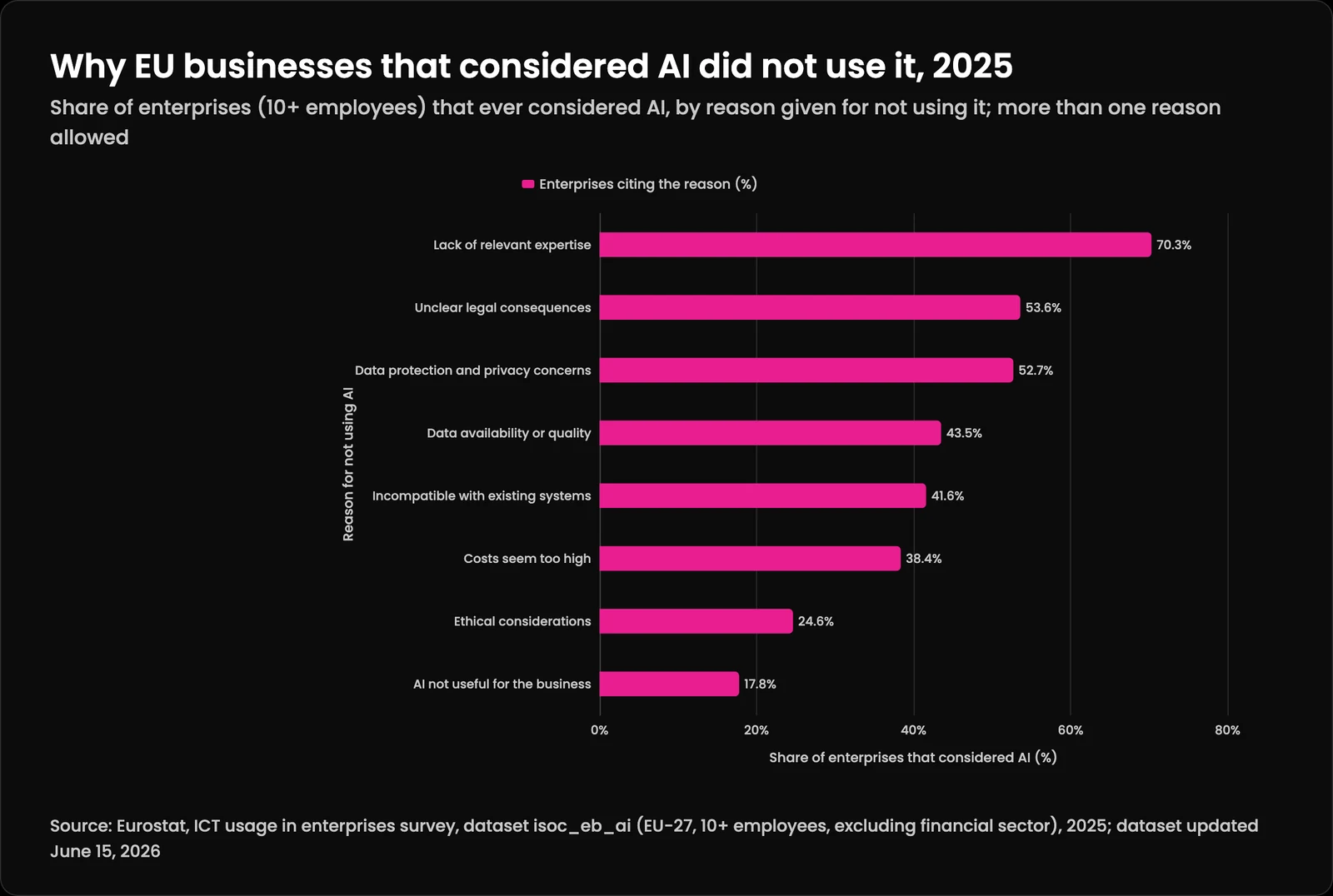
Because the open questions are legal and privacy questions, and they have grown. Eurostat's ICT usage in enterprises survey (dataset updated June 15, 2026) asks EU firms with 10 or more employees that considered AI why they did not use it. In 2025, 70.31% cited a lack of relevant expertise, 53.61% unclear legal consequences and 52.72% data protection and privacy concerns. More than one reason was allowed.
After skills, the two biggest reasons EU firms held back from AI were unclear legal consequences and data protection worries.
Why EU businesses that considered AI did not use it, 2025 (Eurostat, ICT usage in enterprises survey, dataset isoc_eb_ai (EU-27, 10+ employees, excluding financial sector), 2025; dataset updated June 15, 2026)
Reason for not using AI
Enterprises citing the reason (%)
Lack of relevant expertise
70.3%
Unclear legal consequences
53.6%
Data protection and privacy concerns
52.7%
Data availability or quality
43.5%
Incompatible with existing systems
41.6%
Costs seem too high
38.4%
Ethical considerations
24.6%
AI not useful for the business
17.8%
Two of those, legal consequences and privacy, are what AI vendor due diligence answers in writing.
US figures answer a different question and do not compare directly. A Census Bureau working paper, CES-WP-26-25 (April 2026), found that among US firms not planning to use AI soon, 22% cited a lack of knowledge of what AI can do and 20% "concerns about privacy/security." It is a working paper, not official statistics.
Which AI vendor due diligence questions come first?
The data questions, before features or price. How is my data stored and encrypted? Which third parties touch it? Are they training on it? Can I export and delete it? I ask the same of every third party in the chain, including whether it deletes my data when I leave, and of anything that uses my name, image or identity. That boils down to three written answers:
Is our data used to train or improve any model, and where does it say so? Point to a contract clause or data-use page for your plan, not a sales email.
What is kept, for how long, and does deletion include logs? Prompts, files, outputs and monitoring logs can follow different rules.
Who else receives it? Model providers, hosts and support tools all count.
On encryption, "yes" is not an answer: ask whether data is encrypted in transit and at rest, who holds the keys, and who can read prompts for support or review. Keep the answers in one dated AI vendor due diligence file per vendor, with links, for renewal and for when terms change.
NIST action GV-6.1-004 asks for contracts that specify content ownership, usage rights, quality standards and security requirements for generative AI.
The AI vendor due diligence checklist, section by section
1. Data use and training terms
Find the sentence on whether your inputs and outputs train the vendor's models, or any model underneath. OpenAI's API data guide, for example, says "data sent to the OpenAI API is not used to train or improve OpenAI models." That covers its API only. Federal buying rules ask for it: OMB Memorandum M-25-22, dated April 3, 2025, directs agencies toward "Ensuring contracts permanently prohibit the use of non-public inputted agency data and outputted results to further train publicly or commercially available AI algorithms, consistent with applicable law, absent explicit agency consent." Ask for the same wording.
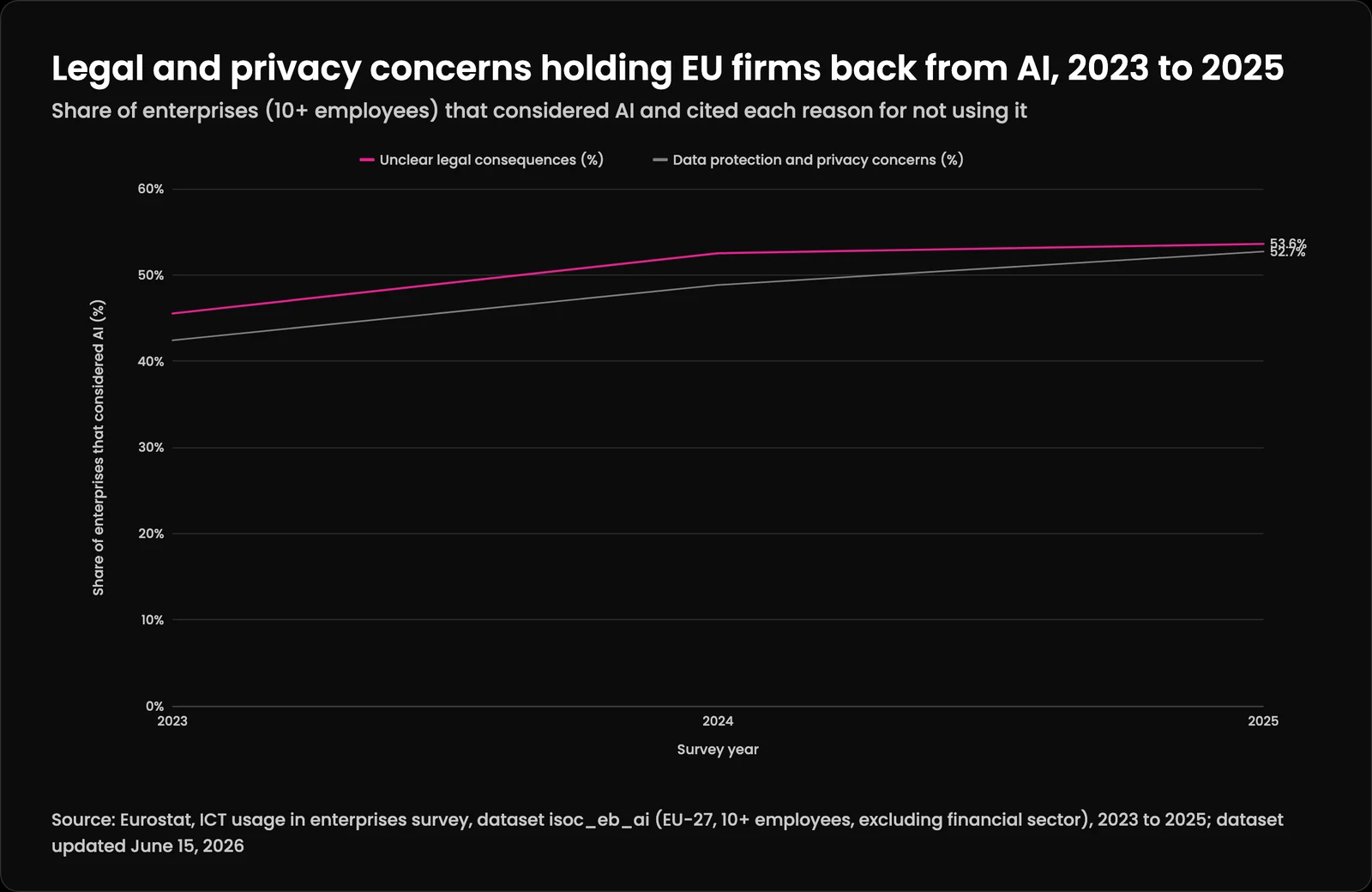
In the same Eurostat dataset, EU firms citing privacy concerns rose from 42.42% in 2023 to 48.83% in 2024 and 52.72% in 2025, and unclear legal consequences from 45.53% to 53.61%.
Privacy and legal uncertainty are growing reasons EU firms hold off on AI, which is what AI vendor due diligence is meant to answer.
Legal and privacy concerns holding EU firms back from AI, 2023 to 2025 (Eurostat, ICT usage in enterprises survey, dataset isoc_eb_ai (EU-27, 10+ employees, excluding financial sector), 2023 to 2025; dataset updated June 15, 2026)
Survey year
Unclear legal consequences (%)
Data protection and privacy concerns (%)
2023
45.5%
42.4%
2024
52.5%
48.8%
2025
53.6%
52.7%
Terms also change after signing. In a February 13, 2024 Technology Blog post, FTC staff wrote that "It may be unfair or deceptive for a company to adopt more permissive data practices" when users learn of them only through a retroactive change to the terms or privacy policy, with AI training among the examples. It is a staff post, not a rule. Ask how, and how early, you will hear about a change.
The risky AI rules are rarely in the main contract, so our AI vendor due diligence reads four places:
The license or IP section: the rights the vendor claims over what you put in and get out.
The data processing addendum (DPA): how long they keep your data, and when they actually delete it.
Linked "AI terms" or "product improvement" pages: pages the vendor can edit without a new contract.
The subprocessor list: which outside AI providers, such as OpenAI or Anthropic, receive your data behind the scenes.
Four phrases make us stop and ask:
"To train, fine-tune, or improve our models and services." Unless zero training is in writing, your prompts and files can feed their shared AI.
A "perpetual, irrevocable license" to "aggregated or de-identified data." A classic loophole. Without your name, that data can still expose your workflows or pricing, and they keep it forever.
"We may update these terms at any time." Rules that change without notice are not locked in.
"Commercially reasonable efforts" to delete, or no timeline. Ask for a hard deadline, such as permanent deletion within 30 days, and zero data retention with their AI subprocessors.
"By submitting User Content via the Services, you grant TikTok USDS Joint Venture and our affiliates, agents, services providers, partners and other connected third parties an unconditional, non-exclusive, royalty-free, fully transferable, sub-licensable, perpetual and worldwide license to use your User Content. This license to your User Content allows us to modify, adapt, reproduce, make derivative works of, display, publish, transmit, distribute and/or store your User Content for the purposes of operating, developing and providing the Services, subject to your Platform settings."
"You further grant us and our affiliates, agents, services providers, partners and other connected third parties a royalty-free fully transferable (including sub-licensable), worldwide license to use your username, image and likeness to identify you as the source of any of your User Content, including for use in sponsored content."
"you hereby grant to Meta a non-exclusive, transferable, sub-licensable (through multiple tiers), royalty-free, fully paid-up, worldwide license to reproduce, distribute, modify, create derivative works based upon, perform and display (publicly or otherwise), and otherwise use such User Content and your image, likeness and other personal characteristics as captured or reflected therein (your "Persona") in connection with Generated Content and the Avatars Services, including the marketing and promotion thereof (consistent with your privacy and application settings)."
Meta adds that "This license will end when your User Content is deleted from our systems."
Marketplaces are changing their terms too. Here is section 5(C) of Etsy's updated Terms of Use (effective December 16, 2026), the part Etsy itself calls "the legalese version":
"By posting Your Content, you grant Etsy and, as authorized by Etsy in its sole discretion, third parties, a non-exclusive, worldwide, royalty-free, irrevocable, sub-licensable, perpetual license to use, display, edit, modify, reproduce, distribute, store, and prepare derivative works from Your Content. This allows us to provide the Services and to promote Etsy, your Etsy shop, other shops and listings, or the Services in general, in any formats and through any channels, including across any Etsy Services, our partners, or third-party website or advertising medium. You agree not to assert any moral rights or rights of publicity against us for using Your Content. You also recognize our legitimate interest in using it, in accordance with the scope of this license, to the extent Your Content contains any personal information. This also includes the right for us and our third party partners and vendors to use Your Content to develop, train, test and improve artificial intelligence and machine learning technologies, including to improve the Services and/or help keep them safe, subject to any applicable opt-out rights described in our Privacy Policy."
The AI sentence at the end gets the attention, but read the middle. Rights of publicity are the rights to control commercial use of your name, face and likeness; moral rights cover credit for your work and keeping it intact. Etsy's own list of "Your Content" includes profile pictures, listing photos and usernames. The license also covers derivative works, use of your photos to promote other shops, and sharing with third parties Etsy picks in its sole discretion. A lawyer can tell you how each clause applies where you live; the wording itself is plain.
In the same document, section 6(E) bars anyone else from using content "obtained from the Services" to train an AI model without Etsy's express permission. In its announcement of the update, Etsy says: "We do not use your content to train AI models designed to copy your original work or replace your creativity."
I have a few products on Etsy. It isn't where I usually sell my art, but reading that clause made me want to take all of it down, and I doubt most sellers will ever read it. If you sell there, read section 5(C) and the opt-out rights in Etsy's Privacy Policy before December 16, and decide with the full wording in front of you.
Ask for retention by type: prompts, files, outputs and monitoring logs. The same OpenAI guide says "abuse monitoring logs are generated for all API feature usage and retained for up to 30 days," and "Zero Data Retention eligible endpoints do not retain any customer content for application state." Ask the vendor and model provider. NIST's GV-6.1-004 asks for "well-defined contracts and service level agreements (SLAs) that specify content ownership, usage rights, quality standards, security requirements, and content provenance expectations for GAI systems." Retention belongs there, and so does who owns the outputs.
3. Subprocessors and who else touches the data
An AI product is often a stack: an application, a model provider, a host, and support and analytics tools. Ask for the current subprocessor list, how you hear about changes, and which parties see prompts rather than only billing data. More in the sub-processor problem. NIST's GV-6.1-007 adds your side: "Inventory all third-party entities with access to organizational content and establish approved GAI technology and service provider lists." For a small company, that is one short list kept by one named person.
4. Model changes after you sign
An AI product can behave differently next month with no new contract. NIST's GV-6.2-007 asks buyers to "Review vendor contracts" for "Clear assignment of liability and responsibility for incidents, GAI system changes over time (e.g., fine-tuning, drift, decay)." Ask how you hear about a model change, whether you can stay on the old version, and who owns a drop in quality. MG-3.1-005 adds: "Review various transparency artifacts (e.g., system cards and model cards) for third-party models." Once live, a weekly drift check catches what a notice clause misses.
NIST asks buyers to assign responsibility for generative AI system changes over time, naming fine-tuning, drift and decay.
5. Security evidence and incident notice
Ask what independent assessment the vendor holds, and read its scope and date. GV-6.1-009 adds a check you can run yourself: "Assess GAI vendors, open-source or proprietary GAI tools, or GAI service providers against incident or vulnerability databases." One place to start is the AI Incident Database, a project of the Responsible AI Collaborative "dedicated to indexing the collective history of harms or near harms realized in the real world." Search the vendor and model provider.
GV-6.2-007 also says to request "Notification and disclosure for serious incidents arising from third-party data and systems" and "Service Level Agreements (SLAs) in vendor contracts that address incident response, response times, and availability of critical support." See also what to ask your vendors about security.
6. Exit and fallback
Plan the way out first. GV-6.2-006 asks for policies "to test and manage risks related to rollover and fallback technologies for GAI systems, acknowledging that rollover and fallback may include manual processing." For a small team, write down how the work gets done by hand for a week. M-25-22 lists anti-lock-in terms: "knowledge transfer, clear data and model portability practices, clear licensing terms, and pricing transparency." More in AI platform exit terms and the vendor exit plan.
How do you test an AI vendor's claims yourself?
Testing is the part of AI vendor due diligence that does not rest on the vendor's word. On May 21, 2026, the FTC announced settlements with Cox Media Group and two other firms that, it charged, "misled small businesses about the capabilities of the Active Listening service" by "claiming they used a special algorithm to listen in on and detect pertinent conversations from smart devices." CMG pays $880,000; MindSift and 1010 Digital Works pay $25,000 each. Finalizing the orders 2-0 on August 27, 2026, the Commission said "the marketing service wasn't based on voice data, and consumers hadn't opted into this service," and each firm is "prohibited from making any misrepresentation about the qualities or features" of its service.
We treat a trial as an operational reality check, not just a tech review. In our experience, demos are cherry-picked on clean data so everything looks effortless. NIST's MEASURE 2.3 asks for performance "demonstrated for conditions similar to deployment setting(s)," meaning yours, so test on your terms:
Bring your own messy data. Use real edge cases (badly formatted PDFs, incomplete records, old notes, compliance files) with sensitive details removed, run by your own team, not a sales engineer. Define a correct answer first, then score each result.
Try to break it. Ask questions your documents cannot answer: does it invent one or admit it does not know? NIST calls this risk confabulation, "confidently stated but erroneous or false content," and asks that a system "fail safely, particularly if made to operate beyond its knowledge limits." It should cite the exact source file and flag uncertain answers for a person to sign off.
Demand consistency, not a lucky first try. Run the same task five to ten times. One model provider's glossary says "Even with temperature set to 0, the results will not be fully deterministic." If format, tone or answers drift, correcting it will cost more time than the manual work.
Question the architecture. Which models does it route to? Can we bring our own API keys to control data and costs? How is our data destroyed after the trial, or if we walk? A vendor that dodges these is likely selling a thin wrapper over a standard model. Put any capability that matters in the order form.
Sometimes the telling answer is the one that changes. When ChatGPT came out, I understood my chats to be private. That understanding did not hold, and it killed my trust. OpenAI's help article on how your data is used to improve model performance, read November 20, 2026, now says:
"When you use our services for individuals (Free, Plus, Pro), we may use your content to train our models."
It adds "After you opt out, we won't use your new conversations to improve our models," so the setting looks forward, not back. In a June 5, 2025 statement, OpenAI wrote that The New York Times and other plaintiffs had demanded it "retain consumer ChatGPT and API customer data indefinitely," including "deleted ChatGPT chats," for Free, Plus, Pro and Team users; an October 22, 2025 update says "Our obligations under the earlier order ended on September 26, 2025." Read the current page for your plan, and expect it to change.
The other answer came from software I used for over 20 years, which I won't name. It added AI features and raised the price. No thanks. I knew it inside and out, used it for creative work and private client documents, and had not asked for AI in it. I dropped it, and we built our own design studio and PDF suite, both 100 percent offline. In my opinion, some things are not supposed to have AI in them. Their one-way connector to our AI system is built so you can create without outside influence or telemetry, which is what I had valued and lost.
The FTC finalized orders on August 27, 2026 barring three firms from misrepresenting the features of a service sold to small businesses.
What should a small company add to an AI vendor due diligence list?
Skip the Fortune 500 checklist. Big companies have in-house lawyers, IT admins and negotiated contracts; small businesses buy off-the-shelf plans on tight margins and get burned in different ways. Ask what a big-company list misses:
Do your privacy terms cover our plan, not just Enterprise? We've seen vendors keep their strictest terms for enterprise contracts while standard plans train by default. The OpenAI article above covers Free, Plus and Pro; Anthropic's August 28, 2025 consumer terms update says "These updates apply to users on our Claude Free, Pro, and Max plans" and "They do not apply to services under our Commercial Terms." Get zero training and deletion deadlines in writing for your plan.
Can we bring our own API keys and set hard spend caps? A surprise $3,000 bill is a rounding error at a Fortune 500 and a ruined month for a small business. Your own keys let you route simple tasks to smaller models and set the ceiling; one provider's rate limits page says you can "set your own spend limit below your tier's cap to control costs."
Where does a human step in before anything goes out? Without a compliance department, you can't afford an AI quietly approving a bad invoice or sending the wrong quote. NIST's MAP 3.5 asks that "Processes for human oversight are defined, assessed, and documented." Ask how the tool queues financial or compliance actions for sign-off.
Who runs this on a normal Tuesday? Without specialists to fix connectors or retrain staff, a fragile tool becomes a second job, or a hidden retainer. Ask how much babysitting it needs after onboarding.
Does it respect permissions without an enterprise IT setup? Small businesses run on shared drives and overlapping logins. If the AI connects through one master admin login, a junior employee's routine question can pull answers from payroll or the owner's financials. OWASP's LLM06:2025 Excessive Agency describes an extension that "accesses downstream systems with a generic high-privileged identity," and says to "Track user authorization and security scope" so actions run as that user.
If we leave, can one person export everything without an engineering fee? We've seen "self-serve export" mean a flat spreadsheet without uploaded files, timestamps or audit logs unless you pay thousands for migration help. Request a sample export during the trial and open it.
This is an operator's check, not legal advice. Where AI vendor due diligence needs a lawyer, such as liability caps, indemnity for output or industry rules, give counsel the vendor's written answers, not the sales notes.
Does the AI provider brand matter in due diligence?
Less than the terms. The same model arrives under different terms bought directly, through its API or inside another product. NIST frames the control as "approved GAI technology and service provider lists," vendors that passed your AI vendor due diligence, not one brand.
We want the client to choose the provider that fits their budget, their team and their privacy and spending policies, including a local model. In my experience, people do their best work with tools that work the way they do. That's why Brian Gagne and I believe in custom.
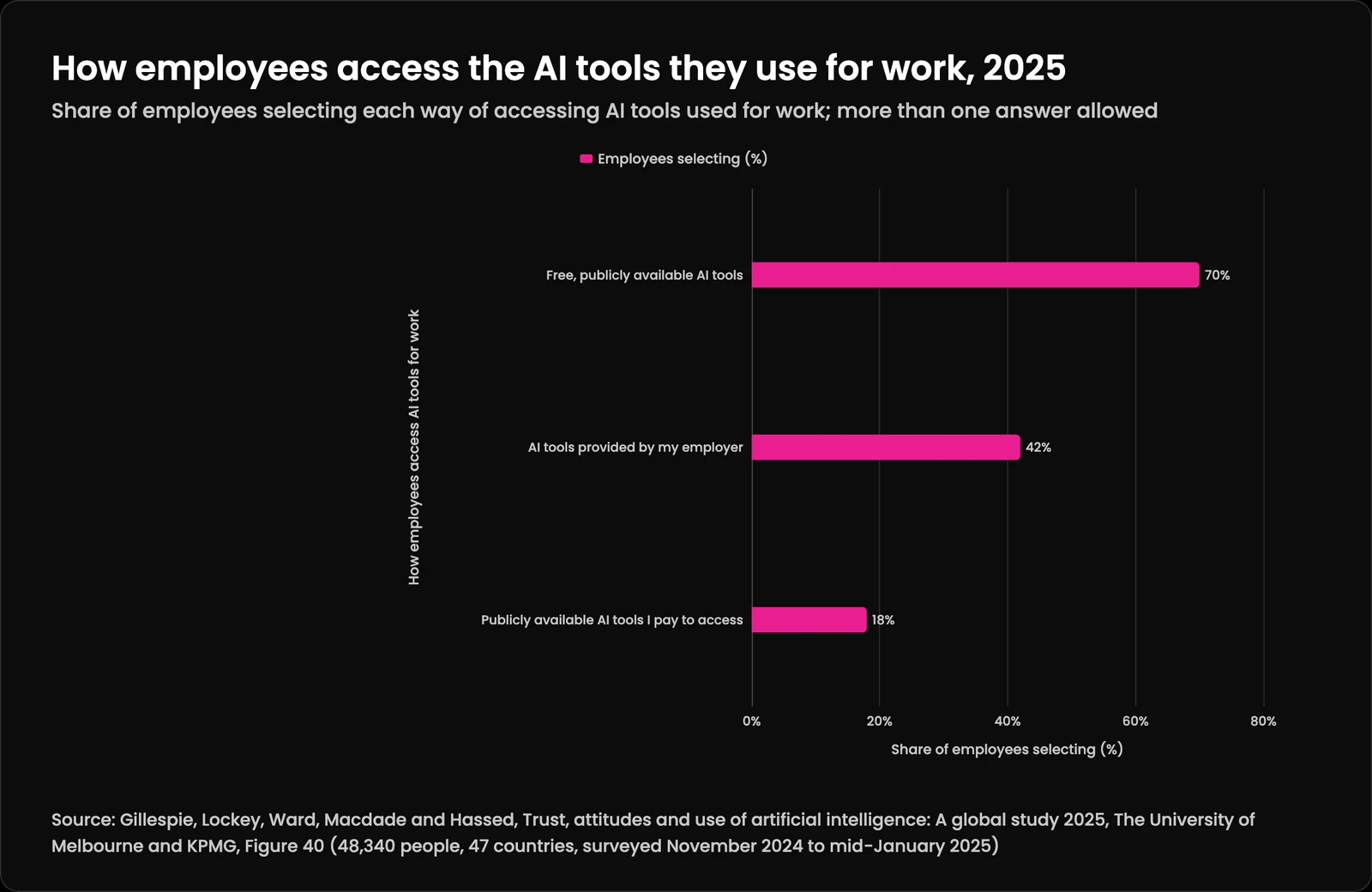
In Trust, attitudes and use of artificial intelligence: A global study 2025, the University of Melbourne and KPMG surveyed 48,340 people in 47 countries from November 2024 to mid-January 2025. Among employees who use AI at work, 70% said free, publicly available tools, 42% tools provided by their employer and 18% public tools they pay for; 67% said AI had increased the efficiency of their work.
Among employees who use AI at work in the 2025 University of Melbourne and KPMG study, more use free public AI tools (70%) than tools their employer provides (42%).
How employees access the AI tools they use for work, 2025 (Gillespie, Lockey, Ward, Macdade and Hassed, Trust, attitudes and use of artificial intelligence: A global study 2025, The University of Melbourne and KPMG, Figure 40 (48,340 people, 47 countries, surveyed November 2024 to mid-January 2025))
How employees access AI tools for work
Employees selecting (%)
Free, publicly available AI tools
70%
AI tools provided by my employer
42%
Publicly available AI tools I pay to access
18%
The 2024 Work Trend Index from Microsoft and LinkedIn (May 8, 2024), surveying 31,000 knowledge workers in 31 markets, found "78% of AI users are bringing their own AI tools to work (BYOAI)," "even more common at small and medium-sized companies (80%)," and users said AI helps them "save time (90%), focus on their most important work (85%)." Both are self-reported; they show people pick their own tools, not that choice alone raises output.
The goal is choice with the company still informed. When AI tools report into LTFI, the company's information stays in one place, and someone on a local model or a different remote setup can still connect. We scope what each connection sees from the company brain and what is redacted, and everyone can see where each project stands.
AI vendor due diligence works the same whichever provider sits underneath. Kief Studio builds and connects AI systems (see its AI implementation page), and its vendor lock-in guide shows what lock-in looks like across a build.
It is the check before buying an AI product that confirms in writing how the vendor uses and keeps your data, who else receives it, how model changes are handled, and how you leave.
How do you vet an AI vendor?
Get three written answers first: whether your data trains any model, how long prompts, outputs and logs are kept, and who receives them. Then test the vendor's claims on your own data.
Does an AI vendor train on my data?
It depends on the vendor, the plan and the contract. Find the sentence in the terms or data-use page for your exact plan. If nobody can point to one, treat the answer as unknown.
What should you do if an AI vendor won't answer in writing?
Record the item as unanswered in your AI vendor due diligence file and ask once more, naming the NIST action. If there is still no answer, keep sensitive data out of that tool or choose another vendor.
What is a red flag in AI vendor due diligence?
No written answer on training, retention or subprocessors is the clearest. Others are a capability that exists only in the demo, and no stated way to hear about model changes.
Which framework should an AI vendor checklist follow?
NIST AI 600-1, the July 2024 Generative AI Profile, is a public US standard with numbered actions on AI vendor due diligence, contracts, transparency documents, incident notice and fallback.
Should a small business bring its own API keys to an AI vendor?
If the vendor allows it, yes. Your own keys control which model provider receives your data, let you route simple tasks to smaller models, and set a hard spending ceiling.
Does this apply to AI features inside software we already use?
Yes. NIST names embedded generative AI in its due diligence action. When a tool you already use adds AI, check whether your contract covers its data use, retention and subprocessors.
A vendor exit plan shows regulators and your board you could leave a critical software vendor. Exits are rare: the UK CMA found about 0.1% of AWS, Microsoft and Google customers switched provider each year from 2020 to 2022. Four questions the plan answers, and a yearly test.
How to audit AI spending without buying a tool first. Zylo's 2026 index found ChatGPT is now the most expensed app, so the audit starts in card statements and expense reports, then moves to API keys, owners and a monthly review.
AI platform exit terms decide what leaves with you when you change AI or agent vendors: prompts, rules, agent configurations, logs, fine-tunes, embeddings and keys, with proof the copies left are deleted. The UK CMA found in July 2025 that fewer than 1% of cloud customers switch provider each year.