AI Platform Exit Terms: How to Leave With Your Data
AI platform exit terms decide what leaves with you when you change AI or agent vendors: prompts, rules, agent configurations, logs, fine-tunes, embeddings and keys, with proof the copies left are deleted. The UK CMA found in July 2025 that fewer than 1% of cloud customers switch provider each year.
AI platform exit terms are the parts of an AI or agent platform agreement that decide what you take with you when you leave: your prompts, rules, agent configurations, logs, fine-tunes and embeddings, in a usable format, with proof that the copies left behind are gone. The UK Competition and Markets Authority found in its July 31, 2025 cloud decision that "less than 1% of customers switch provider each year."
The UK CMA found in July 2025 that fewer than 1% of cloud customers switch provider each year. AI platform exit terms decide whether your rules, logs and agent setup can leave with you.
An AI platform is software that runs models on your behalf, and an agent platform goes further: it takes jobs, follows written rules, calls your tools and keeps a record of what it did. Leaving one differs from leaving a CRM: the records are only part of what you built, and the rest is the instructions, approvals and history that taught it how your company works.
The general contract clauses are already covered in vendor contract exit terms that decide what leaving costs, and the labor side of a move is in what it costs to leave HubSpot or Webflow. This post covers only what is specific to AI and agent platforms. We have run LTFI, our agentic business operating system, in live production for a year and a half, and the exit question looks different from the inside.
The short version: AI platform exit terms are the clauses that let you leave with everything the AI learned about your business, and prove the vendor's copies are gone. Negotiate them before you sign, when your leverage is highest, and test them during the trial.
Name prompts, rules, agent configurations and logs as your property.
Get the source data to rebuild fine-tunes and embeddings.
Require written notice of model and sub-processor changes.
Get a list of every key the platform holds, and revoke each one yourself.
Pause scheduled jobs before access ends.
Ask for a deletion record that includes backups.
What are AI platform exit terms?
AI platform exit terms are the written commitments on ownership, export, deletion, notice and transition for everything an AI system holds or produces about your business. They extend ordinary software exit language to cover artifacts that ordinary software never had.
The same, plus the links between records and agent actions
Prompts, rules and playbooks
Rarely mentioned
Named as customer property, exported as readable text
Agent configurations
Not applicable
Roles, tool permissions, approval lines and schedules in a documented format
Logs and approvals
Often excluded
Full history: who asked, which agent acted, who approved
Fine-tunes and embeddings
Not applicable
Return or deletion, with the source data needed to rebuild them
Keys and connections
Password reset
A list of every credential the platform held, and proof each was revoked
Who owns the prompts, rules, agent configurations and logs?
You should, and your AI platform exit terms should name each item. If the contract says "customer data" and stops there, ask whether rules, agent setups and logs count, because many platforms treat them as service data.
The written rules are the part people underrate. On the October 23 webinar, Brian showed the company instructions inside LTFI: what every blog post must meet, what counts as a fact, which playbook applies. Those rules make an agent behave like your staff. I think of them as an operations manual, and I would not let a vendor keep the only copy.
Logs matter for a second reason. Under Article 28(3)(g) of the GDPR, a processor "deletes or returns all the personal data to the controller" at the controller's choice after the service ends. Agent logs carry personal data (names in emails, customer requests), so returning them is a data protection matter as well as a record-keeping one.
Agent identities belong on the list too. If each agent has its own account in your systems, as described in what a non-human identity for an AI agent is, the exit plan has to retire those accounts on your side, and the vendor's export should show which accounts its agents used.
What happens to fine-tunes and embeddings when you leave?
They usually cannot move as they are, so the realistic exit term is the right to the source data and settings needed to rebuild them, plus written deletion of the vendor's copies. A fine-tuned model and an embedding index are both derived from your data, and both are tied to the model that produced them.
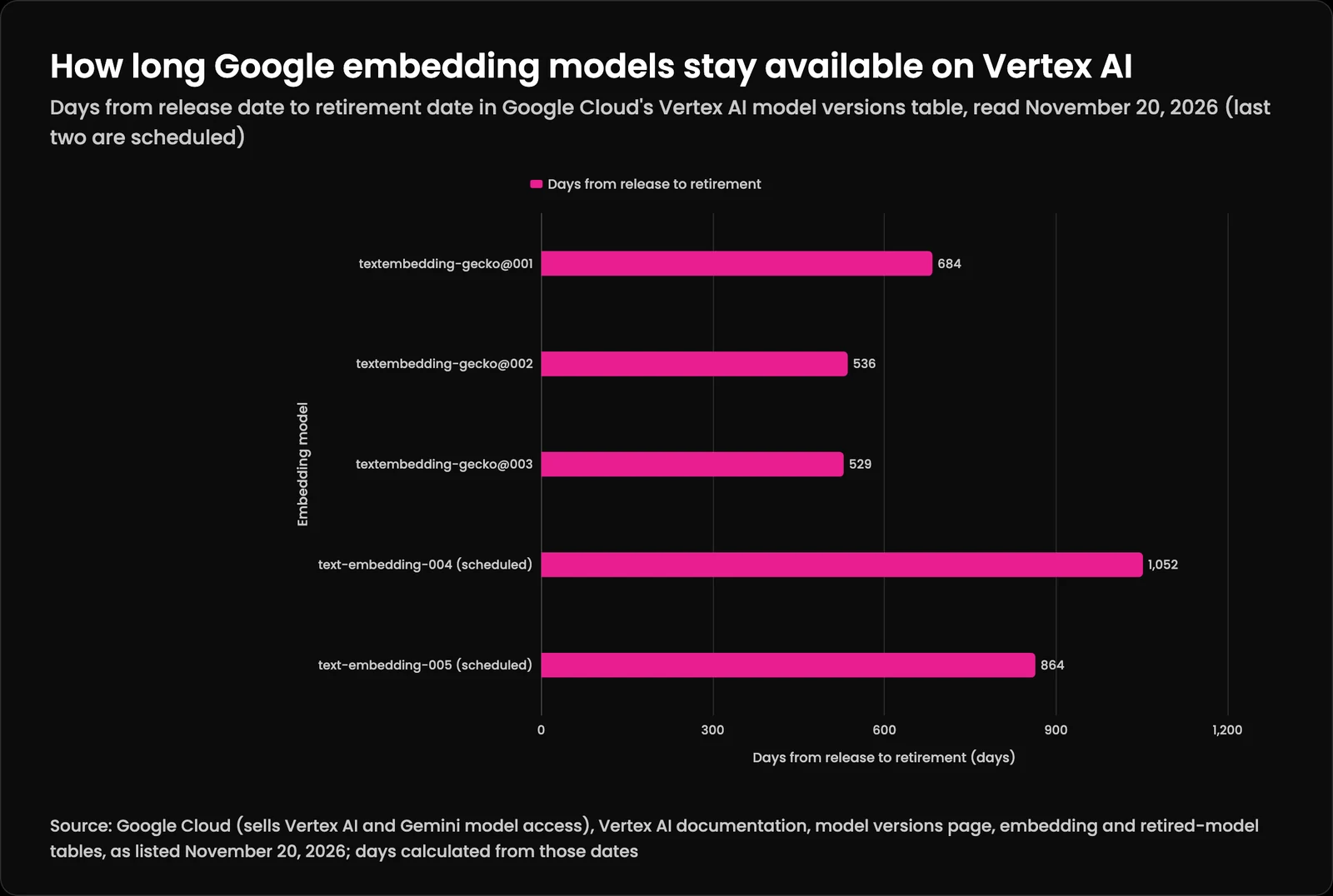
Embeddings are the clearer case. Researchers writing on arXiv in October 2025 (Maystre and colleagues) note that embedding models trained separately "often produce representations that encode stable information but are not directly interchangeable." If your search and memory run on a provider's embedding model, you will re-embed on the new platform, which only works if you have the documents and their metadata. Google's first Vertex AI embedding model, textembedding-gecko@001, was released on June 7, 2023 and retired on April 21, 2025, with gemini-embedding-001 as the recommended upgrade.
If the term is new, an embedding is a list of numbers a model produces for a piece of text so that similar meanings land close together; Qurtoo's definition of an embedding shows how search and memory features are built on them. The numbers only mean something to the model that made them, which is why the exit term that matters is access to the original documents, not the vectors.
Each retired Google embedding model in this chart lasted under two years, so a search index built on one needed a new model within that time.
How long Google embedding models stay available on Vertex AI (Google Cloud (sells Vertex AI and Gemini model access), Vertex AI documentation, model versions page, embedding and retired-model tables, as listed November 20, 2026; days calculated from those dates)
Embedding model
Days from release to retirement
textembedding-gecko@001
684
textembedding-gecko@002
536
textembedding-gecko@003
529
text-embedding-004 (scheduled)
1,052
text-embedding-005 (scheduled)
864
Deletion of derived models is not a theoretical concern. In its May 7, 2021 order against Everalbum, the FTC required the company to delete "the models and algorithms it developed by using the photos and videos uploaded by its users." That was an enforcement case, but the logic carries into a contract: if a model was shaped by your data, your AI platform exit terms should say what happens to it.
Fine-tunes and embeddings rarely move as they are. Good AI platform exit terms secure the source data and settings so they can be rebuilt on the next platform.
Which export formats and deletion proof should AI platform exit terms require?
Ask for machine-readable exports with a published structure for every item in the table above, a fixed retrieval window, and a signed record of deletion afterward. A screen you can scroll through, or a PDF of a chat history, is a view of the data, and you cannot rebuild a working system from one.
Deletion proof deserves its own sentence in the agreement. NIST SP 800-88 Revision 2, published in September 2025, says that after sanitization "a certificate of sanitization (see Appendix C) should be completed for each ISM that has been sanitized". An AI vendor will rarely wipe a dedicated disk for one customer, so ask what its deletion record covers: the primary database, backups, logs, embedding indexes and any copies held by the model providers it used.
Records and files in their usual open formats, with relationships kept.
Rules, prompts and playbooks as plain text or a documented structured file.
The full log, with timestamps, the person who asked, the agent and the approver.
Training and embedding source data, with the settings used.
A deletion record that names each place the data lived, including backups.
What notice should you get about model and sub-processor changes?
You should get written notice before a model you depend on is retired and before a new sub-processor sees your data, with enough time to object or move. Both kinds of change can alter how your agents behave without anyone on your side touching a setting.
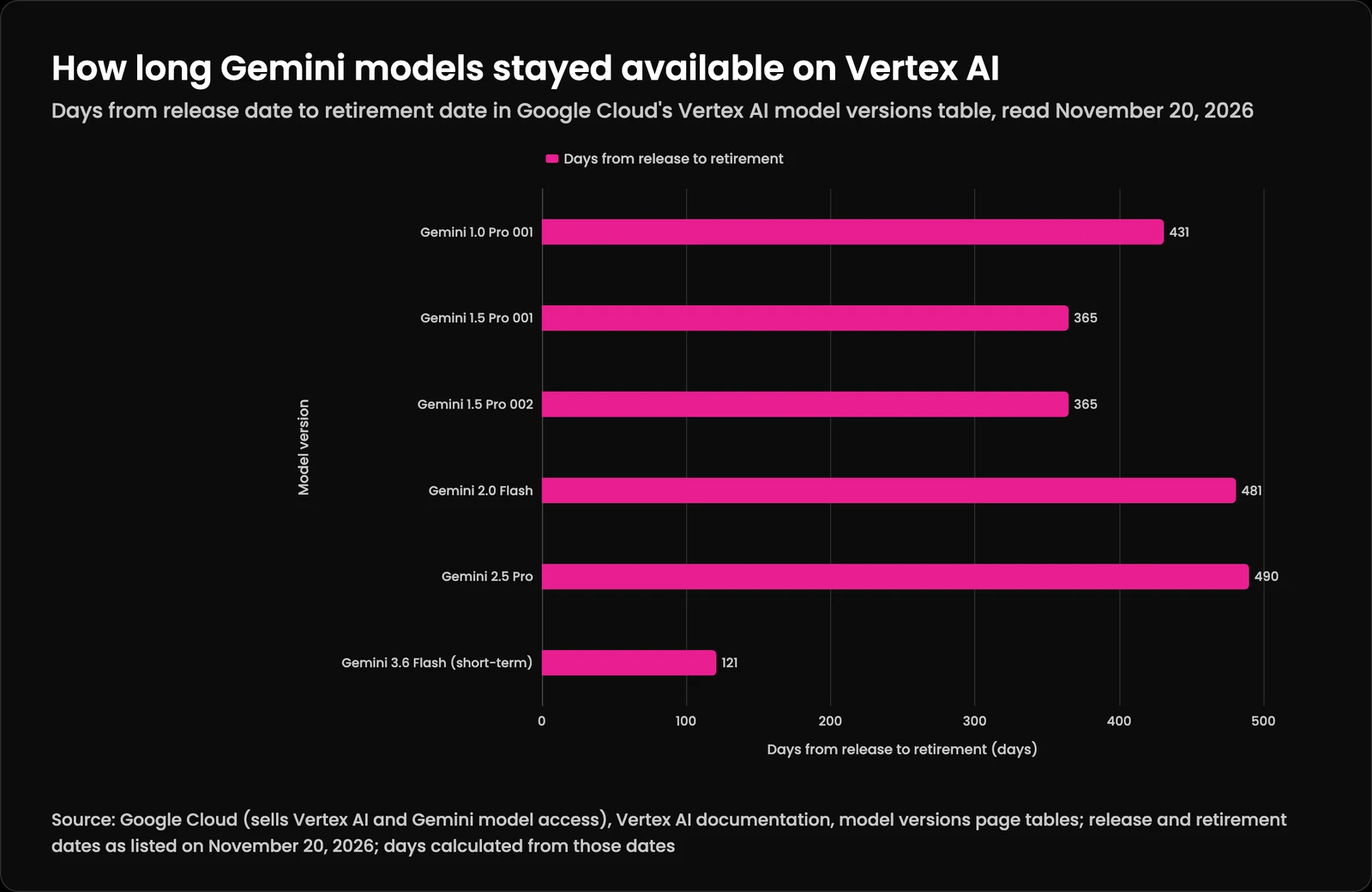
Model retirement is routine. Google Cloud's Vertex AI documentation says that when it schedules one of its short-term availability models for retirement it posts a fixed date "that gives you at least 45 days to migrate," and it lists its stable models as available for at least 12 months after release. If your platform vendor gets 45 days from the model maker, ask how much of that window reaches you, and who tests your rules against the replacement. How to catch AI agent drift covers what changes when the model underneath shifts. In Google's model versions table, Gemini 1.5 Pro 002 was available for 365 days, from September 24, 2024 to September 24, 2025.
Gemini models on Vertex AI have stayed available for 12 to 16 months from release, and a short-term model for four months.
How long Gemini models stayed available on Vertex AI (Google Cloud (sells Vertex AI and Gemini model access), Vertex AI documentation, model versions page tables; release and retirement dates as listed on November 20, 2026; days calculated from those dates)
Model version
Days from release to retirement
Gemini 1.0 Pro 001
431
Gemini 1.5 Pro 001
365
Gemini 1.5 Pro 002
365
Gemini 2.0 Flash
481
Gemini 2.5 Pro
490
Gemini 3.6 Flash (short-term)
121
Sub-processors follow the same logic. GDPR Article 28(2) says a processor working under general authorization "shall inform the controller of any intended changes", giving the controller the chance to object. Every model provider an AI platform calls is a sub-processor, which is the chain described in the sub-processor problem.
Whose keys does the platform hold, and what happens to them?
The best answer is that the platform holds as few of your keys as possible, keeps the ones it needs in a vault separate from the application, and hands you a list of every credential so you can revoke each one on the day you leave. An agent platform connects to email, calendars, social accounts, code and payment tools, and each connection is a key.
Revoking access is its own checklist, and it runs on your side as much as the vendor's. Every connection the platform made lives in the account it touched: your Google Workspace, your Microsoft 365 tenant, Slack, your social accounts. The steps for each are in LTFI's guide to disconnecting an AI app you no longer use, including the point that removing access does not erase what the app already copied. That second half is what your AI platform exit terms have to cover in writing.
On the webinar, Brian showed where LTFI keeps these: "stored in an encrypted vault, they are not included in the same instance as the system itself." Some social connections use the company's own API keys, because a company using the system "should be independent." Write the same expectation into your AI platform exit terms: a credential list, and a revocation you can do yourself.
NIST SP 800-88r2 (September 2025) ties cryptographic erase to sanitizing the keys. Who holds the key is the question AI platform exit terms have to answer before deletion means anything.
What happens to automations that are mid-flight when you leave?
The contract should say that scheduled and in-progress jobs are listed, paused and handed over before access ends, and that nothing queued sends, posts or spends after the cut-off. Agents act on schedules, so an exit can leave a half-finished outreach sequence, a queued social post or a recurring report running on a platform you no longer control.
Scheduled jobs keep running until someone stops them. A single pause for every agent is the first practical step under AI platform exit terms.
I would ask for three things in writing: a list of every scheduled job and open approval at a named date, one control that pauses every agent, and a read-only period after notice so nothing is lost mid-task. On the webinar, Brian showed the staff screen and said, "You can pause everybody." That is the first step of any orderly exit.
What exit terms should you negotiate in an AI search platform contract?
An AI search platform indexes your documents and connected apps and answers questions from them, or, on the marketing side, tracks how your brand shows up in AI answers. Both hold more than your files, so the AI platform exit terms for a search tool need five specific clauses.
The index and its sources. Deletion of the search index and every embedding built from your content, plus a list of the sources it was built from, so you can rebuild it elsewhere.
Connectors and permissions. A list of every system the platform connected to, the permissions each connection held, and how those permissions mapped to your users, so nobody on the new tool sees a document they could not see before.
Query and answer logs. The questions your staff asked and the answers they got, exported with dates and users. They often contain personal data, which brings in the GDPR Article 28 return-or-delete duty quoted above if you process data on EU residents.
Tuning you paid for. Synonyms, boosted results, curated answers and blocked sources are your work. Name them as your property and get them as a readable file.
History, for visibility tools. If the platform tracks how AI assistants describe your business, the tracked questions, the dated answer snapshots and the cited sources are the asset. Without the history you lose the baseline you would measure the next tool against.
Add the same retrieval window and deletion record your other AI platform exit terms require. The EU Data Act's 30-day minimum retrieval period is a fair floor to ask for, even outside Europe.
What contract terms should an agency require to keep control of client data when leaving an AI platform?
An agency sits in the middle: the platform processes its clients' data, and the agency answers to those clients for it. The AI platform exit terms an agency signs have to work client by client, not just for the agency as a whole.
Per-client export. Each client's records, logs, generated content and reports exported separately, so one client can move without exposing another.
Clear ownership lines. Client data belongs to the client; the agency's own prompts, playbooks and templates belong to the agency; the platform owns neither. Write all three down.
Derived products. Drafts, reports and summaries produced for a client are covered by the exit, using the M-25-22 phrase "derived products" quoted above.
Account ownership. The platform account is held by the agency as a company, not by a staff member's personal login, and admin rights can be transferred.
Flow-down. The deletion, notice and sub-processor terms the agency promised its clients appear in the platform contract too. If your client contract says 30 days and the platform says 90, you are in breach the day you leave. How to match the two is in flowing security obligations down to vendors.
Per-client deletion records. One record for each client, so you can hand it to that client.
The same list works in reverse when a client asks about the AI platform exit terms behind your own tools. An agency that can show its clients this paperwork is in a stronger position at renewal than one that has to ask the platform after the fact.
What happens to your data if an AI company shuts down?
People search for which AI company is shutting down because it happens, and the exit window can be days, not months. In February 2025, Humane told owners of its AI Pin that the device would "continue to function normally until 12pm PST on February 28, 2025," that owners should download stored pictures, videos and notes before then, and that "all remaining consumer data will be permanently deleted" at that time. That was a consumer device, but the pattern carries to business tools: a shutdown notice sets the export window, and the window is whatever the company decides.
AI platform exit terms protect you here only if they survive the vendor. Three clauses help:
A minimum notice period before a shutdown or end of service, with the export still available during it.
A standing export you can run yourself at any time, so you are never waiting on a support queue that is being wound down.
Terms that bind a buyer of the business or its assets, so the commitments do not end with an acquisition.
The practical habit matters as much as any clause in your AI platform exit terms. Run the export on a schedule, store it somewhere you control, and open it now and then to check it still works. The plan for the whole vendor list, AI or not, is in how to write a vendor exit plan.
How do you test an exit before you sign?
Run a small exit during the trial: put low-risk work into the platform for two weeks, request the full export, and rebuild one agent and one rule set elsewhere. It is the only way to know your AI platform exit terms work before you depend on them.
If the platform holds personal information about Massachusetts residents, state rules already expect you to choose a capable provider, bind it by contract and see that disposal is done properly.
For a firm in Worcester or Westborough, that means the AI platform exit terms belong in the same file as the rest of your vendor diligence. This is general information, not legal advice.
How LTFI handles AI platform exit terms
Kief Studio built LTFI from scratch as one whole system, and leaving was part of the design from the start. Whatever platform you choose, ask it to say in writing where your rules and logs live, because a platform that does not hold them in one place cannot hand them back in one export.
Your data is yours. Contacts, files, content and the work your AI teammates did belong to the company. If you leave, we export it.
Your own server. Each company runs on its own dedicated server, which Kief Studio runs. No shared hosting, so your data is not mixed with anyone else's on the way out.
Keys in a vault. Keys and secrets sit in an encrypted vault, not in the app, and permissions are scoped per person.
Any AI provider, or a local model. LTFI works with Claude Code, Codex, Cursor, Gemini, GitHub Copilot, Grok and OpenCode, and connects to models from Claude, Gemini, Mistral and more through OpenRouter, or to the company's own local model through Ollama. Changing the model does not mean leaving the platform.
Everything logged, everything pausable. The log shows who asked, which AI teammate did the work and who approved it, and every agent can be paused at once.
Rules written once. Company rules are written in one place and every AI teammate follows them, so they are a single body of text you can take with you.
Brian put the model point well on the webinar: whichever model a person prefers, "they all end up with the same context." That keeps a model change from becoming a migration. In a year and a half of production use, that shared context of rules, approvals and history is what has grown most valuable, and it is what I would most want back.
Exit terms are part of the planning in Kief Studio's AI implementation work.
Frequently asked questions about AI platform exit terms
What should AI platform exit terms cover?
Ownership and export of records, prompts, rules, agent configurations, logs, fine-tunes and embeddings; notice of model and sub-processor changes; a list and revocation of every key; handling of scheduled jobs; and a written deletion record that includes backups.
Can I take a fine-tuned model or embeddings to another AI platform?
Usually not as they are, because both are tied to the model that produced them. Ask for the source data and settings so you can rebuild them, and for written deletion of the vendor's copies.
Do I own the prompts and rules I write in an AI platform?
Only if the contract says so. Ask for a sentence that names prompts, rules, playbooks, agent configurations and logs as your property, exportable as readable text.
How much notice should an AI vendor give before changing models?
Enough to test your rules on the replacement. Google Cloud's Vertex AI documentation promises at least 45 days to migrate when it retires one of its short-term availability models, so a platform built on such models should pass on a clear, written window.
When should I negotiate AI platform exit terms?
Before you sign, and after a small exit test during the trial. Leverage is highest before your rules and history live on the vendor's servers, and a test shows whether the export works.
What exit terms should I negotiate in an AI search platform contract?
Deletion of the index and embeddings with a list of their sources, a list of connectors and permissions, export of query and answer logs, ownership of your tuning, and for visibility tools, the dated history of tracked answers.
What contract terms should an agency require to keep control of client data when leaving an AI platform?
Per-client exports, written ownership lines between client, agency and platform, coverage of derived products, a company-held account, flow-down of client promises, and one deletion record per client.
What happens to my data if an AI company shuts down?
The company's notice decides the export window. Humane gave AI Pin owners until February 28, 2025, then permanently deleted remaining consumer data. A standing export you run yourself, written into your AI platform exit terms, is the best protection.
The questions to ask an agentic AI provider are about control: where it runs, whose keys it holds, what waits for a yes, what is logged, which models work, how you pause it and how you leave. IBM's 2026 research found 92% of organizations with an AI-related breach lacked proper AI access controls.
Agent washing is selling a chatbot or script as an AI agent. Gartner estimates only about 130 of thousands of agentic AI vendors offer real agentic features. Seven on-screen tests, the FTC and SEC cases so far, Massachusetts law, and what a year and a half of running agents taught us.
Only 13% of organizations think they have the right AI agent governance in place, Gartner reported in April 2026. AI governance for agentic AI is six controls built into where agents run: identity, permissions, approvals, audit, data ownership and model choice.