Vendor Exit Plan: How to Show Regulators You Can Leave
A vendor exit plan shows regulators and your board you could leave a critical software vendor. Exits are rare: the UK CMA found about 0.1% of AWS, Microsoft and Google customers switched provider each year from 2020 to 2022. Four questions the plan answers, and a yearly test.
A vendor exit plan is the written, tested answer to the question a regulator, auditor or board asks about a critical software vendor: if you had to leave, could you do it without stopping the business? It names the data you would take, the timeline, who does each job and what you do on day one, and you test it once a year.
For some firms it is an explicit expectation. US bank regulators wrote termination planning into their 2023 interagency guidance on third-party relationships, and EU financial entities must keep documented, tested exit plans for ICT services that support critical or important functions under the Digital Operational Resilience Act (DORA). Everyone else can borrow their structure when a board, an auditor or a large customer asks.
The contract clauses that make leaving possible are covered in vendor contract exit terms that decide what leaving costs, and what is specific to AI and agent platforms is in AI platform exit terms. This page is the plan itself and the yearly test, with what we have learned at Kief Studio helping companies leave platforms.
A vendor exit plan names the data, the timeline, the owners and the day-one fallback. The 2023 US interagency guidance asks banks to plan for transition options, timing, termination costs and data destruction.
Why write a vendor exit plan for a vendor you are happy with?
Because even the best vendor can be acquired, raise its prices overnight, change its terms of service, suffer a breach or shut down, and none of those things is in your control. Writing the plan while the relationship is good is the only time you have the leverage, the budget and a clear head to design it properly.
In regulated industries, losing access to operational or compliance records can stall the entire business. That is why regulators and boards want proof that a company can survive a vendor disruption, and why the plan belongs in the file before anyone needs it.
The easiest way to raise it without sounding negative is to treat it as ordinary continuity planning, like a backup generator or business insurance. You do not buy a generator because you are angry at the power company. You buy it because your board, your customers and your regulators expect you to keep running whatever happens outside. Mature vendors understand governance and will not take offense at a routine plan.
When a team tells me a vendor is too embedded to ever leave, I tell them: "You might never plan to leave them, but you don't control whether they leave you." A vendor too embedded to leave is an outside company holding the keys to your business, however good the partnership feels. We have seen platforms add AI features and change their data terms, and suddenly a tool you trusted puts your proprietary data or your compliance at risk.
Who requires a vendor exit plan, and who borrows the model?
The rules and guidance that name exit planning are written for specific kinds of firms. It helps to say plainly which ones, because a vendor exit plan built for the wrong rulebook wastes everyone's time.
US banks: the 2023 interagency guidance and its proposed replacement
The Federal Reserve, the FDIC and the OCC issued the Interagency Guidance on Third-Party Relationships in June 2023 (88 FR 37920). It treats termination as one stage of the third-party relationship life cycle. The planning stage already includes "the banking organization's contingency plans in the event the banking organization needs to transition the activity to another third party or bring it in-house," and contracts should "Assign all costs and obligations associated with transition and termination."
For the termination stage itself, the guidance lists what to consider, including "Options for an effective transition of services, such as potential alternate third parties to perform the activity;" the "capabilities, resources, and the time frame required to transition the activity;" "Costs and fees associated with termination;" data retention and destruction, system connections and access control; and the "Handling of joint intellectual property."
On September 11, 2026, the OCC, the Federal Reserve, the FDIC and the NCUA proposed to "rescind and replace" that guidance with a principles-based version. Its termination section says management's ability to exit efficiently "may depend on previously negotiated contract provisions," and that as "the complexity and materiality of a third-party relationship increases, a banking organization may benefit from advanced planning." OCC Bulletin 2026-57, dated November 13, 2026, extended comments to December 16, 2026, and notes that the proposal, "like all supervisory guidance, is non-binding." Until the agencies finalize it, the 2023 text is the one in place.
The same three agencies issued a joint statement on community banks and core service providers on September 11, 2026. It says "core provider contract provisions may act as obstacles" to a bank seeking an exit, names "unsupported or contractually undefined core deconversion fees" among the terms it will weigh, and observes that "a significant percentage of the core provider market is represented by just a few large providers, which limits CBOs' negotiating power."
EU financial entities: DORA Article 28(8)
DORA, Regulation (EU) 2022/2554, is the most explicit. Article 28(8) says: "For ICT services supporting critical or important functions, financial entities shall put in place exit strategies." They must be able to exit "without: (a) disruption to their business activities, (b) limiting compliance with regulatory requirements, (c) detriment to the continuity and quality of services provided to clients." Exit plans "shall be comprehensive, documented" and "shall be sufficiently tested and reviewed periodically."
Everyone else: the FSB toolkit, NIST CSF 2.0 and the EU Data Act
The Financial Stability Board's third-party risk toolkit, published December 4, 2023 for financial institutions and authorities, says firms "may consider identifying, documenting and, to the extent possible, testing exit strategies" for critical services, and that "There is no one-size-fits-all approach to exit planning."
Outside finance, NIST's Cybersecurity Framework (CSF) 2.0, published February 26, 2024, puts the idea in two lines. GV.SC-04: "Suppliers are known and prioritized by criticality." GV.SC-10: plans "include provisions for activities that occur after the conclusion of a partnership or service agreement."
The EU Data Act works from the provider side. According to the European Commission, its switching rules apply since September 12, 2025, and from January 12, 2027, providers must "entirely remove switching charges, including charges for data egress." That lowers the cost of leaving a data processing provider in the EU. It does not write your plan for you.
None of these binds a 40-person US manufacturer, a dental group or a regional law office. DORA reaches EU financial entities, and the interagency guidance reaches the banking organizations those agencies supervise. The FSB toolkit and NIST CSF are guidance and a framework. They still make a sound model for a vendor exit plan when a board, an auditor or a large customer asks the same question, because they are public, specific and written for exactly this job.
What should a vendor exit plan answer?
A vague promise to "switch providers if needed" is not a plan. A real vendor exit plan answers four operational questions, and each answer should be specific enough that someone new could act on it.
1. What data do you own, how does it come out, and how do you prove deletion?
Write down exactly which data is yours, what format it exports in, and how long a full pull takes, including historical logs and attachments. Then write down how you will verify that the old vendor permanently deletes your data once you are out.
2. How long would the move really take?
List the notice period, the contract renewal deadline, and an honest count of the weeks it takes to migrate, test and run both systems in parallel before you cut the cord. A vendor exit plan that assumes a weekend migration for a system holding years of records is a guess.
3. Who does what?
Name the people responsible for pulling the data, revoking old API keys and permissions, configuring the replacement and signing off on the compliance checks, so nothing falls through the cracks. If one person holds all of it, the plan has the same weakness described in the bus factor and key person risk. Who holds the admin accounts in the first place is its own question, worked through in who owns the site, the host and the login.
4. What do you do on day one if the vendor goes dark?
Describe the minimum workflow your team falls back to if the vendor goes down without warning or locks access during a dispute, so core operations do not freeze while you transition.
Those four questions line up closely with what the regulators list. The table maps each one to the 2023 US guidance and the FSB toolkit, quoting each document directly.
The four questions of a vendor exit plan, next to the 2023 interagency guidance and the FSB toolkit (December 2023)
Question
2023 interagency guidance
FSB toolkit
Data and deletion
"data retention and destruction"
assets "returned in a cost-effective and timely manner, and in a format that allows them to continue their business operations"
Timeline
"the time frame required to transition the activity"
"Contractually agreed transitional periods to minimise the risk of disruption"
Owners
"Relevant capabilities, resources"
Not named directly
Day one
"contingency plans"
"other business continuity measures" (see below)
The FSB toolkit asks firms to plan for the "ownership, maintenance, preservation, and long-term availability of records (including audit trails and other regulatory records)."
Which data do people forget in a vendor exit plan?
Most teams ask one question, "Can we export a CSV?", and forget everything that makes that data usable. These are the four gaps I would check first.
History, attachments and relational context. A flat spreadsheet export usually strips out uploaded files, audit trails, timestamps, internal notes and the links that show how records relate to each other. Without those, your historical data is half broken. The FSB names "audit trails and other regulatory records" for the same reason.
Export limits and throttling. Many vendors cap bulk downloads or API request rates, which can turn what you assumed was a one-hour export into a bottleneck that lasts weeks.
Logins, single sign-on and downstream keys. If the vendor manages user sign-in or holds API keys for connected tools, shutting off your account can lock your team out of other systems.
Proof of deletion. People focus so hard on getting data out that they forget to require written confirmation that the vendor purged it from active servers, backups and any internal AI models.
Deletion has a second layer. Your vendor has its own vendors, and copies can sit with them too, which is the chain described in the sub-processor problem. A complete vendor exit plan asks where those copies are and who confirms they are gone.
Why does a vendor exit plan need a test, not just a document?
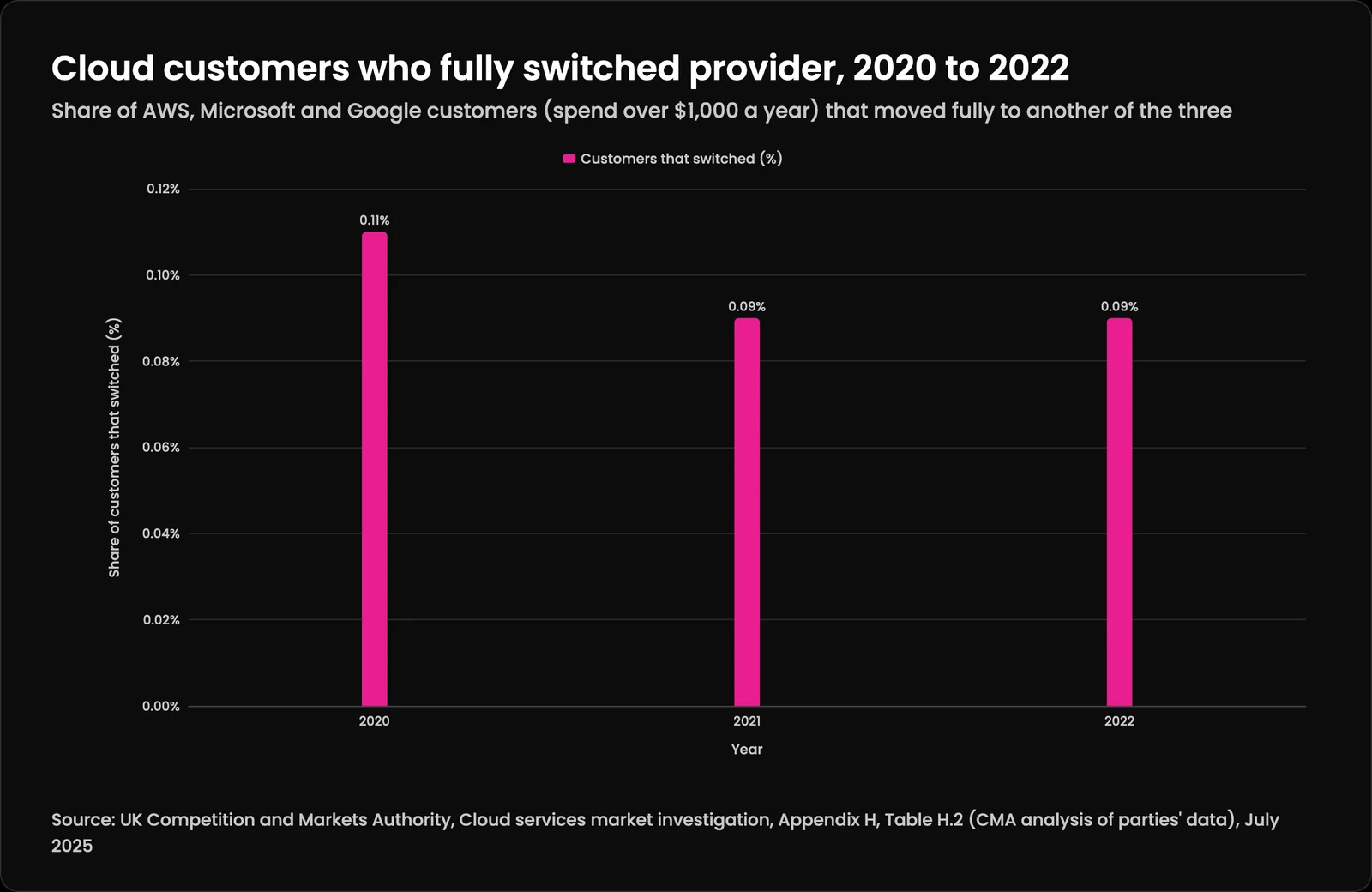
Because real exits are rare, and a plan can sit untouched for years. When the UK Competition and Markets Authority analysed customer data from AWS, Microsoft and Google in its cloud market investigation (Appendix H, July 2025), about 0.1% of customers switched provider in each year: 41 of 36,310 in 2020, 38 of 42,325 in 2021 and 41 of 47,031 in 2022. The CMA cautions that the analysis "is not intended to be read as a precise estimate."
About one cloud customer in a thousand fully switched provider in a year, according to the UK regulator's analysis.
Cloud customers who fully switched provider, 2020 to 2022 (UK Competition and Markets Authority, Cloud services market investigation, Appendix H, Table H.2 (CMA analysis of parties' data), July 2025)
Year
Customers that switched (%)
2020
0.11%
2021
0.09%
2022
0.09%
Cost is part of the reason. The CMA's final decision summary called egress fees "a key commercial barrier," weighing most on "smaller customers and those with large proportions of stored data." Its October 16, 2026 update reports that Amazon and Microsoft changed their contracts so UK customers can move data out for free when switching, and lengthened the free-egress switching window to 180 days (from 90 days at Amazon and 60 at Microsoft).
Fees are only one surprise. We have helped several companies untangle themselves from third-party platforms and consolidate their workflows into a cleaner setup they own. In those exits, what took longer and cost more than expected was getting clean, usable historical data out and uncovering hidden dependencies. Many vendors make onboarding effortless and offboarding painful.
We ran into throttled export limits, raw data dumps missing key context or attachments, and "data extraction" fees buried in the contract. Once we started disconnecting a core tool, we found forgotten API keys, add-ons nobody remembered installing, and manual workarounds staff had built around the platform, which had to be rebuilt before the old system could be safely turned off. The order that keeps this manageable is in how to offboard a managed service provider, and the parallel-run approach is in vendor consolidation for regulated industries.
DORA Article 28(8) says exit plans "shall be sufficiently tested and reviewed periodically." The yearly cadence below is how we run it.
How do you test a vendor exit plan in 90 minutes?
Review the vendor exit plan once a year, ideally 60 to 90 days before the contract's auto-renewal deadline, so you still have leverage if you decide to renegotiate or walk. Review it again whenever the vendor is acquired, changes its terms of service or raises prices.
For a small team, the test should not be an IT fire drill that disrupts the day. Keep it to a focused 60-to-90-minute "export and tabletop" check:
Run a real test export. Trigger a full data pull and open the files on a local computer. Confirm that records, attachments and historical logs come out cleanly and make sense, not as a broken wall of raw code. Note how long it took, because that number belongs in question two.
Audit logins, keys and procedures. Check who holds admin access, review active API keys and third-party connections, and make sure your written offboarding steps match how the software actually works today.
Walk through a 20-minute day-one outage. Sit down with the key people and ask: "If this vendor locked us out tomorrow morning, what are the exact first three steps we take so operations and compliance don't freeze?" If nobody can answer cleanly, update the plan on the spot.
A dental group can run this against its practice management system, a logistics company against its dispatch platform, and a nonprofit against its donor database. The steps stay the same. What changes is which records a regulator or funder will ask to see afterward.
This is a proportionate test. The FSB's own line, "to the extent possible," leaves room for that, and the US proposal ties planning to "complexity and materiality." What a small team cannot skip is the real export. A plan that has never produced a file is still a promise.
The FSB notes that exit strategies "are unlikely to be a feasible response to short-term severe disruption," which is the job of business continuity.
Is a vendor exit plan the same as a business continuity plan?
No, and the difference matters when you explain the plan to an examiner. The FSB toolkit describes exit as the answer to "Extended disruption to critical services that cannot be managed through other business continuity measures," and adds that exit strategies "are unlikely to be a feasible response to short-term severe disruption."
An outage shows why you need both. Microsoft estimated on July 20, 2024 that CrowdStrike's update "affected 8.5 million Windows devices, or less than one percent of all Windows machines." Leaving a vendor is no answer to an outage measured in hours or days. What carries a business through it is the continuity side: a fallback that lets work continue while the fix arrives.
That is why the fourth question, day one, sits inside the vendor exit plan. It is the bridge between the two documents. The continuity side is covered in business continuity architecture, not a binder, and the exit plan picks up where a short outage turns into a decision to leave.
What do you show a regulator or your board?
Show evidence that the work happened. For each critical vendor, a reviewer can follow a short file:
The list of suppliers ranked by criticality, the step NIST CSF 2.0 calls GV.SC-04, with this vendor's place on it.
The vendor exit plan itself, with the four answers and the named owners.
The date of the last test, how long the export took, and what it did and did not contain.
The tabletop notes and the changes made to the plan afterward.
The contract terms the plan relies on: notice, transition assistance, data return and deletion, as set out in the exit terms worth negotiating.
If a test shows the plan depends on a term the contract does not have, that finding goes to the renewal conversation, which is why the test sits 60 to 90 days before it. The same file feeds technology vendor due diligence the next time you choose a tool.
Having a vendor exit plan does not mean you plan to walk out the door. It means you own your data, your workflows and your business instead of renting them. And vendors tend to treat you better when they know you are able to leave.
Whether a specific rule applies to your firm, and how an examiner will read your plan, is a question for counsel or your regulator. This page covers the operating side.
A vendor exit plan is a written, tested plan for leaving a critical vendor without stopping the business. It covers the data you take and how deletion is proved, the timeline, who does each job, and what your team does on day one.
Do US banks need a vendor exit plan?
The 2023 interagency guidance from the Federal Reserve, FDIC and OCC expects banking organizations to plan for termination, including transition options, timing, costs and data destruction. A proposed replacement announced September 11, 2026 is open for comment until December 16, 2026.
Does DORA apply to a US small business?
No. DORA's exit plan rule in Article 28(8) applies to EU financial entities for ICT services supporting critical or important functions. A small US business outside EU finance is not bound by it, though the article is a clear model to borrow.
What should a vendor exit plan include?
A vendor exit plan should include the data you own and its export format, proof of deletion, a realistic timeline with notice and renewal dates, named owners for each task, and the minimum workflow your team runs if the vendor goes dark.
How often should you test a vendor exit plan?
Once a year works for most teams, ideally 60 to 90 days before auto-renewal so you keep leverage, plus whenever the vendor is acquired, changes its terms or raises prices. DORA Article 28(8) says "periodically."
What does a vendor exit plan test look like for a small team?
A 60-to-90-minute check: run a real full export and open the files, audit admin access, API keys and offboarding steps, then spend 20 minutes on a day-one lockout scenario and fix the plan on the spot.
Is an exit plan the same as a business continuity plan?
No. The Financial Stability Board says exit strategies are unlikely to answer short-term severe disruption, which business continuity handles. A vendor exit plan covers extended disruption or a planned move, and its day-one fallback links the two.
When do EU cloud switching fees end?
Under the EU Data Act, switching rules apply since September 12, 2025. From January 12, 2027, providers must entirely remove switching charges, including data egress charges, according to the European Commission. Until then they may charge the costs they incur.
The Massachusetts data privacy act passed the Senate 40-0 and the House 146-0 in different versions. As written, the House text can cover a business of any size that targets Massachusetts residents and keeps customer passwords. Seven systems to build, with checks.
Massachusetts AI regulations are existing laws, not one AI statute. The Attorney General's April 16, 2024 advisory applies Chapter 93A, the anti-discrimination law and 201 CMR 17.00 to AI, and a 2025 settlement over AI lending models reached $2.5 million. What each law means for an AI agent.
NetDiligence found business interruption incidents cost small and mid-sized organizations over five times more than incidents without it. Duration is the expensive variable, and an MSP SLA usually does not commit to it.