The Massachusetts data privacy act passed the Senate 40-0 and the House 146-0 in different versions. As written, the House text can cover a business of any size that targets Massachusetts residents and keeps customer passwords. Seven systems to build, with checks.
The Massachusetts data privacy act passed the Senate 40-0 and the House 146-0, and the two versions have sat in a conference committee since June 2026. As written, the House version reaches a business of any size that targets Massachusetts residents and collected customer login credentials in the prior year, which can include a small shop whose customers sign in to order.
Law firms have compared the two bills clause by clause. What follows is the owner's view: who is covered, why a login page matters, and the systems both versions point to, with a check for each you can run this week. It is the systems view, not legal advice, and counsel should read whatever final text emerges.
The Massachusetts data privacy act passed both chambers 40-0 and 146-0 in different versions, and conferees from each side are negotiating one text.
What the Massachusetts data privacy act means for your business
The Massachusetts data privacy act is not law yet. The Senate and the House each passed a different version. Negotiators are working on one text, and the governor would then sign or veto it.
The House version of the Massachusetts data privacy act reaches small businesses. As written, if you do business in Massachusetts, aim your products or services at Massachusetts residents and your customers log in to your site, you can be covered no matter how small you are.
The Senate version is aimed at larger data holders. It covers businesses with data on 60,000 or more Massachusetts consumers, plus anyone handling reproductive or sexual health data and certain affiliates that pass sensitive data along.
Neither version is final. The start dates could change, and the final text could narrow or widen who is covered.
The work is the same either way. Whatever the final Massachusetts data privacy act says, know what you collect, keep only what you need, say so honestly, and be able to answer and delete when a customer asks.
A Massachusetts data privacy act checklist you can do this week, without a lawyer
Write down every form and login on your site, then reload a page with your browser's developer tools open (Network tab) and list every script, ad pixel and analytics tag that loads.
List every tool that receives customer data: your email platform, booking or ordering system, payment processor, CRM and spreadsheets.
Remove form fields you never use.
Read your privacy notice next to that list. Fix anything it gets wrong or leaves out.
Set up two ways for a customer to ask for their data, such as an email address and a web form. Both versions use a 45-day response clock.
Create a test customer, then delete it everywhere it landed. Note where it survived.
Look for health, precise location, children's or ID-number data. If you have any, write down why you need it.
If you run retargeting ads, turn on Global Privacy Control in Firefox and see whether those pixels still fire on your site.
Where does the Massachusetts data privacy act stand?
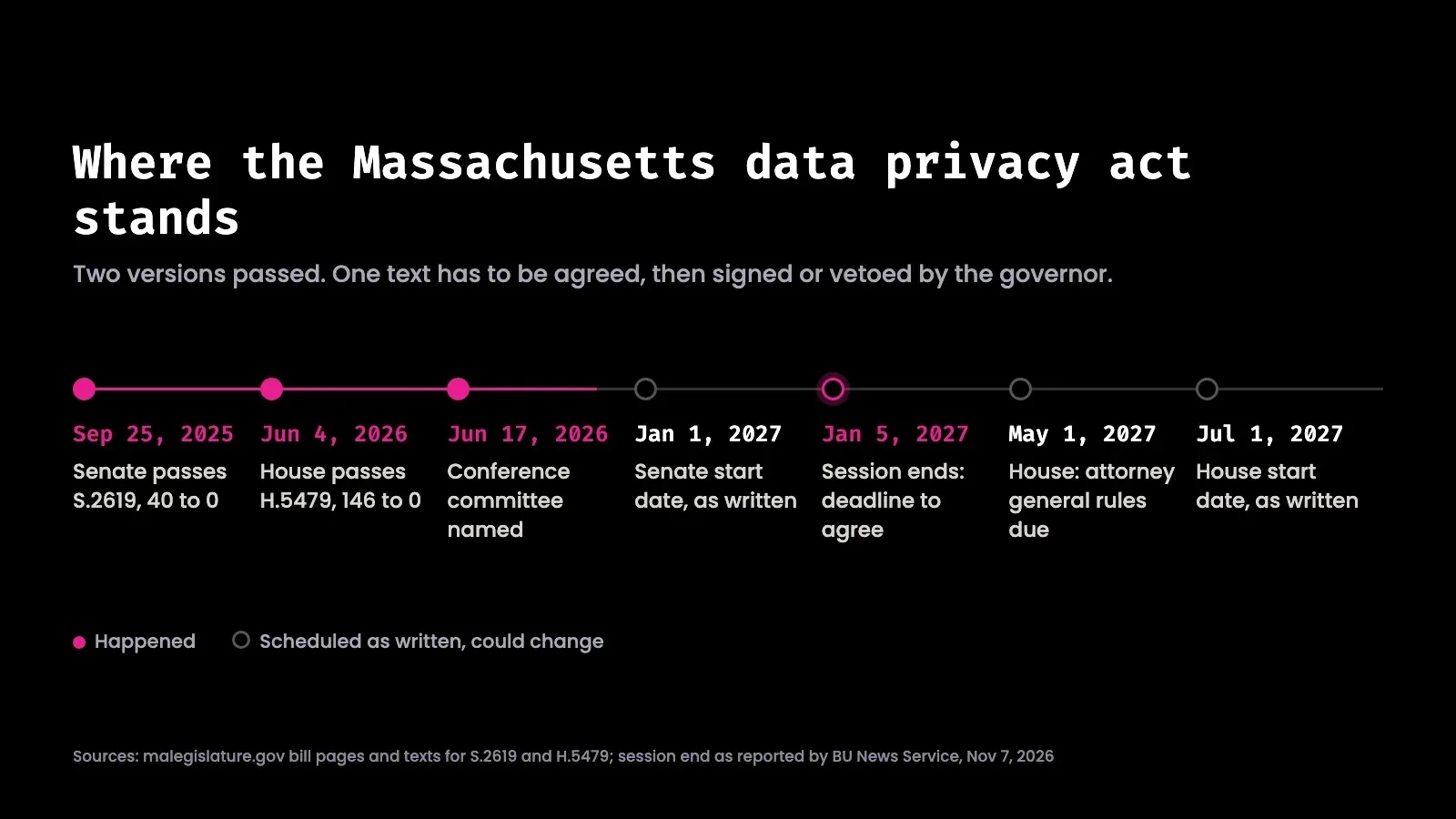
The bill history for S.2619 is short. On September 25, 2025, the Senate amended its committee draft, S.2608, on the floor and passed the result, S.2619, 40 to 0. On June 4, 2026, the House substituted and amended its own text, published as H.5479, and passed it 146 to 0.
Both chambers have voted. Every date after June 2026 is as written and could change in conference.
On June 11 the Senate declined the House version and named Senators Creem, Finegold and O'Connor to a conference committee. Six days later the House insisted on its text and named Representatives M. Moran, Farley, Bouvier and Vieira. The bill page shows no later action as of November 21, 2026.
BU News Service reported on November 7, 2026 that the conferees first met in July and are still working through how far sales of sensitive data should be restricted and how the law would be enforced, and that Senator Cynthia Creem called the protections a "top priority." It says both chambers must approve a final bill by January 5, 2027, after which it would go to Governor Maura Healey to sign or veto. Progressive Massachusetts gives the same date for the end of the current session.
For anyone tracking the conference committee in November 2026: no conference report has been filed, and the formal session's last day is January 5, 2027. If the conferees do not file a compromise that both chambers accept by then, the Massachusetts data privacy act would have to be filed again in the next session and start over.
Even the name differs. The Senate text calls the new chapter the Massachusetts Data Privacy Act, and the House amendment retitles the bill "An Act establishing the Massachusetts consumer data privacy act."
Who does the Massachusetts data privacy act cover as written?
S.2619 applies to anyone that, in the preceding calendar year, processed the personal data of at least 60,000 consumers, or at least 20,000 consumers while earning at least 20 percent of gross revenue from selling personal data, or "collected, processed or transferred reproductive or sexual health data of consumers." It adds one more reach with no size floor: "This chapter shall also apply to an affiliate of a person described under this section if such affiliate transferred sensitive data to the person or the person's other affiliates in the preceding calendar year." A standalone business under those lines that handles no reproductive or sexual health data is outside the Senate version.
The volume thresholds are only part of the test. As written, the House version also covers any business that collected sensitive data, including customer logins, with no minimum.
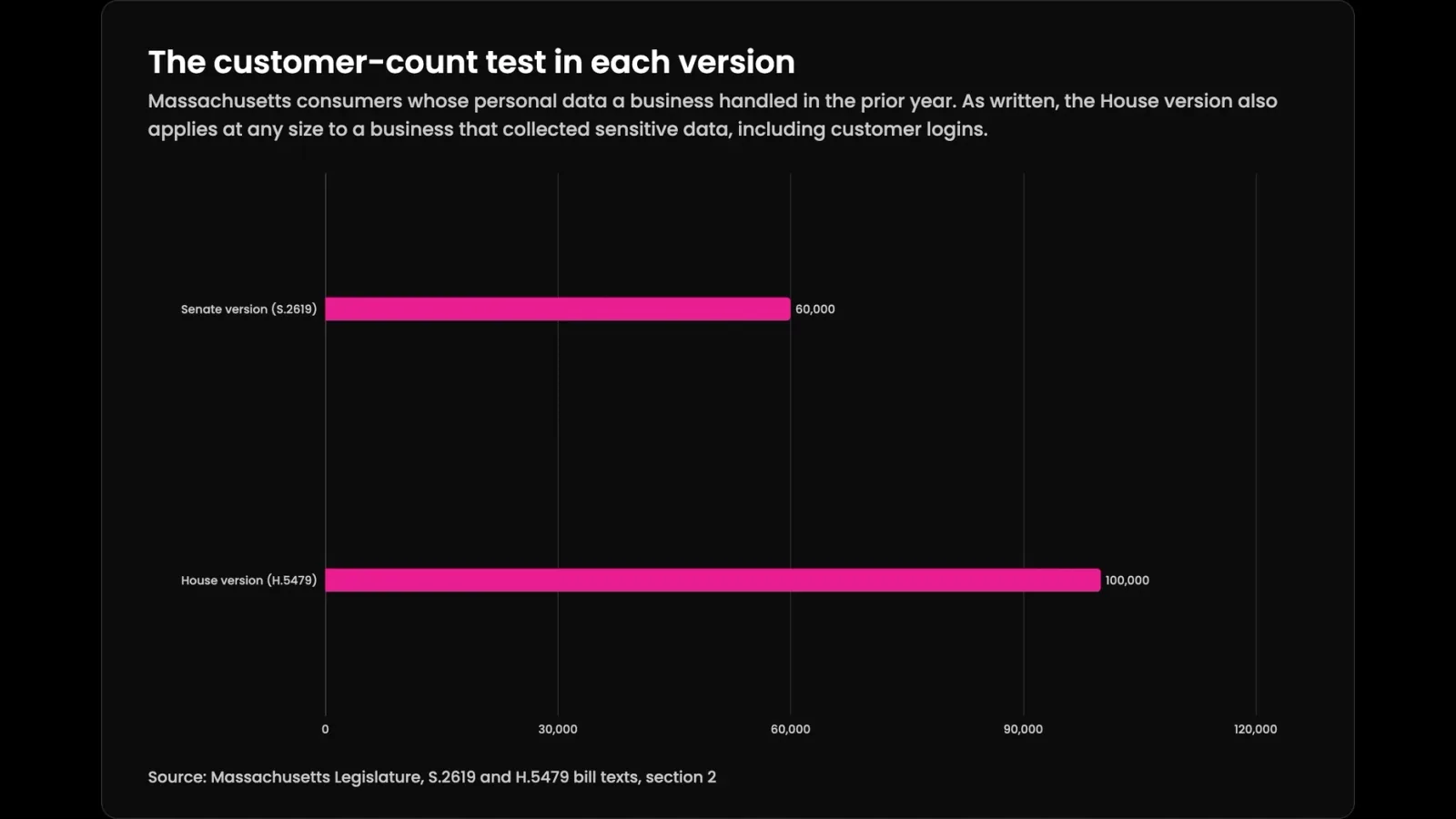
The customer-count test in each version (Massachusetts Legislature, S.2619 and H.5479 bill texts, section 2)
Volume threshold
Massachusetts consumers
Senate version (S.2619)
60,000
House version (H.5479)
100,000
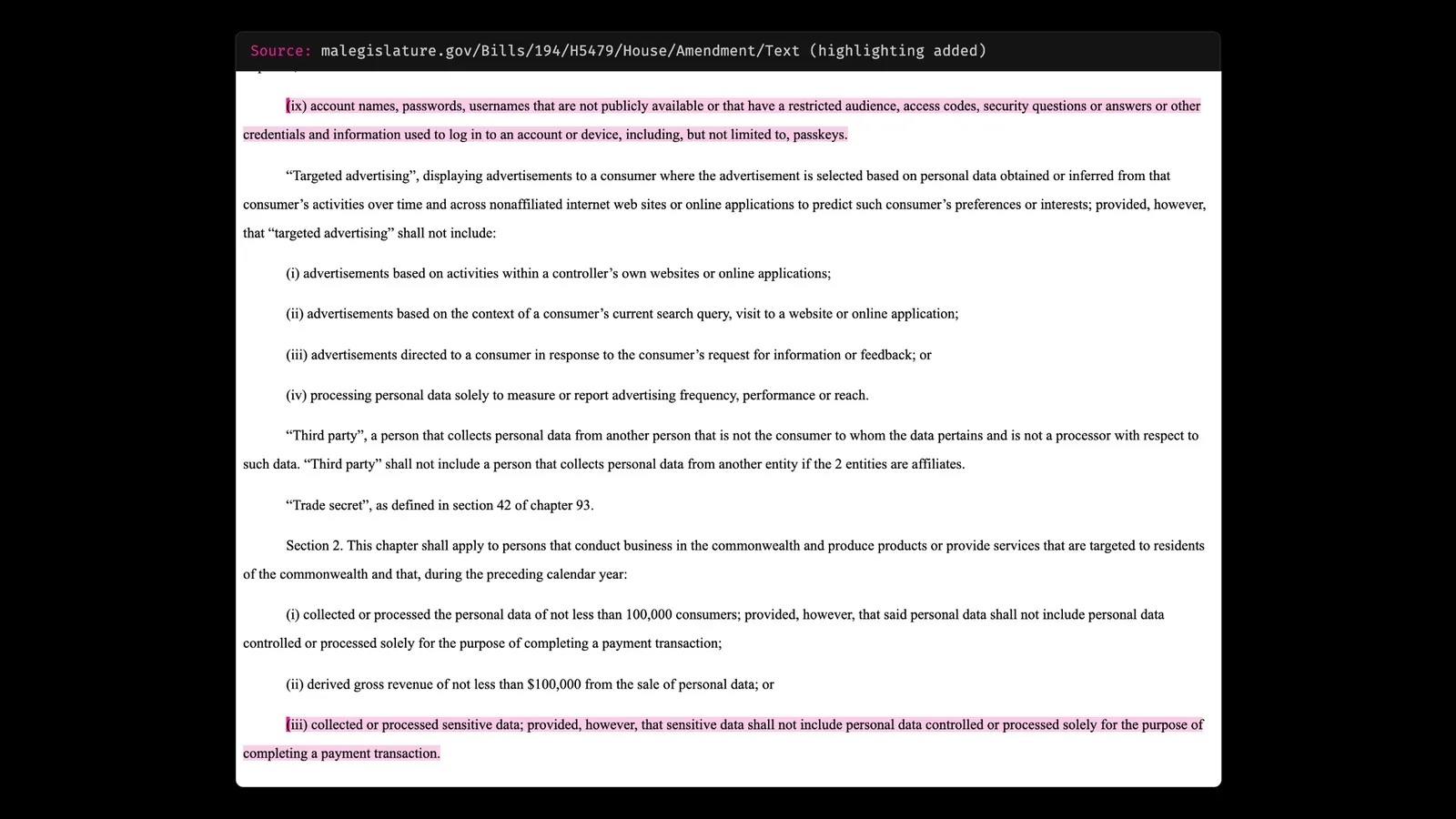
H.5479 sets two volume tests and then a third that has no volume at all. It applies to persons that "conduct business in the commonwealth and produce products or provide services that are targeted to residents of the commonwealth" and that, in the preceding year, processed the personal data of at least 100,000 consumers, earned at least $100,000 from selling personal data, or "(iii) collected or processed sensitive data; provided, however, that sensitive data shall not include personal data controlled or processed solely for the purpose of completing a payment transaction."
A "consumer" in both texts is a Massachusetts resident acting for themselves, not in a role at another organization, and both texts exempt your own applicant and employee records. That limits whose data the duties run to. Whether a business serving only other businesses still trips the House coverage test is less clear, since the House defines personal data by reference to any identifiable individual; that one is for counsel. The payment carve-out is narrow too: it covers data handled "solely" to complete a payment.
Why do customer logins matter so much in the House text?
Because of what the House counts as sensitive. Its list of sensitive data ends with item (ix): "account names, passwords, usernames that are not publicly available or that have a restricted audience, access codes, security questions or answers or other credentials and information used to log in to an account or device, including, but not limited to, passkeys."
The House text as published on malegislature.gov, with highlighting added.
Read that next to the third coverage test. Illustrative example: a Worcester bakery that lets regular customers create accounts with a password to place orders collects login credentials from Massachusetts residents. As written, that is collecting sensitive data, and the House text applies to the bakery at any size, provided it does business in Massachusetts and targets Massachusetts residents. The same reasoning reaches a gym whose members sign in to book classes and a small online shop with saved customer accounts.
Hashing passwords does not change that reading. In the House definitions, to "collect" includes "receiving" personal data, and to "process" includes "storage." Customers still send you the password when they sign in. If a platform hosts the accounts for you, it is usually acting as your processor, which the House defines as a person who "collects or processes personal data on behalf of" a controller, so the credentials are still collected for you. Whether a given platform is your processor or a controller in its own right is a fact-based question under both texts. A one-time sign-in code reads as an "access code," also on the list.
The Senate text lists credentials as sensitive too: "account or device log-in credentials or security or access codes for an account or device." The difference is in coverage. Its no-size triggers are reproductive or sexual health data and the affiliate rule, so under S.2619 a standalone bakery is covered only if it crosses one of the volume thresholds.
The short version: under the House version, a customer login page alone can bring a small business under the law. Under the Senate version, a login page alone would not.
Coverage pulls in the rest of the House chapter. Section 6 says a controller shall "not collect or process sensitive data concerning a consumer without obtaining the consumer's affirmative consent." Section 10 treats "processing of sensitive data" as a heightened-risk activity that needs a documented data protection assessment. How the consent rule sits beside section 12, which says nothing in the chapter restricts the ability to "provide, maintain, improve or update a product or service specifically requested by the consumer," is a question for counsel and for the attorney general's rules.
All of this is the House text as written. The conference committee could narrow it, and the attorney general's rules could shape it. Under both current texts, though, a customer sign-in system holds sensitive data, and it is worth engineering that way now.
A gym app, a nonprofit and a dental practice
A gym with an app that tracks workouts or sleep collects "consumer health and wellness data," which the House defines as data gathered "by a health and wellness device or application" built to track things like fitness, sleep or stress. That is sensitive data in its own right.
A nonprofit with donor logins gets no blanket pass. The House exemptions name specific nonprofits (insurance fraud prevention, educational nonprofits, blood banks), so a charity is tested like any business.
A dental practice that is a HIPAA covered entity sits at the other end, mostly. Section 3(a)(9) of the House text exempts covered entities and business associates, but section 3(b) still requires every exempt entity to follow the sale limits in section 7(a)(i): no sale of precise geolocation data, and no sale of other sensitive data without affirmative consent. S.2619 exempts protected health information as data, and exempts a covered entity only if it processed the personal data of not more than 60,000 consumers.
House text item (ix) lists passwords, security answers and passkeys as sensitive data, so a customer sign-in screen is a sensitive data system as written.
How do the Senate and House versions compare?
The table below uses only the two bill texts. It holds the rows that change what a business builds, not every difference.
Question
Senate (S.2619)
House (H.5479)
Volume thresholds
60,000 consumers, or 20,000 plus 20% of revenue from selling data
100,000 consumers, or $100,000 from selling data
Triggers with no size floor
Reproductive or sexual health data; an affiliate that transferred sensitive data to a covered person
Any sensitive data, payment-only data excluded
Login credentials sensitive?
Yes, item (v)
Yes, item (ix), passkeys named
Collection standard
Reasonably necessary to provide a requested product or service
Reasonably necessary and proportionate to disclosed purposes
Sensitive data
Only when strictly necessary; consent to transfer; no sale; no sale of precise geolocation collected in Massachusetts
Affirmative consent to collect; consent to sell; no sale of precise geolocation
Rights request clock
45 days, one 20-day extension
45 days, one 45-day extension
Ways to submit a request
At least 2
At least 2
Opt-out preference signal
Link plus signal satisfies the request rule; signal must be sent with the consumer's affirmative consent
Required
Who enforces
Attorney general only
Attorney general, exclusively except for large data holders
Cure period
60-day notice and cure unless the attorney general finds cure impossible or immediate action needed; repealed June 1, 2027
None in the text
Civil penalty cap
$5,000 per violation
$5,000 per violation
Takes effect, as written
January 1, 2027, four days before the session ends
July 1, 2027, with attorney general rules due May 1, 2027
The House defines a large data holder as one that processed the personal data of more than 2,000,000 consumers or the sensitive data of more than 200,000 in the most recent year. Both texts make a violation an unfair or deceptive practice under chapter 93A, the same consumer protection statute behind the existing Massachusetts rules on AI in business.
The short version: the two versions of the Massachusetts data privacy act differ most in reach and enforcement. The House version reaches more businesses and lets consumers sue the very largest data holders. The Senate version reaches fewer businesses and leaves enforcement to the attorney general. The two handle sensitive data differently.
What should a business build before the Massachusetts data privacy act is final?
The useful part of a bill in conference is the overlap. Seven systems follow from both texts, though the details differ, most of all on sensitive data, and each is good engineering whether or not a final law ever covers you.
1. A data inventory
Both privacy notices start with "the categories of personal data collected and processed," with sensitive data listed separately. That list needs to know where data lives: the ordering site, the email platform, the booking app, the Friday spreadsheet export. Where to start with data governance walks through the inventory itself.
The check: list every place a customer can type something into a form, and every tool that receives it. Then open the developer tools Network tab, reload your site, and list every script, advertising pixel, analytics tag and chat widget it loads; each one collects something too. Page source alone misses anything a tag manager adds after the page loads.
2. Collection limited to what the purpose needs
Data minimization appears in both texts. The Senate limits collection to what is "reasonably necessary to provide or maintain a specific product or service requested by the consumer." The House version asks for what is "reasonably necessary and proportionate" to the purposes disclosed to the consumer, and those purposes must be consistent with the consumer's reasonable expectations, judged on four listed factors. A birthday field nobody uses is a liability with no purpose, and data you don't keep can't leak makes the engineering case.
The check: open your signup and checkout forms and ask, field by field, which order or service would fail without it.
3. A privacy notice that matches reality
Both texts require categories, purposes, how to exercise rights and appeal, what is sold or transferred and the categories of third parties that receive it, and a working email address or online contact. The House adds how long each category is kept; the Senate adds a description of your security practices.
The check: read your notice next to the inventory from step one. Every category in the inventory should appear, and nothing should appear that you do not collect.
4. A rights request path with a 45-day clock
Consumers get the right to confirm and access their data, correct it, delete it, take a portable copy, and opt out of targeted advertising, sale and certain automated profiling. A consumer rights request must be answered within 45 days in both texts, and a denied request needs an appeal path answered within 60 days. Both require at least two ways to submit a request, and neither lets you force someone to create a new account.
The check: email your own privacy address asking for a copy of your data, then time how long the answer takes and count how many systems you had to search.
Example: a privacy requests page that fits both versions of the Massachusetts data privacy act
Here is a model you can adapt. Where the two texts differ, it follows the stricter one, so it holds up whichever version passes.
Your privacy requests
You can ask us to confirm whether we hold personal data about you, show it to you, correct it, delete it, or send you a copy you can take elsewhere. If we sell personal data, you can ask for a list of the companies we sold yours to. You can also opt out of targeted advertising, the sale of your data, and certain fully automated decisions about you.
Two ways to ask: use the form on this page or email [email protected]. You do not need to create an account.
When you will hear back: within 45 days. If we need more time, we will tell you why within those 45 days, and we will extend only once, by up to 20 days.
Cost: free, at least twice a year for each type of request.
Checking it is you: before we show, correct, delete or copy your data, we confirm your identity, and we use that information only for that check. Opting out does not require it.
Someone acting for you: a person you authorize can opt out on your behalf.
Browser signals: if your browser sends Global Privacy Control, we treat it as your request to opt out of targeted advertising and sale.
If we say no: we will tell you why within 45 days and how to appeal. Appeal the same way you made the request. We will answer in writing within 60 days, and if we still say no, we will tell you how to file a complaint with the Massachusetts attorney general.
Every line traces to both texts of the Massachusetts data privacy act: two request methods and no forced account (House section 8, S.2619 section 5), a 45-day answer with one notified extension (the Senate allows 20 days, the House 45), free requests at least twice a year (the Senate counts per right), no verification for opt-outs, authorized agents for opt-outs, and a written appeal decided within 60 days with a path to the attorney general. Swap in your own details, and have counsel read it against the final text.
5. Honoring an opt-out preference signal
The House says the means for exercising rights "shall include" opting out of targeted advertising and sale through "an opt-out preference signal." S.2619 says its request-method rule is met if you offer both a clear opt-out link and the signal, which makes honoring the signal the plain route to compliance; whether a business could meet the rule another way is a question for counsel. It adds that the mechanism sending the signal must "require the consumer to provide affirmative consent in order to opt out." In both, the signal wins over a conflicting site setting or loyalty program, though you may tell the customer about the conflict and offer the choice to confirm their setting. An IP address is "sufficient" to estimate residency.
Global Privacy Control is the best-known signal of this kind. Under the GPC specification, a browser sends the header Sec-GPC: 1 and exposes navigator.globalPrivacyControl to the page. The GPC project's own list has Firefox offering it in settings and Brave and DuckDuckGo sending it by default. Whether a signal sent by default meets that Senate consent condition is open.
The check: turn GPC on in Firefox, load your site, open the developer console and confirm navigator.globalPrivacyControl returns true. Then watch the Network tab and see whether retargeting and ad-network pixels still send data about the visit. Both bills exclude pure ad measurement from targeted advertising, so the question is cross-site tracking. If your site runs no targeted advertising and sells no data, there is nothing for the signal to switch off.
The short version: some browsers can send an automatic message that says "don't sell my data or use it for targeted ads." The House version says you must respect it. The Senate version treats respecting it, together with an opt-out link, as how you meet its rules.
6. Sensitive data handled on purpose
This is where the two texts part most. The House requires affirmative consent before collecting or processing sensitive data at all. S.2619 allows collecting it only when "strictly necessary" for a product or service the consumer requested, requires affirmative consent to transfer it, and bans selling it. In both, affirmative consent excludes agreement buried in general terms of use and agreement obtained through dark patterns, and revoking consent must be "at least as easy as" giving it, with processing stopped within 15 days under the House text and 30 under the Senate's.
The check: list the sensitive data you hold (logins first), write down why each item is needed, and find where your systems record any consent a customer gave, with a date.
The short version: health details, exact location, children's data, ID numbers and logins need extra care. The House version wants the customer's clear yes before you collect them (for a known child, the federal COPPA rules apply instead). The Senate version lets you collect them only when they are truly needed for what the customer asked for, and never lets you sell them.
Both texts give consumers a right to delete personal data, including data a business obtained from another source.
7. Deletion that actually deletes
The deletion right in both texts covers data the consumer provided and data obtained from another source, and the House adds derived data. The House also asks for a retention schedule that deletes data once it is "no longer necessary for the purpose for which the data was collected or processed." Deleting a customer in the admin panel while the record lives on in the email platform does not meet that.
The check: delete a test customer, then search every system from your inventory for that email address. The same inventory tells you where to look, and a password manager for the team keeps the admin logins to those systems from becoming their own sprawl.
Behind all seven sit the vendors. Both texts require a written contract with every processor covering instructions, confidentiality and deletion or return of data at the end of the service.
The current session runs through January 5, 2027, and both chambers must approve one final text by then before it can go to the governor.
How does the Massachusetts data privacy act sit next to 201 CMR 17.00?
Massachusetts already requires a written information security program under 201 CMR 17.00, scaled to the business, from any business that holds "personal information" about a resident. That term is far narrower than either bill's "personal data": under 201 CMR 17.02 it means a name together with a Social Security number, a driver's license or state ID number, or a financial account or card number. A password on its own is not on that list. Most employers keep staff Social Security numbers for payroll and tax forms, so few businesses with employees sit outside it.
What is the Massachusetts data protection law while the act is pending?
Until a final Massachusetts data privacy act is signed, the state's data protection law is a set of older statutes, and they already apply to most businesses with employees or customers here. Four are worth knowing by name.
Breach notice, M.G.L. chapter 93H. If personal information about a resident is acquired or used without authorization, the business must notify the attorney general, the Office of Consumer Affairs and Business Regulation and the affected residents. The steps and timing are in Massachusetts data breach notification requirements, and Brian's 24-hour plan for a hacked small business website shows where that notice fits in the first day.
Security program, 201 CMR 17.00. The written information security program described in the section above, covering the narrow "personal information" definition.
Disposal, M.G.L. chapter 93I. Paper and electronic records holding personal information must be destroyed or erased "so that personal data cannot practicably be read or reconstructed." The statute sets a civil fine of up to "$100 per data subject affected," capped at "$50,000 for each instance of improper disposal."
Consumer protection, M.G.L. chapter 93A. Unfair or deceptive practices, which is also how both versions of the bill would be enforced.
What none of these do is give a customer a right to see, correct or delete their data, or to opt out of targeted ads. Those rights are what the Massachusetts data privacy act would add. A business that already runs a WISP, disposes of records properly and has a breach plan has the foundation; the bill adds the customer-facing layer on top.
What should vendor contracts say under the Massachusetts data privacy act?
Both texts require a written contract with every processor, so the vendors in your inventory from step one become a contract list. The practical questions to ask each vendor are the same ones you would ask to protect proprietary data: what do you collect from us, who else do you pass it to, how fast will you tell us about a breach, and how do you delete our customers' data when we ask or when we leave.
Two points tend to be missed. First, the processor's own vendors (its sub-processors) need to be bound too, or a deletion request stops one layer down; that is the sub-processor problem. Second, 201 CMR 17.03 already requires you to bind service providers to security measures by contract, so one contract update can cover both at once. The clause-by-clause version is vendor contract security obligations and flow-down.
How does the Massachusetts data privacy act compare with GDPR, CCPA and other US privacy laws?
The United States has no single federal privacy law covering every business. Federal rules are sector by sector: HIPAA for health care, the Gramm-Leach-Bliley Act for financial institutions, COPPA for children under 13 online, and the Fair Credit Reporting Act for consumer reports. Comprehensive consumer privacy laws come from the states, and the list keeps growing; the IAPP state privacy legislation tracker keeps the current count.
California's law, the CCPA as amended by the CPRA, is enforced by the California Privacy Protection Agency and the state attorney general. Europe's GDPR is broader still: it applies to any processing of personal data, not only consumer data, and requires a lawful basis for each use. The Massachusetts data privacy act, in either version, follows the state-law model (notices, consumer rights, opt-outs, sensitive data rules) more than the GDPR model. The differences that matter for a Massachusetts business are covered in GDPR for Massachusetts companies.
If your systems already meet one of these laws, most of the work carries over: an inventory, a notice that matches it, a request process with a clock, and deletion that reaches every system. The coverage tests are what differ, and the House text's login trigger is the one to watch.
Mapping where customer data flows, and making a deletion reach every system it touched, is the data engineering work Kief Studio does for Massachusetts businesses.
This is general information about the systems involved, not legal advice. Kief Studio is not a law firm, and reading this does not create an attorney-client relationship. For your own situation, talk to a licensed Massachusetts attorney.
Frequently asked questions about the Massachusetts data privacy act
Has the Massachusetts data privacy act passed?
Not as law. The Senate passed its version 40-0 in September 2025 and the House passed a different version 146-0 in June 2026. A conference committee is working on one text, and the bill page shows no later action as of November 21, 2026.
When would the Massachusetts data privacy act take effect?
That depends on the final text. The Senate version, as written, sets January 1, 2027, before the January 5 session end. The House version sets July 1, 2027, with the attorney general's rules due by May 1, 2027.
Does the Massachusetts data privacy act apply to small businesses?
Under the House text as written, it can. A business that targets Massachusetts residents and collected any sensitive data in the prior year is covered at any size, and that list includes customer passwords and other login credentials.
Are passwords sensitive data under the Massachusetts data privacy act?
In both versions, yes. The House lists account names, passwords and usernames that are not publicly available or that have a restricted audience, plus security questions and passkeys. The Senate lists log-in credentials and access codes. Only the House makes collecting them a coverage trigger at any size.
Can consumers sue under the Massachusetts data privacy act?
The Senate text leaves enforcement to the attorney general alone. The House text gives the attorney general exclusive authority over every business except large data holders, those with more than 2,000,000 consumers or sensitive data on more than 200,000. BU News Service reads that as allowing private suits against them.
Does the Massachusetts data privacy act require honoring Global Privacy Control?
The House text requires a covered business to honor an opt-out preference signal, and the Senate text treats honoring one, plus an opt-out link, as meeting its rules. Global Privacy Control is the best-known signal. Whether default-on browsers meet the Senate's consent condition is open.
What does the Massachusetts data privacy act require a website to do?
Under both texts, a covered business needs a privacy notice that matches its data, at least two ways to request access, correction and deletion answered within 45 days, strict rules for sensitive data, and a working opt-out from targeted advertising and sale.
Does the Massachusetts data privacy act replace 201 CMR 17.00?
No. Neither text repeals it. It covers a narrower set: a name with a Social Security number, a driver's license or state ID number, or a financial account or card number. That data still needs a written security program, whatever happens to the Massachusetts data privacy act.
Is the Massachusetts data privacy act still in conference committee?
Yes. As of November 21, 2026, the bill page shows the conference committee appointed in June 2026 and no conference report. Both chambers must approve a final text by January 5, 2027, the last day of the formal session.
What is the Massachusetts data protection law today?
Without a final Massachusetts data privacy act, the state relies on chapter 93H for breach notice, 201 CMR 17.00 for a written security program, chapter 93I for disposal of records, and chapter 93A for unfair or deceptive practices. None of them gives consumers access or deletion rights.
What are the main privacy laws in the USA?
There is no single federal privacy law. Federal rules cover sectors, such as HIPAA for health care, Gramm-Leach-Bliley for financial institutions, COPPA for children online and the Fair Credit Reporting Act for consumer reports. Comprehensive consumer privacy laws come from the states, with California's the best known.
What is GDPR and CCPA?
GDPR is the European Union's General Data Protection Regulation, which governs personal data of people in the EU and applies to companies elsewhere that offer them goods or services or monitor them. CCPA is the California Consumer Privacy Act, amended by the CPRA, which gives California residents rights over their personal information held by covered businesses.
What are the laws governing invasions of privacy in Massachusetts?
M.G.L. chapter 214, section 1B gives every person "a right against unreasonable, substantial or serious interference with his privacy," enforced in Superior Court, per the statute. The wiretap statute, chapter 272, section 99, bars secretly recording conversations, which matters for call recording and AI notetakers. Data rules sit in 93H, 93I and 201 CMR 17.00.
How do I file a consumer complaint in Massachusetts?
The Attorney General's Consumer Advocacy and Response Division takes complaints through an online form, by mail or through its consumer hotline; the options are listed on the AG's consumer services page. Under both versions of the Massachusetts data privacy act, a denied privacy appeal would also point the consumer to the attorney general.
Massachusetts AI regulations are existing laws, not one AI statute. The Attorney General's April 16, 2024 advisory applies Chapter 93A, the anti-discrimination law and 201 CMR 17.00 to AI, and a 2025 settlement over AI lending models reached $2.5 million. What each law means for an AI agent.
Massachusetts call recording laws make secret recording a crime, and section 99 of chapter 272 lets each person secretly recorded sue for actual damages, with a floor of $1,000 or $100 a day, whichever is higher. What that means for AI notetakers, AI receptionists and the transcripts they keep.
GDPR for Massachusetts companies applies when they offer goods or services to, or monitor, people in the EU. Fines reach EUR 20 million or 4% of worldwide turnover, whichever is higher. Here is how it overlaps with 201 CMR 17.00.