Massachusetts Workforce Training Fund: Run the Round
The Massachusetts Workforce Training Fund has paid for AI courses at 270+ employers since July 2024. How to run a funded round well: what to teach about agents and approvals, vetting providers, the packet and calendar, measuring results and keeping records.
The Massachusetts Workforce Training Fund has paid for AI courses at more than 270 employers through more than 45 training providers since July 2024, according to Commonwealth Corporation's 2026 course design guidance. Getting a grant approved is the easy half. Running a training round that changes how people work with AI agents is the half that takes planning.
Commonwealth Corporation reports that Central Massachusetts ranks among the four regions with the most employers using the Massachusetts Workforce Training Fund for AI courses.
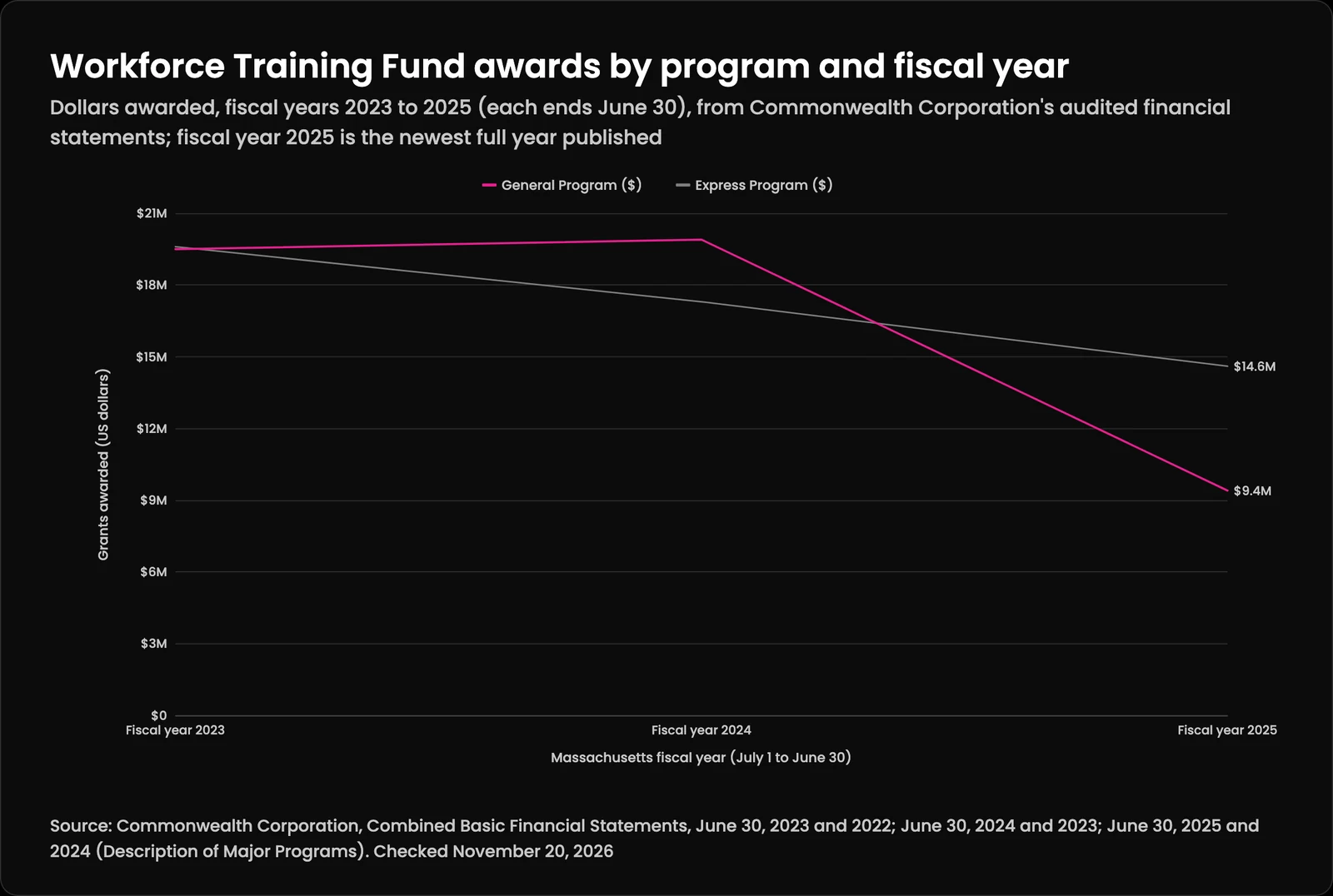
A training round, as I use the term here, is one funded cycle: a chosen skill, a vetted provider, an approved application, the course itself, a measured result and a file the state can audit. Every program detail below was checked on commcorp.org on November 3, 2026. Commonwealth Corporation's audited financial statements for fiscal year 2025 report $9.4 million in General Program awards and $14.6 million in Express awards that year, down from $19.9 million and $17.3 million in fiscal year 2024.
Workforce Training Fund awards fell from $39.1 million in fiscal year 2023 to $24.0 million in fiscal year 2025, with the General Program dropping most.
Workforce Training Fund awards by program and fiscal year (Commonwealth Corporation, Combined Basic Financial Statements, June 30, 2023 and 2022; June 30, 2024 and 2023; June 30, 2025 and 2024 (Description of Major Programs). Checked November 20, 2026)
What does a training round with the Massachusetts Workforce Training Fund involve?
It involves six pieces of work, and only one of them is the course. The others are choosing the skill, vetting the provider, building the packet, measuring the result and keeping records, and each one has a rule from Commonwealth Corporation attached.
The rules reward planning. Express training cannot begin before the service agreement start date, which the Express guidelines set "21 days from the date of application submission," and all approved training must finish within 12 months of that date. The General Program adds a contract that must be executed before anyone sits in a classroom.
The fund also expects the learning to last. The same guidelines state that "grant recipients are responsible for continued investment in training necessary to maintain new capabilities gained via grant funded training." I read that sentence as the brief for the whole round: the state pays for the course, and the company owns everything after it.
What belongs in an AI governance course for people who work beside agents?
The skills that keep an AI agent inside its lane: who approves what, how rules are written, how to read a log, what data may go where and how to keep prompts clean. Commonwealth Corporation's own data shows these topics are scarce in funded courses today.
Its guidance names "AI agents and automation tools" and "AI governance and risk" among subject areas that are "lightly represented in current data relative to how quickly these areas are growing nationally." Marketing and content courses are the largest cluster. That gap is where a company running agents gets the most from its Massachusetts Workforce Training Fund dollars, because writing prompts is easy to learn for free and supervising an agent is not.
From what we have seen running AI teammates in production at Kief Studio for a year and a half, a useful syllabus covers six things:
Approval lines. Which actions go ahead on their own, which wait for a person's yes, and which only a person may ever do. Trainees practice reading a pending approval: what will run, who it reaches and what it contains.
Written rules. How to state a company rule once, plainly enough that every AI teammate follows it, and how to test that it holds.
Logs. How to trace a piece of work back to who asked, which agent did it and who approved it.
Data handling. Which records may go to which model, and which never leave the building. Commonwealth Corporation lists "what should never be entered into a tool" as part of a core competency.
Prompt hygiene. No passwords or keys in a prompt, no pasted customer files, and outside content treated as data rather than instructions.
Stopping. How to pause an agent that has bad context, and who is allowed to.
Commonwealth Corporation lists AI agents and AI governance among the subject areas still lightly represented in courses paid for by the Massachusetts Workforce Training Fund.
Does the required-training exclusion apply to security awareness under 201 CMR 17.00?
Possibly, for a basic course, and Commonwealth Corporation has not published an answer. The Express guidelines say "courses that a company is legally mandated to provide to its employees are not eligible for reimbursement," with OSHA as the example, and Massachusetts does require security training of many employers.
The requirement sits in 201 CMR 17.03, which says "every person that owns or licenses personal information about a resident of the Commonwealth shall develop, implement, and maintain a comprehensive information security program," including "ongoing employee (including temporary and contract employee) training." Section 17.04(8) adds "education and training of employees on the proper use of the computer security system and the importance of personal information security."
The regulation mandates that training happens. It does not name a course. My reading is that a short annual awareness module, bought because the information security program calls for it, is the kind of purchase a reviewer may treat as mandated, while a multi-hour course on handling data with AI tools and supervising agents goes well past the legal floor. That is an inference, not a ruling.
How do you vet a training provider before you name it on an application?
Do it yourself, because the state does not. The Express guidelines say "Commonwealth Corporation makes no endorsement regarding the quality of the training providers/courses listed in the directory," and "businesses must conduct their own research."
A useful checklist is the bar Commonwealth Corporation set for FAST AI providers, published in its RFQ question responses dated October 13, 2026. It applies just as well to an Express or General course:
Ask the provider
Why it matters
How long has your organization delivered training?
FAST AI requires "being in operation for at least two years," and sole proprietors are not eligible.
Can we see completion rates and three employer references?
FAST AI asks for "number of participants trained and completion rates, and at least three letters of reference."
How do you measure learner outcomes?
FAST AI course forms include a "How Learner Outcomes Are Measured" field.
Will exercises use our real tools without our confidential data?
Providers "should use sample, synthetic, or de-identified data for instructor demonstrations and shared exercises."
Is the certificate a recognized credential?
A provider's own certificate is not an "industry-recognized credential" unless an accredited body backs it.
Two Express rules can disqualify a provider outright. The provider cannot have an ownership stake in your company, and it cannot employ a close relative of any owner, investor or employee. For a General Program plan, self-paced work "is limited to 30% of the total course hours," so a mostly video course will not fit.
Last, ask what a trainee will be able to do alone afterward. Commonwealth Corporation tells providers the strongest courses "describe what a trainee will be able to do on their own." For a Massachusetts Workforce Training Fund course on agents, that answer should name approvals and logs.
How should you build the Massachusetts Workforce Training Fund packet and calendar?
Work backward from the course date and treat the certificates as the long pole. Every document has a freshness window, and a stale one stops the application.
Here is the calendar I would set for a Massachusetts Workforce Training Fund Express round, using the dates in Commonwealth Corporation's guidelines:
Eight weeks out. Pick the skill and write down the baseline you will measure against (more on that below). Confirm course availability and pricing with the provider, which the guidelines make your job.
Six weeks out. Request the Department of Revenue Certificate of Good Standing (its notice date must fall within 6 months of submission), the Department of Unemployment Assistance Certificate of Compliance verifying fund contributor status, and a signed W-9 dated within a year.
Four weeks out. Submit the application. The start date is set 21 days later, and the course start you list can be no later than 6 months from submission.
Course weeks. Staff attend on paid time, including pre-work, and the provider delivers every listed hour.
Within 30 days of completion. Send the reimbursement request.
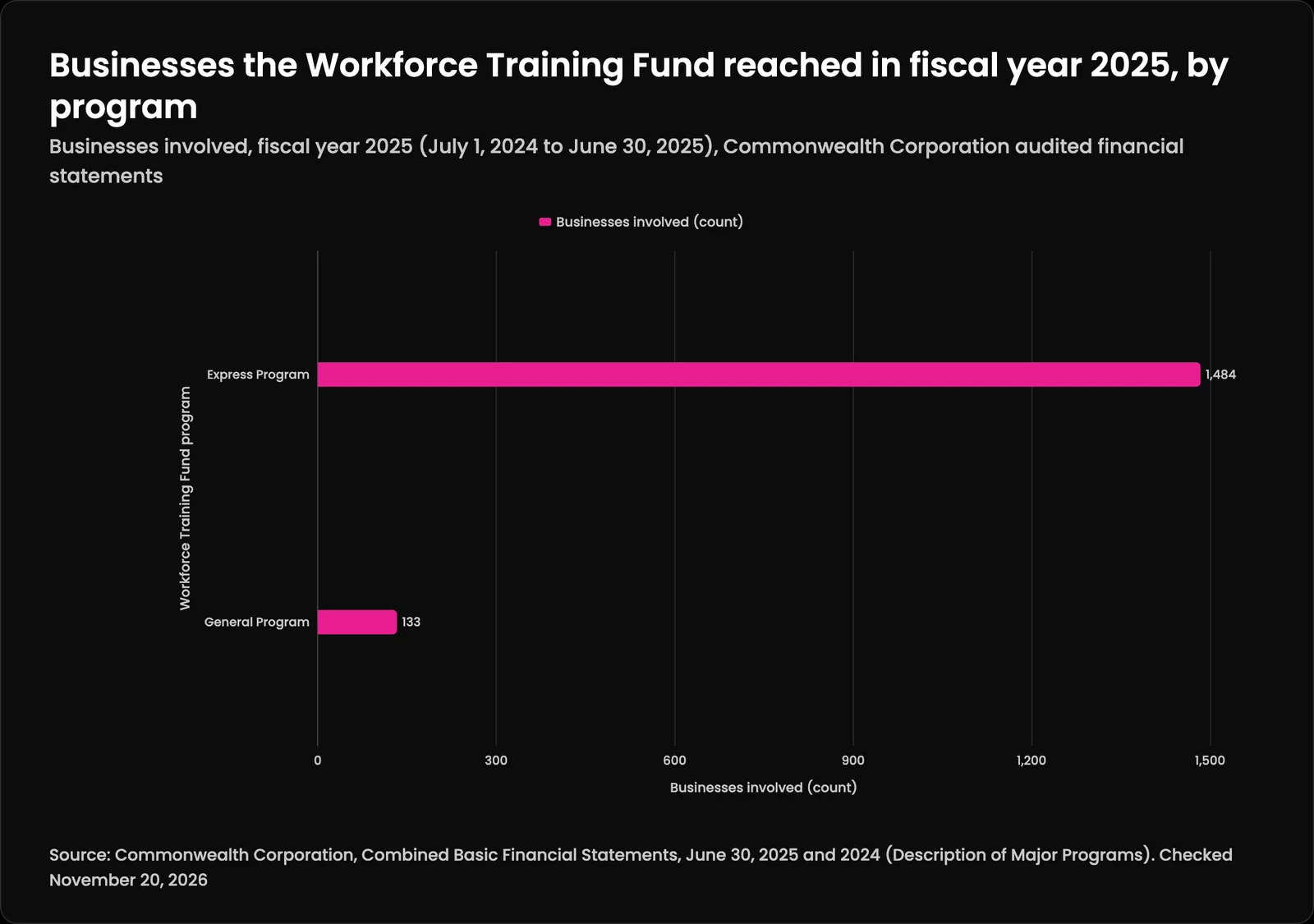
The General Program runs on a longer clock. Its guidelines say funding decisions are "generally made within 60 days," and companies need "at least two full years of financial statements." A Central Massachusetts business with a modest training need can also join a consortium, which the guidelines allow a chamber of commerce or business league to lead. In fiscal year 2025, Express grants involved 1,484 small businesses and General Program grants 133, according to Commonwealth Corporation's audited statements.
Express grants involved about eleven times as many businesses as the General Program in fiscal year 2025, but fewer than twice as many workers.
Businesses the Workforce Training Fund reached in fiscal year 2025, by program (Commonwealth Corporation, Combined Basic Financial Statements, June 30, 2025 and 2024 (Description of Major Programs). Checked November 20, 2026)
Program
Businesses involved (count)
Express Program
1,484
General Program
133
How do you know a Massachusetts Workforce Training Fund course worked?
Measure the same behavior before and after, on real work. Attendance proves the course happened; it says nothing about whether people now catch a bad draft or stop before an unapproved send.
Federal guidance supports this shape. NIST SP 800-50 Revision 1, published September 2024, says a learning program "should encourage behavior change" and includes "suggested metrics and evaluation methods to regularly improve and update the program." The state is moving the same way: for FAST AI, Commonwealth Corporation "expects to collect feedback from trainees on course quality and from employers on training impact and worker retention."
For an AI governance course, I would track four measures at baseline, 30 days and 90 days:
Share of AI-assisted drafts sent back for rework after review.
Approvals a person rejected, and why, read straight from the activity log.
Data-handling misses: records found in a tool they should never have reached.
A short scenario check: five realistic requests, and whether each trainee routes them to go ahead, wait or person-only correctly.
Keep the measures about behavior, not scores people can chase. Why your team games every metric explains how a single number drifts from the thing it was meant to show.
Commonwealth Corporation may run post-training evaluations of General Program grants from the Massachusetts Workforce Training Fund and can ask grantees for participant-level data.
What records does the Massachusetts Workforce Training Fund expect you to keep?
Enough to prove who was trained, for how long, on paid time, and that the provider was fully paid. Reimbursement turns on those facts, and later evaluations may ask for more.
An Express reimbursement needs four components: the signed reimbursement form, the list of trainees, a provider invoice naming the course as it appears on the service agreement, and proof of payment such as a bank or card statement. The guidelines add two traps. Payment does not count while any loan from the provider remains outstanding, and if fewer hours were delivered than listed, the program "may consider approving reimbursement of a prorated portion."
I would keep one grant folder per round with six items: the application and service agreement, the three certificates, the written answer on any exclusion question, attendance by session with hours, the invoice and proof of payment, and the baseline and follow-up measures. The General Program warns that grantees "may be required to provide participant-level data," and its disclosures note that administrators "may conduct post-training evaluations."
Treat that folder as sensitive. A trainee list tied to payroll records can hold personal information as 201 CMR 17.00 defines it, so give the grant file the same controls as customer records. FAST AI makes the point directly: its privacy terms cite "compliance with G.L. c. 93H," with records retention set in each contract.
How do you keep AI skills alive after the course ends?
Write what was learned into the company's rules, practice it on real work every week, and plan to fund refreshers yourself. A funded course is a starting point, and the fund's own rules assume the company carries it forward.
The repeat rule makes that budgeting real. Express says employees should not take "the same or similar training" funded by a prior grant "until a minimum of five years have passed since the closeout," and the General Program applies the same five-year limit to topics. An annual security refresher, the kind 201 CMR 17.00 expects, is therefore an internal cost in years two through five. Plan a different, deeper topic for the next Massachusetts Workforce Training Fund round.
Three habits carry the skill forward at no cost. A monthly review of the activity log, where the team reads a few approved and rejected items together. A shared rule book that changes when someone finds a gap. And short peer sessions, the approach laid out in how to train your team on AI without hiring a consultant. People who learned to govern AI then help their colleagues use it well, which is the point of shadow AI: govern it by enabling it.
Behavior also shifts as models update, so the course needs an anchor that stays put. The written rules and the log are that anchor, and noticing change against them is covered in AI agent drift: how to catch it.
Express guidelines bar funding the same or similar training for five years, so refreshers after a Massachusetts Workforce Training Fund course are the company's own investment.
How does LTFI turn a training round into daily practice?
LTFI holds the rules people learned, so the training shows up in the system instead of fading from memory. We have run LTFI, our agentic business operating system, in live production for a year and a half: the CRM, projects, content, sites, security and AI staff in one system, on a dedicated server Kief Studio runs for each company.
The syllabus above maps onto how it already works. People talk to one chief of staff, which hands work to the AI teammate who owns it. Default approval lines, which each company sets for itself, let briefs, summaries, research, drafts and record keeping go ahead, while sending email, posting and publishing, messages to clients, spending and scheduling wait for a person's yes. Rules and permissions, who approves what, passwords and keys, deleting and money stay person-only.
Company rules are written once, and every AI teammate follows them. In our October 23 webinar, Brian Gagne showed one: what every press release must include. One AI teammate's work can go to another to check against those rules before it counts as done. Everything is logged, including who asked, which AI teammate did the work and who approved it, so the monthly log review has its material ready. Every agent can be paused at once.
Permissions are scoped per person, and LTFI works with the tools a team may have trained on, including Claude Code, Codex, Cursor, Gemini, GitHub Copilot, Grok and OpenCode.
One boundary, stated plainly: the Massachusetts Workforce Training Fund pays for instruction, and Commonwealth Corporation's guidance says that does not include "consulting, implementation, software configuration, AI development, software licenses." It does not pay for LTFI. Use the fund to train your people, and let the system keep what they learn.
Wrappers around a chat window or a free open-source agent framework are arriving quickly now. LTFI was meticulously built from scratch by Kief Studio as one whole system. A walkthrough is at ltfi.ai, and the replay of What is an agentic business operating system? shows it running. Kief Studio is based in the Worcester and Shrewsbury area. We have worked remotely with clients around the world for more than 13 years, and we meet local businesses in person.
Can the Massachusetts Workforce Training Fund pay for AI governance training?
Yes, if the course is skills training listed in the Express Course Directory or included in a General Program plan. Commonwealth Corporation notes governance and risk courses are still scarce, so you may need to ask a provider to register one.
Does the Massachusetts Workforce Training Fund cover security training required by 201 CMR 17.00?
It depends on the course. Express excludes training a company is legally mandated to provide, and 201 CMR 17.03 requires ongoing employee training. Ask Commonwealth Corporation in writing before applying, and keep the answer in your grant file.
How far ahead should we plan a training round?
About eight weeks for Express. Certificates take time to gather, the application must go in at least 21 days before training starts, and the reimbursement request is due within 30 days of completion.
Can the same employees take a funded refresher next year?
Not on the same or similar topic. Both programs bar repeat funding for five years after the prior grant closes, with an exception for English for Speakers of Other Languages, so refreshers are an internal cost.
Does the fund pay to set up AI agents or software for us?
No. Commonwealth Corporation's guidance says its programs do not fund consulting, implementation, software configuration, AI development or software licenses. They pay for instruction that teaches a skill a worker can repeat.
AI governance cost for a small or mid-size business is mostly people time: rules, an approval step, a log and a review. An AI incident can cost a client, a Chapter 93A penalty of up to five thousand dollars per violation, or an excluded claim. What each side costs and buys.
Massachusetts AI regulations are existing laws, not one AI statute. The Attorney General's April 16, 2024 advisory applies Chapter 93A, the anti-discrimination law and 201 CMR 17.00 to AI, and a 2025 settlement over AI lending models reached $2.5 million. What each law means for an AI agent.
An AI acceptable use policy for small business now has to cover agents that act, not just people who paste. ISACA's May 2026 poll found only 38 percent of organizations had a formal, comprehensive AI policy. Seven parts to write, from approval lines to Massachusetts law.