AI governance cost for a small or mid-size business is mostly people time: rules, an approval step, a log and a review. An AI incident can cost a client, a Chapter 93A penalty of up to five thousand dollars per violation, or an excluded claim. What each side costs and buys.
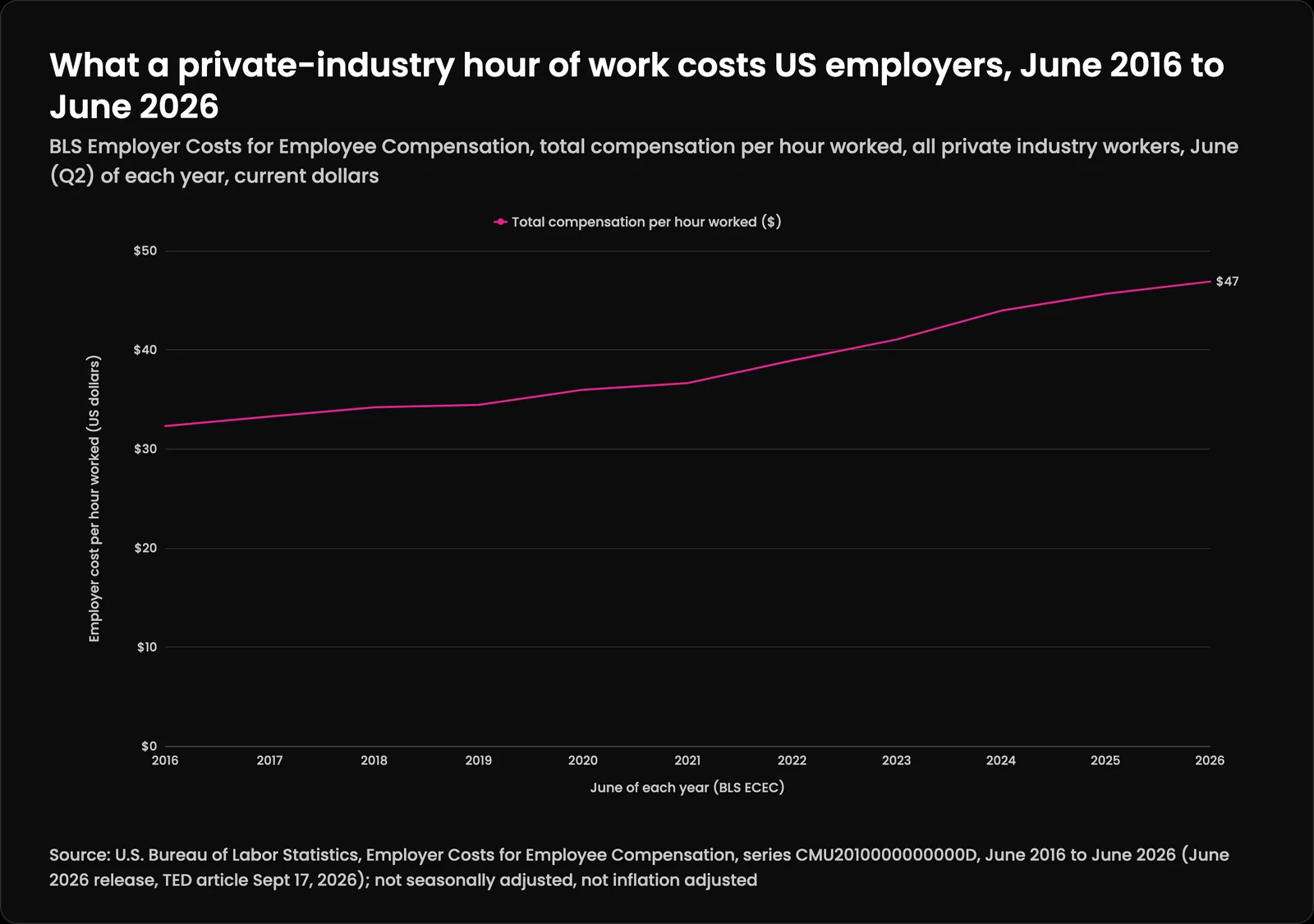
Private-industry employers paid an average of $46.89 in compensation per hour worked in June 2026, the Bureau of Labor Statistics reported, and hours are the main input to AI governance cost. For a small or mid-size business it is mostly people time: written rules, an approval step, a log and a regular review. An incident is the unplanned number, and it usually lands on a client relationship first.
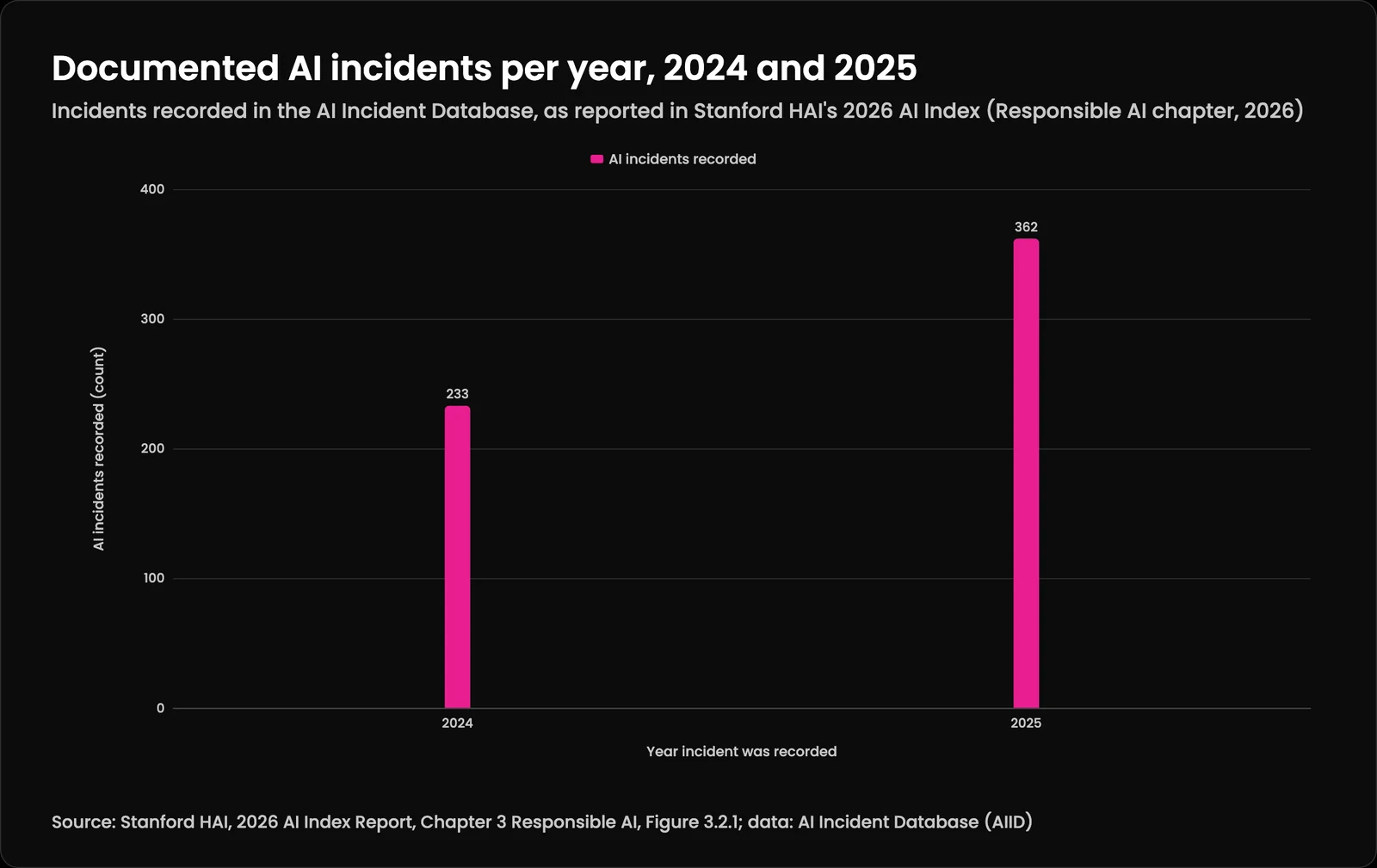
AI governance cost is a recurring, budgeted line. The AI Incident Database recorded 362 documented AI incidents in 2025, up from 233 in 2024, according to Stanford's 2026 AI Index.
What is AI governance cost, and what is it compared against?
AI governance cost is what a business spends, in hours and in tools, to decide what its AI may do, to prove what it did and to stop it when needed. The comparison is the cost of an AI incident: the time, money, trust and legal exposure that follow when an AI system does something nobody approved.
I find the comparison useful because the two numbers behave so differently. Governance is a known quantity that shrinks as the rules settle. An incident is a range with a long tail: a client who leaves, a regulator's letter, a claim that turns out to be excluded.
Documented AI incidents rose from 233 in 2024 to 362 in 2025 in the AI Incident Database.
Documented AI incidents per year, 2024 and 2025 (Stanford HAI, 2026 AI Index Report, Chapter 3 Responsible AI, Figure 3.2.1; data: AI Incident Database (AIID))
Year
AI incidents recorded
2024
233
2025
362
What goes into AI governance cost for a small or mid-size business?
Seven lines make up AI governance cost for most companies under a few hundred people, and the first four are people time. Licenses and tooling are usually the smaller share, which is why so many budgets underestimate it.
People time to decide the rules. Someone senior writes down what the AI may do alone, what waits for a person and what it may never touch.
The approval step. Every outbound email, post or payment that waits for a yes takes a person seconds to minutes, multiplied by volume.
Reviews. A periodic look at what the AI did and what was rejected, which is also how drift gets caught (see how to catch AI agent drift).
Logging. A record of who asked, which AI did the work and who approved it, kept somewhere the AI cannot edit.
Tooling. Access controls, a key vault, monitoring. Some of this you already pay for.
A managed system, if you choose one, which turns the lines above into configuration instead of a project.
The frameworks themselves cost nothing. NIST's AI Risk Management Framework, released on January 26, 2023, is "intended for voluntary use" and is free to download, along with its July 2024 profile for generative AI. The money is in applying them.
To price the people time, use your own loaded hourly cost. The same BLS release put full-time private-industry workers at $54.00 per hour worked in June 2026. A manager's hour costs more, so an honest AI governance cost estimate starts with real names and hours. The all-worker average has risen every June since 2016, from $32.29 to $46.89 per hour worked, in the BLS employer cost series, which is not adjusted for inflation.
The hour that governance is priced in has grown more expensive every June since 2016, before adjusting for inflation.
What a private-industry hour of work costs US employers, June 2016 to June 2026 (U.S. Bureau of Labor Statistics, Employer Costs for Employee Compensation, series CMU2010000000000D, June 2016 to June 2026 (June 2026 release, TED article Sept 17, 2026); not seasonally adjusted, not inflation adjusted)
June of year
Total compensation per hour worked ($)
2016
$32
2017
$33
2018
$34
2019
$34
2020
$36
2021
$37
2022
$39
2023
$41
2024
$44
2025
$46
2026
$47
The same Stanford report found AI-specific governance roles grew 17% in 2025. A smaller company rarely hires for it; the work lands on an owner or an operations lead, which is why the AI governance cost has to be designed to be small.
Most AI governance cost is people time, priced at your own hourly rate. BLS put private-industry employer compensation at $46.89 per hour worked in June 2026, and the NIST AI Risk Management Framework itself is free for voluntary use.
What does an AI incident cost a business?
An AI incident costs whatever it takes to undo the action, repair the relationship and answer the client, regulator or insurer who asks. The amount depends on what the AI was allowed to do far more than on which model it used.
There is no reliable public average for what an AI incident costs a small business, so I do not borrow a large-company figure here. A 30-person firm in Central Massachusetts will not lose millions to a bad email, but it can lose a client worth years of revenue. The useful way to price an incident is by type, using sources that are records rather than estimates: court decisions, statutes, insurance forms and reported events.
A wrong email to a client
An AI that sends on its own can quote the wrong price or promise a date nobody agreed to. The direct cost is small; the cost to the relationship is not.
When an AI can act, not just write, an instruction it ignores becomes an operational outage. Fortune reported in July 2025 that an AI coding agent "deleted a live database during a code freeze", wiping records for more than 1,200 executives and over 1,190 companies. The vendor's chief executive called it "Unacceptable and should never be possible." Every part of that cost traces back to one missing control: nothing stopped a destructive action from running without a person.
Regulatory exposure under Massachusetts rules
Massachusetts has no single AI statute, but its existing laws already reach AI. On April 16, 2024, Attorney General Andrea Joy Campbell issued an advisory stating that the state's "consumer protection, anti-discrimination, and data privacy laws apply to AI" and that her office "intends to enforce these laws accordingly."
Insurers are now writing AI into and out of policies by name. Verisk's ISO released optional generative AI exclusions for commercial general liability with a January 2026 edition date, including form CG 40 47, which excludes bodily injury, property damage and personal and advertising injury arising out of generative AI. Ask your agent before renewal whether one is attached. We have covered why cyber insurance claims get denied, and the pattern holds for AI: the claim is decided by the controls you can prove you had.
An approval step is the cheapest line in AI governance cost. Fortune reported in July 2025 that an AI coding agent deleted a live database during a code freeze, an action a required human yes would have stopped.
AI governance cost vs the cost of an AI incident, side by side
Set next to each other, AI governance cost is small, recurring and mostly hours, while an incident is irregular and its largest lines are the ones you cannot invoice: trust, time and legal exposure. The table puts the two in the same rows.
Line
Governance (planned)
Incident (unplanned)
People time
Writing rules once, a few seconds per approval, a periodic review
Days of senior time to investigate, apologize and fix
Client relationship
Drafts read before they leave
A wrong quote or promise the client has in writing
Data
Rules on which data goes to which model; scoped access
Records in an account you do not control; possible notice duties
Operations
Destructive actions wait for a person; a pause switch
Downtime and recovery after an action nobody approved
Regulation (Massachusetts)
A written program that already covers AI under 201 CMR 17.00
93A civil penalties per violation; two to three times damages if willful
Insurance
Evidence of controls at renewal
A claim tested against an AI exclusion
Evidence
A log of who asked, who did it and who approved it
AI governance cost buys three things an incident never returns: permission to use AI on real work, proof for clients and insurers, and a faster path to tuning the AI. Spending on an incident buys you back to where you started.
The first is easy to miss. A business with no approval line keeps AI on the side, in personal accounts, because nobody is comfortable letting it near clients. Once the lines are enforced, the same business lets an AI draft every follow-up, because nothing leaves without a yes. AI governance cost is the price of being allowed to use the thing.
The second is evidence. A client questionnaire, a renewal application and a regulator's letter all ask what controls you had and whether you can show them. A log answers in minutes.
The third is speed. In our own work, the log has been the tuning tool: when an output misses, it shows which instruction and which model produced it, so the fix is one rule instead of a guess.
How do you size AI governance cost for your own business?
Size AI governance cost from your own workflows, not an industry average: list what the AI touches, decide which actions wait for a person, then price the hours. A one-page worksheet is enough for most firms.
List every AI use, including personal accounts people already use.
Sort each action into three groups. Goes ahead on its own (drafts, summaries, research, record keeping); waits for a person (sending, posting, client messages, spending, scheduling); person-only (permissions, who approves what, keys, deleting, money).
Count the waits. Estimate how many approvals a week the second group creates and how long each takes. That is your recurring AI governance cost in hours.
Price the setup. Hours to write the rules and the policy, once.
Price the worst plausible incident for each group, such as a wrong email to your largest client, using your own revenue, not a headline average.
Compare and decide. Where an incident is cheap and reversible, let the AI go ahead. Where it is expensive or permanent, put a person in the path.
Most businesses we talk to around Worcester and Shrewsbury find the same shape: real thought once, then an AI governance cost that is mostly the seconds spent reading drafts.
Stanford's 2026 AI Index reports the AI Incident Database recorded 362 AI incidents in 2025, up from 233 in 2024. Preparation that is already in place costs far less than a response improvised afterward.
How LTFI keeps AI governance cost low by building it in
LTFI makes governance part of the system the AI works in, so the approval lines, the log and the permissions are already there on day one. We have run LTFI in live production at Kief Studio for a year and a half, and the governance has never been a separate project.
LTFI is an agentic business operating system: the CRM, projects, content, sites, security and AI staff in one system, on a dedicated server Kief Studio runs for each company, with no shared hosting. People talk to one chief of staff, which hands work to the AI teammate who owns it.
Approval lines by default. Briefs, summaries, research, drafts and record keeping go ahead. Sending email, posting and publishing, messages to clients, spending and scheduling wait for a person's yes. Rules and permissions, who approves what, passwords and keys, deleting and money are person-only. Each company sets its own lines.
Rules written once. A company instruction, such as what every press release must include, is followed by every AI teammate.
Everything logged. Who asked, which AI teammate did the work and who approved it. The same log is how the work gets tuned.
A second check. One AI teammate's work can go to another to check against the written rules before it counts as done, and each job can run on a different model.
Scoped seats and spending caps. Permissions are scoped per person, so a contractor can get the files without the AI system, and spending can be capped per person.
A pause for everyone. Every agent can be paused at once.
Keys and data. Keys and secrets sit in an encrypted vault, not in the app. Your data is yours, and if you leave, we export it.
In our October webinar, an AI teammate drafted an email to a client about a late project, and it waited until Brian approved it. That approval took seconds, and it is the whole difference between the two columns in the table above.
LTFI works with the AI tools a team already uses, from Claude Code and Cursor to Gemini and GitHub Copilot, and connects to models through OpenRouter or a company's own local model through Ollama (the full list). Lookalikes are arriving, many of them wrappers around someone else's agent; LTFI was meticulously built from scratch by Kief Studio as one whole system, so governance is part of it. More on that in AI governance for agentic AI.
Kief Studio is based in the Worcester and Shrewsbury area. We have worked remotely with clients around the world for more than 13 years and meet local businesses in person. If you want to see the approval lines working, there is a walkthrough at ltfi.ai and the full replay of What is an agentic business operating system?.
What is a realistic AI governance cost for a small business?
For most small businesses, AI governance cost is a few working sessions to write the rules and policy, then a few seconds per approval and a short periodic review. Price it with your own staff's hourly cost; BLS put private-industry employer compensation at $46.89 per hour worked in June 2026.
Is AI governance cost lower than the cost of one AI incident?
For most firms, yes, because the governance lines are hours while an incident can cost a client, a penalty and an insurance dispute. Under Chapter 93A, section 4, the Attorney General can seek up to five thousand dollars per violation, and an AI repeating the same error to many customers multiplies that count.
Does Massachusetts law apply to a business's AI tools?
Yes. The Attorney General's April 16, 2024 advisory says the state's consumer protection, anti-discrimination and data privacy laws apply to AI, and Chapter 93A allows civil penalties of up to five thousand dollars per violation. This is general information, not legal advice.
Will cyber insurance cover an AI mistake?
It depends on your policy. Verisk's ISO released optional generative AI exclusions with a January 2026 edition date, and carriers decide whether to attach them, so ask your agent which AI wording is on your renewal.
What is the cheapest control that prevents the most AI incidents?
An approval step on anything that leaves the business. Drafts go ahead while sending, posting, client messages, spending and scheduling wait for a person. It adds seconds to AI governance cost and stops most wrong emails and destructive actions.
Massachusetts AI regulations are existing laws, not one AI statute. The Attorney General's April 16, 2024 advisory applies Chapter 93A, the anti-discrimination law and 201 CMR 17.00 to AI, and a 2025 settlement over AI lending models reached $2.5 million. What each law means for an AI agent.
An AI acceptable use policy for small business now has to cover agents that act, not just people who paste. ISACA's May 2026 poll found only 38 percent of organizations had a formal, comprehensive AI policy. Seven parts to write, from approval lines to Massachusetts law.
The Massachusetts Workforce Training Fund has paid for AI courses at 270+ employers since July 2024. How to run a funded round well: what to teach about agents and approvals, vetting providers, the packet and calendar, measuring results and keeping records.