Managed Website and Writing Without a Ten-Person Team
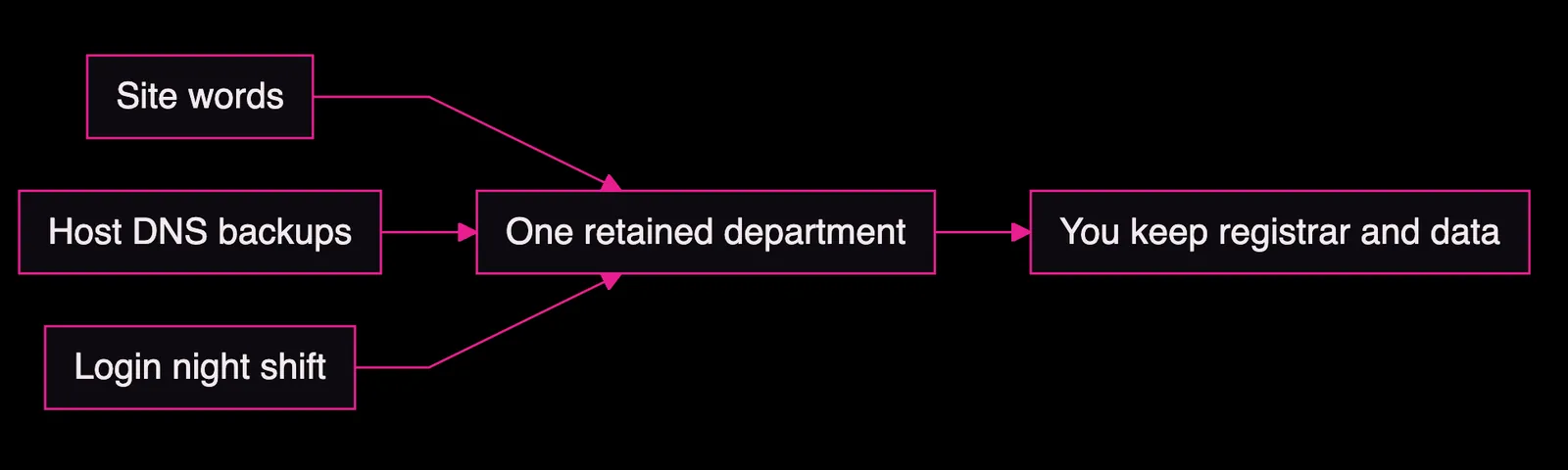
Managed website and writing without a ten-person team: one retained department for site, host, and night-shift login. Brooks: more people, more paths. You keep the registrar and the data. SparkToro 2024: 58.5 percent of US Google searches had no click.
You do not need a ten-person digital team to keep a website live and a writing cadence honest. You need one retained department that holds the site, the host, and the night-shift login, while you keep the domain and the words. Extra faces in a kickoff do not restore a backup on Sunday.
I run Kief Studio with Brian. We've been building together since 2012. Fred Brooks documented this in 1975: adding people to a late software project makes it later. The math is straightforward. A team of three has three communication paths. A team of seven has twenty-one. We automated the third time we did a task, which is how two people stay in the range of a much larger team. The longer version of that math is the two-person studio model. If a ten-person "digital team" quote is sitting in your inbox, we can walk the roles before anyone signs.
Ten people is a communication tax unless each person owns a slice you actually need. Most sites need writing, hosting, and someone who answers at 11pm.
What that ten-person deck is usually selling
Pull the last agency slide onto the call with me. Count the roles out loud: account, project manager, designer, front-end, back-end, SEO, ads, copy, QA, and a strategist. Some of those are real jobs on a large account. Some are meetings about the real jobs. If your actual work is keep the site fast, publish twice a month, and do not lose the domain, you are buying a floor of people so the quote looks legitimate. The site does not care how the slide looked.
We confuse more faces in a kickoff with more care. Care, on a Sunday, is who can restore the backup. Faces in a slide do not restore a site. Every extra person is another place a ticket can sit. I have watched owners sign the crowded deck because the empty-looking alternative felt risky. Then month four arrives, the intern who launched the theme is gone, and the ticket for a patch sits in a queue that opens at 9am. That is the tax: communication paths you will never walk.
Before you sign, list three assets and put a name next to each one: the site, the host, and the login. That split has its own conversation in who owns the site, the host, and the login. If those three names are three companies plus you, you just became the fourth vendor. You will spend Tuesdays translating between them. That is not a digital team. That is a switchboard.
Three jobs sit in one department. You keep the registrar and the data export. That is the split that survives a breakup.
What retained actually means when you are tired of projects
A project is a start and an end. You get files. Then you are the operator. A retainer is a calendar. Someone is still on the hook in month seven, when the theme needs a patch and the intern who launched it is gone. If you have ever inherited a finished site and been afraid to touch the host login, you already know the difference. Finished is not staffed. Looking good at launch is not the same as being ready to restore the box when a plugin update blanks the homepage.
U.S. copyright, under 17 U.S.C. § 201, starts with the author. If a freelancer wrote the theme, you want a written assignment if you want to own that code. A paid invoice does not transfer copyright by itself. I am not your lawyer. I am the person who has watched a redesign get stuck because nobody can find the Figma. Put the assignment in the agreement before the launch party. Independent contractors are usually authors until they assign. Read that clause out loud with the designer in the room. It is an awkward five minutes. It is cheaper than a year of "we cannot move hosts."
LTFI is how we name the hire: managed digital operations. You do not install a box. You do not own our software. You own name, content, data, and custom code unless a LICENSE file says otherwise. Terms live on ltfi.ai. The sibling billing conversation is retainer versus project. Projects are useful for a bounded build. Writing and hosting are not bounded. They keep happening after the party. If your quote is mostly kickoff hours and a handoff PDF, you are buying a project that will quietly become your second job.
Writing twice a month with one editor who knows the product beats a rotating copy bench that relearns your voice every sprint.
Writing is operations, not a content pod
A visitor can leave a search box satisfied without ever opening your site. SparkToro's 2024 zero-click work, with Datos clickstream, found 58.5 percent of US Google searches ended without a click. Assistants and answer boxes are more of that pattern, not less. You do not beat that with ten writers. You beat it with pages that answer a real question in the first fifty words, with a named author, and that stay findable after you publish them.
That is the week of work in the week-long AEO audit, and the citation version in how to get a small business cited by ChatGPT. A ten-person content pod will produce volume. Volume without a clear question per page is how a site gets long and still silent. I would rather publish fewer pages that each settle one question a buyer actually asks. Headcount is the expensive way to hide that decision. If you cannot hear the question when you read the opening out loud, the page is not ready, no matter how many people touched it.
Google's people-first guidance rewards experience you can name. A rotating bench dilutes that. Keep the byline stable. Keep the NAP identical everywhere. NAP is name, address, and phone: the three-line identity on Google Business, the footer, and the invoice. If those three disagree, the town page is a rumor. That identity work is local AEO if you serve real towns. Fake city mills waste the two people you do have. Write the towns you actually drive to. If a copy bench needs a week to relearn your product every sprint, you are paying for onboarding, not writing.
When you actually need more than two people
You need more people when the work is parallel in a way tools cannot swallow: twenty stores, a live newsroom, or a regulated review queue that cannot be the same two humans. You need a specialist when the gap is real, such as a payment flow the generalist cannot hold. Those are honest reasons. They are not the same as wanting the kickoff to look bigger. If your partner wants the crowded room because a buyer might ask "who is on the account," answer with names who can publish, patch, and pick up the phone. Titles that only exist in the slide do not help that buyer at 11pm.
You do not need ten people to change a banner and post a blog. You do not need a strategist, an account lead, and a project manager to ship two articles a month. Those roles exist for a reason on large accounts. They are a tax on a single site. The ceiling is also honest. Two people cannot sit in twelve meetings at once. They can own restore, publish, and the registrar path, with tooling that already ran the third time. Engineering notes for that tooling live on kief.dev. Architecture write-ups live on briansgagne.com when the question is how the box is built. The studio that holds the work is still two people on the invoice.
A Tuesday test before you sign a ten-person quote
If we were on a call with the quote in front of us, I would not start with the monthly number. I would start with three names. List who restores the site if it dies at 9pm. You want a name, a number, and a practiced restore, not a ticket queue that opens at 9am. List who publishes the next article in your voice. If that person has to relearn the product every sprint, you are paying for onboarding, not writing. List who holds the domain registrar. That login stays yours even when someone else operates the box.
If those three answers are three companies and you, you are the fourth vendor. Read consolidation cost savings before you add a fifth. Ask for a written assignment of custom code and a data export drill. Run the drill once while everyone is still friendly. Quotes with more names feel safer. Safety is a restore you have practiced. If the quote is a floor of people "to look legitimate," ask which of those people can publish, patch, and pick up the phone. The rest is ceremony.
Walk that test once a year even if you already have a department. People change jobs. Cards expire. MFA phones get replaced. A retainer that cannot show you the registrar in your name, an assignment on file, and a restore date is a retainer that holds more of you than you think. Ask. Write the answers on one page. Put the page next to the contract. Then go back to the work that actually ships: a fast site, two honest articles a month, and a person who still answers in month seven.
If the current site is already live and messy, you do not need a ten-person rescue. You need one owner who will take the registrar, the assignment, and the restore date in that order. Price comes after those three. A cheaper monthly number that hides four leftover keys is not cheaper. It is a second job you did not staff, waiting for a night you did not choose.
Can two people really replace a ten-person web team?
For a single site, hosting, and a writing cadence, yes, if the two people own the stack and the tools. Parallel work across many brands is a different math, and that is when you hire for parallelism, not for a slide of titles.
What do I still own if I hire a department?
Keep the registrar. Keep a path to export content and data. Get custom code assigned in writing. The operator holds the night-shift login so patch night is not your second job.
Will I rank worse with fewer writers?
Not if each page answers one real question in the first fifty words, with a named author who stays. Volume without a question is a long site that still stays silent.
Do I need an agency for SEO?
You need extractable answers, a named author, and an index that assistants can read. That can be a department you hire. It does not require a ten-person SEO pod.
When is a larger team the right call?
When work must happen in parallel: many stores, a newsroom, or a review queue the same two humans cannot hold. Hire for that parallelism. Do not hire to make the kickoff look crowded.
What do I tell my partner who wants the crowded kickoff?
Ask which names on the slide can publish, patch, and pick up at 11pm. If the answer is two people plus a lot of ceremony, buy the two people and skip the ceremony.
Who owns your website on a retainer is three questions: site, host, and login. U.S. copyright vests in the author unless assigned. Keep the registrar. Let an operator hold the night-shift login.
What LTFI is: hire a department, not a box you install. Site, host, identity, and on-call on infrastructure Kief Studio operates. You own name, content, data, and custom code.
IT platform consolidation cost savings vs vendor claims should be scored against waste you already have. Flexera 2025: 27 percent of IaaS and PaaS spend unused. Changing the logo is not savings.