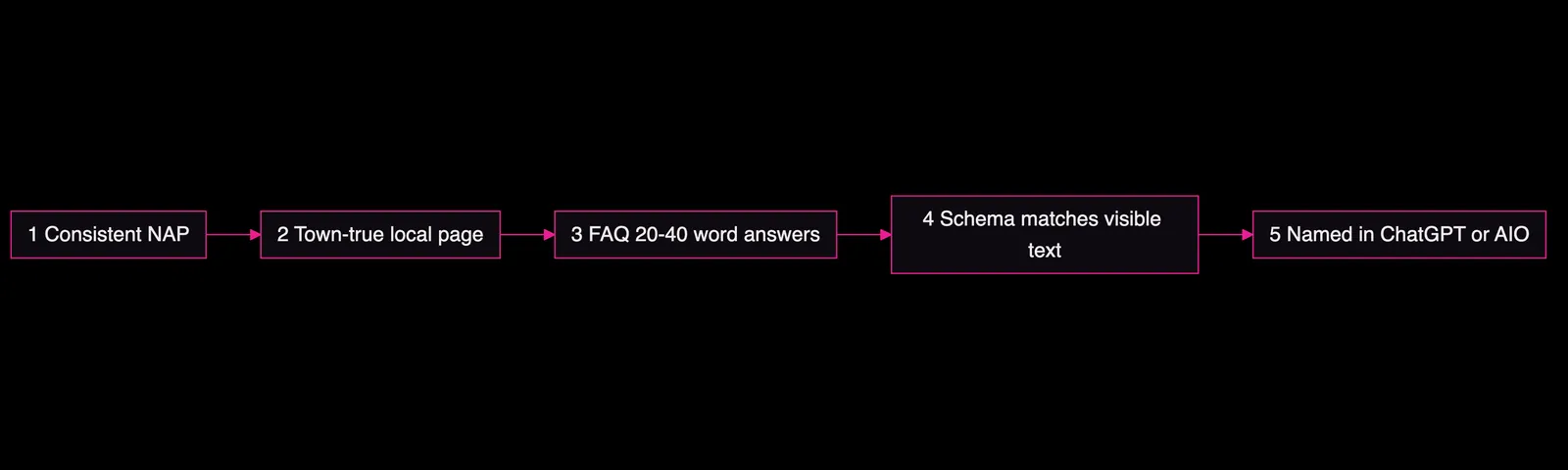
AEO for Massachusetts local service businesses: identical NAP, town-true pages, 20 to 40 word FAQs. SparkToro 2024: 58.5 percent of US Google searches ended without a click. Fake city mills are a trust leak.
AEO for Massachusetts local service businesses is getting your legal name, town, hours, and a short answer onto the page a neighbor would actually read. When someone asks ChatGPT for an emergency plumber near Shrewsbury tonight, the model hunts for a page that already says those facts in plain HTML.
Most of those hunts never send a click back to you. SparkToro's 2024 zero-click study, using Datos clickstream, found 58.5 percent of US Google searches ended without a click. Local answers now live in maps, AI Overviews, and assistants. Treat a named mention as a win, not a lost session.
I run Kief Studio with Brian, from Shrewsbury, Massachusetts. We are two people. We write town pages for shops that roll a truck. If you and I were on a Zoom with the site open, I would not start with a blog calendar. I would start with the footer, the Google Business Profile, and the towns the crew can describe from a Tuesday.
Shrewsbury is a real city on this byline. A town page you do not serve teaches the model the wrong town.
What AEO means when the customer is down the road
Answer engine optimization for a plumber in Worcester County is a practical test. When someone asks ChatGPT or Google for an emergency plumber near Shrewsbury, Massachusetts tonight, does your legal name, town, hours, and a forty-word answer show up. If that answer lives only on Facebook, a directory will win the citation, and you will never see the session.
Google's people-first content system is the public document behind E-E-A-T. For a local service that means experience in the towns you actually serve, a current owner name, and pages that match the truck wrap. If the wrap says one name and the site says another, you look like two companies, and the model has no reason to pick yours.
OpenAI's ChatGPT search help says the model rewrites a prompt into targeted queries and may send them to search partners. A rewritten query for a local service is often the service, the town, MA, plus hours or a license. Put that string in HTML. Keep Bing Places and Google Business Profile in lockstep. Copilot reports for this domain are Bing-labeled. File Bing Places even if daily life is Google, because a rewritten hunt may never touch the profile you polish every week.
Five gates we actually run: identical name, address, and phone; a town-true page; short FAQ answers; schema that matches the visible text; then a named mention. Fake city pages skip the second gate.
Write the name, address, and phone once, then copy it
NAP means name, address, and phone, written the same way every time. On a call I ask you to write the legal name, street, city, state, ZIP, and phone once on a card, then copy that card into the site footer, the contact page, Google Business Profile, Bing Places, invoices, and the truck wrap. If we have printouts on the desk, Street versus St is the first red mark, because engines will not sit down and reconcile it for you.
If those surfaces disagree, you look like three companies. They will pick a directory that already agrees with itself. Abbreviations that look cute split the entity. LLC on one surface and not on another is enough to do the same damage. Entity SEO is that consistency plus a Person or LocalBusiness node that matches the owner card. The model is trying to decide whether you are one shop. Help it. Do not make it guess from a Facebook about box and a footer that drifted two years ago.
Hours belong in HTML, not only in a profile dashboard. Saturday hours that exist only in Google Business Profile will win the map pack and lose the assistant that rewrote the query into a web hunt. License numbers, emergency versus scheduled work, and the towns you will and will not take after 6pm belong on the same page as the NAP. Put the same NAP in schema and in the footer. A service pillar with town pages pointing at it can help. It still does not replace the card.
If you cannot ship a NAP fix on a Friday because a freelancer still holds the CMS, that is a contract question, not a copy question. I wrote that as who owns the site, host, and login. We will not invent a prettier slogan while the login still lives in someone else's Gmail.
One honest page per town you actually serve
Then write one page per town you roll a truck to, with proof a skeptic could check. Proof can be a job photo, a permit number, or a sentence about travel time that is true on a Tuesday. "We schedule Westborough on Tuesdays and Thursdays, same-day for leaks inside our published radius" is a passage an assistant can lift. "We proudly serve MetroWest" is a slogan. Slogans do not get cited, because they do not answer a town-plus-service hunt.
Do not mill fifty Massachusetts city pages from a template. Google's helpful-content guidance is explicit about people-first pages over scaled unoriginal ones. Assistants copy that preference. They quote a specific passage. Fifty identical passages are one passage with worse trust. If you serve Shrewsbury, Westborough, Northborough, and Grafton, write four pages with four facts. If you do not roll a truck to Worcester, do not publish a Worcester page. Town pages you do not serve teach the model the wrong town. They also waste crawl time you could spend on hours and license pages.
FAQ answers of 20 to 40 words under question headings are the extract. If someone asks whether you serve Westborough, answer yes, then give the schedule and the same-day rule. If someone asks whether you are licensed in Massachusetts, answer yes, then give the license number, the date it is current through, and where it is posted. Snippet shape is the same habit. FAQPage schema must match those visible answers. Schema that invents a town the HTML does not mention is a lie the crawler will eventually notice.
A town-true page is short on purpose. Match the legal name and NAP to Google Business Profile, put the town in the first fifty words only if you serve it, add one proof, hours in HTML, two or three short FAQ answers, and schema that does not invent extra towns. If you cannot fill that list, publish the homepage NAP correctly first, then add towns you can stand behind.
Most local searches never send a click
Local packs, maps, and AI Overviews absorb even more of the hours and near-me class than the national 58.5 percent figure. SparkToro published that US Google number from Datos in 2024. Track branded search and calls, not only sessions. A session is someone who arrived. A citation is your legal name spoken when they never clicked. That measurement shift is zero-click as citation.
On this site the 29 August 2026 Bing AI page report showed 13 cited URLs of 147 posts, with the top three taking 66 percent. Local service sites often have the opposite problem: one Google Business Profile and a thin homepage. You do not need 147 essays. You need ten town-true questions with ten extractable answers. Run those prompts a Massachusetts customer would actually type, including the town name. If you hold a state credential, put the license in HTML the same way. ChatGPT citation for a regulated small business is that version of the job.
People still ask whether ChatGPT reads Google Business Profile. OpenAI describes query rewriting and search partners, not a Google Business Profile API. Keep the profile accurate anyway. Assistants and Overviews still read the open web and directories. The official site has to win the rewritten hunt, not only the map pack. Looking good in the map pack is not the same as being the named shop when a neighbor asks an assistant at 9pm.
A week you can actually run
On Monday we write ten prompts with the town in them, as full sentences you would say out loud. Ask who is an emergency plumber in Shrewsbury tonight. Ask whether this shop is licensed in Massachusetts. Ask what the Saturday hours are. Ask who owns the company. Ask whether the truck serves Westborough, and how far they will travel from Shrewsbury. Those are receptionist questions. They belong on live pages.
On Tuesday we run those prompts in ChatGPT with search on, in Google, and in Bing Copilot if you have it. Screenshot the cited URL. If a directory wins, your official page did not answer in the first fifty words, or it is not in the index the partner used. Do not argue with the model on the call. You are measuring who got named.
On Wednesday we fix the NAP card. Confirm the footer matches Google Business Profile character for character. Confirm Bing Places matches both. If Street versus St is the only difference, that is still a difference. Change one surface, not a slogan. On Thursday we write or rewrite one town page you can stand behind. Put the town in the first fifty words. Put hours and the license on that page. Add two FAQ answers a neighbor would ask. Do not invent a second town to look bigger.
On Friday we ping IndexNow on that page. Recheck the prompts. Put a 30-day recheck on the calendar. NAP drifts. Hours change. Freelancers leave. The recheck is the work, not a launch party. If we were looking at a folder of printouts together, I would mark two things first. One is a mismatch on the card. The other is a town in the nav that nobody on the crew can describe from a Tuesday. Fix those before you write another essay. The model quotes a specific passage. It does not forgive a fake city because the rest of the site is pretty.
At Kief Studio we will not invent a Worcester page for a Shrewsbury shop. We will not compare you to a named competitor. We will put the same NAP in schema and footer. LTFI is the department that keeps the site, host, and login if you do not want a second job. kief.dev is the engineering public square. Architecture notes live on briansgagne.com. I write the town-true page. He keeps the host able to serve it at 2am. That is the two-person version of this work: the person who wrote the page is still on the call when the citation check fails next month.
What is AEO for a Massachusetts local service business?
AEO for a Massachusetts local service business is consistent name, address, and phone, town-true pages, 20 to 40 word FAQ answers, schema that matches the page, and a name assistants can verify against a license or a truck wrap.
Do I need a page for every Massachusetts town?
Only towns you serve with a fact you can stand behind. Empty templates train the model to distrust you, and they waste crawl time you could spend on hours and license pages.
Does ChatGPT use my Google Business Profile?
OpenAI describes query rewriting and search partners, not a Google Business Profile API. Keep GBP accurate anyway. Assistants and Overviews still read the open web and directories.
How do I know the local pages worked?
Ask ChatGPT and Google the town-plus-service prompt monthly. Note whether your legal name appears. Also watch branded search and calls, because sessions alone understate zero-click.
Should I still create a Bing Places listing?
Yes. Copilot reports on this domain are Bing-labeled, and a rewritten local query may hit Bing. Match Bing Places to the same NAP card you use on Google Business Profile and the site footer.
What does character-identical NAP actually mean?
Character-identical NAP means the legal name, street spelling, city, state, ZIP, and phone match exactly across the site, Google Business Profile, Bing Places, and invoices, including Street versus St.
An AEO audit in a week: ten real questions, who gets cited, one URL per query, extractable first sentences, schema, IndexNow. This domain: 13 cited URLs of 147 posts in Bing AI Performance (29 Aug 2026).
A Bing index still matters for Copilot citations. OpenAI: ChatGPT search rewrites queries and may cite partners. This domain: 13 cited URLs of 147 posts (Bing AI, 29 Aug 2026). IndexNow with a real key file. One query, one URL.
Getting a regulated small business cited by ChatGPT: OpenAI rewrites queries and may cite partners. Put license, town, and a 50-word answer in HTML. This domain: 13 cited URLs of 147 posts (Bing AI, 29 Aug 2026).