How a Regulated Small Business Gets Cited by ChatGPT
Getting a regulated small business cited by ChatGPT: OpenAI rewrites queries and may cite partners. Put license, town, and a 50-word answer in HTML. This domain: 13 cited URLs of 147 posts (Bing AI, 29 Aug 2026).
A regulated small business gets cited by ChatGPT when official pages answer the rewritten query in the first fifty words. OpenAI's help article on ChatGPT search says the product rewrites a prompt into targeted queries, may send those to search partners, and can show inline citations. A license on the wall does not raise that count by itself. Current, extractable pages do.
I run Kief Studio with Brian. Cannabis operations are my lane. Fintech architecture is Brian and JK's. If your homepage is a mood film and the license number lives in a PDF, the rewrite has nothing it can lift. After ten minutes of a polished walkthrough, people hand it a real job. Looking good in a meeting is not the same as being ready to refund a customer's card. The general SMB playbook is how to get a small business cited by ChatGPT. How engines pick sources is this sibling. On this domain, Bing AI Performance (29 Aug 2026) attributed citations to 13 URLs out of 147 posts. That is a measurement on this site, not a law of the product.
OpenAI documents that ChatGPT search rewrites questions into targeted queries. A regulator-facing site that never answers those queries in the first fifty words will not be the passage that gets lifted.
How ChatGPT search actually treats a licensed operator
If we were looking at your site together, I would open OpenAI Help: ChatGPT Search first, not a vendor blog. Search is available to Free, Plus, Team, Edu, and Enterprise users. When search runs, ChatGPT typically rewrites your query into one or more targeted queries and sometimes partners with other search providers. Responses that use search may include inline citations. That is the official mechanism. Treat vendor blogs that claim a single engine owns 87 percent of ChatGPT citations as hypotheses until you open a primary. Copilot's grounding, on this site's Bing export, is a different product with a different report. Do not collapse them into one story.
For a licensed operator the rewritten query is often "Massachusetts cannabis retailer [town] hours" or "is [company] licensed," not "best marketing agency." Put the legal name, the license identifier, the town, and the one-sentence scope in HTML. Use the same string as the regulator's public list. That is entity SEO. An entity, here, is a named business a machine can match to a public record, the way a clerk matches a d/b/a to a license printout on the counter. If those four facts live in a PDF, a footer image, or a staff-only intranet, the rewrite will look somewhere else. I have sat with owners who could show me a beautiful homepage and could not show me the license string in copy-paste text. The video looked finished. The rewrite had nothing to quote.
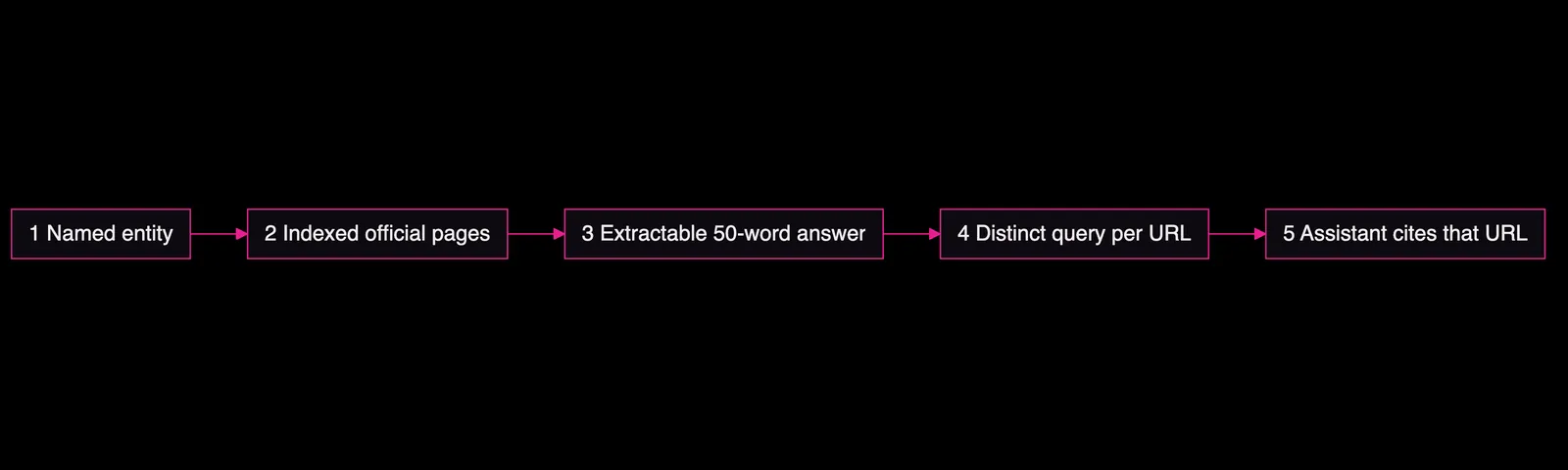
Five gates. Fail entity and you are a string. Fail extractable answer and you are a PDF the model will not quote.
What changes in the first fifty words
Unregulated blogs can open with a metaphor. A cited regulated page should open with the fact a lawyer would not dispute: who you are, where you are licensed, what you sell, what you do not. Then one number that is public: hours, towns, license class. Save the origin story for later. The first screen has a job, and the job is to be quotable without a disclaimer meeting.
Google's people-first content guidance is the public E-E-A-T document: experience, expertise, authoritativeness, trust. For a cannabis operator that means a named person, a current license, and no medical claims you cannot source. People trust a sentence they can read at the counter. Regulators trust a record that matches the state's list. Write for both. Mixing them into alarm copy helps nobody. "We are the most trusted shop in town" is not a record. The license string is.
I served as Secretary of the TRaViS board until May 2026. TRaViS is an enterprise cybersecurity EASM platform. The useful part of that work was matching a company name to a public record. The seat ended. The habit did not. Write your legal name the way the state writes it, and keep the title current. Assistants copy the same preference: they quote a page they can attribute to a person and a company that still exist. Past-tense titles belong in past tense. A current license belongs in current HTML.
SparkToro's 2024 zero-click study (Datos panel) found 58.5 percent of US Google searches ended without a click. AI Overviews and assistant answers are more of that pattern, not less. When the click never happens, the named URL is the remaining public fact. Measure named URLs, not sessions alone. See zero-click search is not the enemy. A session is a person who arrived. A citation is a name spoken when they never arrived. For a licensed shop, that name had better match the license. If ChatGPT names a directory that has your old hours, customers will show up to a locked door. That is not a marketing problem. That is an operations problem with a public URL.
A page set a licensed shop can actually maintain
Do not make one 4,000-word "ultimate guide" that tries to cover license, delivery, and HR. Give each official question its own slug a clerk could print. Who you are and the license belongs on About. What you sell in this town belongs on a true local page, not a fake city mill. How a first-time customer checks a license belongs in an FAQ with 20 to 40 word answers. Hours and location belong in HTML, not an image of a chalkboard. If a crawler cannot copy the hours, an assistant will invent them or skip you.
Then add FAQPage and Organization schema that match the visible text. Schema is a labeled copy of what a person can already read, like a price on the shelf matching the receipt. Hidden license fields that contradict the page are a trust problem. Ping IndexNow after the pages are live, then confirm GPTBot, OAI-SearchBot, PerplexityBot, and Bingbot are allowed. A subscribe wall is a citation wall. That sequence is also the week-long AEO audit. You can run it without a ten-person SEO pod. You cannot run it if the facts live in three dashboards that disagree.
Disconnected compliance data will poison the answer. If POS, tracker, and the public site disagree on a SKU, the model will pick a copy. Disconnected data costs more than missing data. Missing data is a gap you can name. Disconnected data is two stories that both look complete until Tuesday. Fix the source of truth before you ask ChatGPT to name you. Architecture for that source of truth is what building for regulated industries requires. Massachusetts operators: put the city where it is true. Do not invent local law. If you have not opened the state's published guidance this week, do not paraphrase it. Local AEO for Massachusetts service businesses is the NAP and town-page version of the same work.
What not to claim, and what still belongs on the page
Do not claim ChatGPT "uses only Bing." OpenAI's help text says partners, plural, and query rewriting. Do not claim a percentage of citations from a vendor case study you have not opened. Do not paste competitor names. Do not invent hours, towns, or a license class you do not hold. Stay in Bing anyway if you care about Copilot reports on a domain like this one. Index the official pages. Keep the first fifty words answer-shaped. True pages do that work. No plugin substitutes for them.
Experience is a named operator who has shipped in the industry. A stock photo of a greenhouse does not count. Expertise is credentials you actually hold. Authoritativeness is the same legal name as the public license list. Trust is honest titles, written in past tense when they ended. Google's people-first document is the public E-E-A-T source. Outbound links to .gov and to OpenAI Help do more work than a paragraph of unsourced percentages. Internal links to the license page, the hours page, and the FAQ keep the cluster together. A licensed shop can have more than one URL named without fighting itself, if each page answers a different official question.
If you want a retained department that already holds logs and the night-shift login, that hire is how we describe the work at ltfi.ai. Engineering notes live on kief.dev. Architecture notes live on briansgagne.com when the question is how the control is built. Neither is a citation switch. The pages still have to be true, current, and open to the crawlers the products actually document.
If we were ending this call with homework, it would be four files you can open without me. The About page with legal name and license in HTML. The hours page that a crawler can copy. The FAQ that tells a first-time customer how to check the license on the state's list. The IndexNow key file that is a real public URL, not a screenshot. Ask ChatGPT the question a customer would type. Write down which URL, if any, it names. If it names a directory instead of you, the official pages are not doing their job yet. Fix the pages. Do not buy a plugin that promises to "get you cited."
How do I get a regulated small business cited by ChatGPT?
Match a rewritten query with an official HTML page: legal name, license, town, a 50-word answer, and open crawlers. Schema should repeat the visible text, not hide a second license string.
Does ChatGPT search use Bing?
OpenAI says it rewrites queries and sometimes partners with search providers. Do not reduce that to a single engine. Stay in Bing anyway if you read Copilot reports on your domain.
Should license numbers go in schema?
Put them in visible HTML first. Schema should repeat what a person can read. Hidden license fields that contradict the page are a trust problem for people and for machines.
What belongs in the first fifty words on a licensed page?
Who you are, where you are licensed, what you sell, and one public number such as hours or license class. Save the metaphor for later. The opening has to be quotable.
Why would POS, tracker, and the website disagree?
They often do when nobody owns a source of truth. Assistants will quote whichever copy they find. Connect the records before you ask to be named.
We already have a beautiful About video. Isn't that enough?
A video does not give ChatGPT a sentence it can lift. Put the legal name, license, town, and hours in HTML a clerk could print. Keep the film if you like it. Do not hide the facts inside it.
An AEO audit in a week: ten real questions, who gets cited, one URL per query, extractable first sentences, schema, IndexNow. This domain: 13 cited URLs of 147 posts in Bing AI Performance (29 Aug 2026).
A Bing index still matters for Copilot citations. OpenAI: ChatGPT search rewrites queries and may cite partners. This domain: 13 cited URLs of 147 posts (Bing AI, 29 Aug 2026). IndexNow with a real key file. One query, one URL.
AEO for Massachusetts local service businesses: identical NAP, town-true pages, 20 to 40 word FAQs. SparkToro 2024: 58.5 percent of US Google searches ended without a click. Fake city mills are a trust leak.