Who Owns the Source Code When You Hire a Developer
Who owns the source code for custom software? Under 17 U.S.C. 201 and 204(a), the developer or agency that wrote it, until a signed written assignment transfers it. Paying the invoice usually buys a licence to use it, not ownership. What the contract, the deliverables and the repositories need.
Who owns the source code for software you paid a developer or an agency to build? Under US copyright law, the person or firm that wrote it, unless the people who wrote it were your employees or the owner signed a written transfer to you. 17 U.S.C. 204(a) says a transfer of copyright ownership is not valid unless it is "in writing and signed by the owner of the rights conveyed." A paid invoice is neither.
That default surprises a lot of owners, because the money went one way and the code came back. What follows is the build side of who owns the source code: why the "work made for hire" label rarely settles it for software, what paying actually gets you, what the assignment and the deliverables list should cover, where the repositories should live, and what nobody can own in code an AI assistant wrote.
Who owns the source code is decided on paper: under 17 U.S.C. 204(a), a copyright transfer needs a writing signed by the owner of the rights.
Who owns the source code by default?
The author does. 17 U.S.C. 201(a) says copyright "vests initially in the author or authors of the work." For software, the author is whoever wrote the code, and when the writers work for a firm, that usually means the firm.
There is one exception, and it is narrow. Section 201(b) makes the employer or commissioning party the author of a "work made for hire." The definition in 17 U.S.C. 101 has two routes in: a work "prepared by an employee within the scope of his or her employment," or a work specially ordered or commissioned for one of nine listed uses, with a signed written agreement that calls it a work made for hire.
Those nine uses are a contribution to a collective work, part of a motion picture or other audiovisual work, a translation, a supplementary work, a compilation, an instructional text, a test, answer material for a test, and an atlas. Software is not named. The US Copyright Office's Circular 30 lists four criteria a commissioned work must meet, the first being that it falls in one of the nine categories, and adds: "If a work fails to satisfy any of these requirements, it is not a work made for hire."
The website version of this question, with the domain, the host and the admin login, is covered in who owns the site, the host, and the login. The rest of this piece is about the code itself and the rights that come with it.
Employee or contractor: the test the Supreme Court set
Whether a developer counts as your employee for copyright purposes is decided by common law agency rules. A job title or a contract label does not settle it. In Community for Creative Non-Violence v. Reid, decided unanimously on June 5, 1989, the Court held that "the term 'employee' should be understood in light of the general common law of agency."
The factors start with "the hiring party's right to control the manner and means by which the product is accomplished," and continue through the skill required, who supplied the tools, where the work was done, how long the relationship lasted, how the person was paid, whether benefits were provided and how the person was taxed. Reid, the sculptor in that case, was found to be "an independent contractor," so the sculpture was not a work made for hire.
For software, that usually sorts cleanly. A developer on your payroll, writing code as part of the job, produces work made for hire, and your company is the author. A freelancer who invoices you, or an agency with its own staff, almost always sits on the contractor side, even when they join your stand-ups every morning.
Why a "work made for hire" clause rarely does the job for software
Many contractor agreements still say the code "shall be considered a work made for hire." For a commissioned work that falls outside the nine categories, that sentence does not create authorship on its own. What carries the transfer is an assignment, which is why careful drafting pairs the label with present-tense assignment language that works even if the label fails.
The label can also carry side effects. In California, Labor Code section 3351.5(c) counts as an "employee" any person engaged by contract to create a commissioned work under a signed agreement that calls it a work made for hire. That is a workers' compensation question for counsel, and a reason not to paste the phrase into every freelance contract by habit.
One more difference is easy to miss. Under 17 U.S.C. 203, an individual author who assigns a copyright can terminate that grant in a five-year window that opens 35 years after it was signed. Circular 30 notes that these termination rights "do not apply to works made for hire." For most business software, 35 years is a long horizon, but it is the real difference between the two routes.
What does paying the invoice actually get you?
Usually a licence to use what you paid for. Ownership stays with the author. The definition of "transfer of copyright ownership" in section 101 covers assignments and exclusive licences "but not including a nonexclusive license," so a nonexclusive licence needs no signed writing at all.
The leading case is Effects Associates v. Cohen, decided by the Ninth Circuit on July 20, 1990. A film producer commissioned special effects footage, paid almost $56,000 of the agreed price but withheld about $8,000 for a shot he disliked, and used the footage with no written transfer. The court found an implied licence, quoting the rule that "[a] nonexclusive license may be granted orally, or may even be implied from conduct."
Read what that does and does not give the commissioning party. The court said the effects house had given up "only one stick from that bundle," the right to sue that producer for infringement, and kept the copyright and the right to sue in state court for breach of contract. On the writing itself, the court was blunt: "It doesn't have to be the Magna Charta; a one-line pro forma statement will do."
Translated to a software build: if an online retailer paid an agency for a custom checkout and nobody signed an assignment, the retailer can likely keep running it. The retailer does not own it, cannot stop the agency from licensing the same code to someone else, and may have a harder time selling the company when a buyer's counsel asks who owns the source code and wants to see the chain of title.
An assignment can only pass rights the signer owns: 17 U.S.C. 204(a) requires a writing signed by "the owner of the rights conveyed."
Writing the spec does not make you a co-author
A detailed specification feels like authorship, and copyright law treats it as ideas. The Copyright Office's 2025 report on copyrightability cites S.O.S., Inc. v. Payday, Inc. (9th Cir. 1989), which rejected an authorship claim from a party that commissioned software: "[t]he supplier of an idea is no more an 'author' of a program than is the supplier of the disk on which the program is stored."
So the logistics company that wrote forty pages of requirements, sat in every review and named every screen still needs the assignment. The requirements document is theirs. Who owns the source code that implements it is a separate question, and the answer is whoever wrote it until the paper moves it.
What should the source code assignment clause say?
The clause needs five parts, each traceable to the statute or to how disputes actually go. Counsel will draft the words; these are the parts an owner should check are there.
A present transfer. Words that assign now ("hereby assigns"). A promise to assign later leaves a step still to take. In Stanford v. Roche (2011), a patent case, a researcher had signed Stanford's form saying he "agree[d] to assign" and later a company's form saying he "will assign and do[es] hereby assign." The Federal Circuit concluded the second one assigned his rights to the company, and the Supreme Court affirmed.
Signed by the owner. Section 204(a) requires the signature of "the owner of the rights conveyed or such owner's duly authorized agent." With an agency, that is the agency as a company.
A clean chain behind it. The agency can only assign what it owns. If a subcontractor wrote the payments module and never assigned it to the agency, the agency's assignment to you does not reach it. Ask in writing who worked on the build and whether each one signed an assignment to the agency.
All the rights, worldwide. Copyright plus any other intellectual property in the deliverables, so a later argument about a patentable method or a trade secret does not reopen the question.
Help with paperwork later. A duty to sign whatever confirmatory documents you need, such as a short assignment for a registration or a buyer's due diligence.
What "deliverables" should cover
An assignment covers what the contract defines. If "deliverables" means "the application," you may own the running code and nothing that lets anyone else rebuild, deploy or change it. A complete list for a custom software build:
Source code for every component, in the repository, with its full commit history and all branches still in use.
Build scripts, CI pipeline configuration and the dependency lockfiles.
Infrastructure-as-code and deployment configuration for every environment.
Database schemas, migrations and seed data, plus the automated tests.
API specifications, architecture notes, runbooks and an admin guide.
Design files: the source files for the interface, the component library, icons and any custom illustration.
An inventory of every third-party account, key and service the system depends on, with who holds each one.
The last item is the one that turns a code handover into a working handover. A bus factor of one applies to a vendor as much as to an employee, and a runbook in the deliverables is how you raise it.
Pre-existing tools and open-source components
Most agencies build on their own starter code and internal libraries, and they will not assign those to every client. That is reasonable. The fix is a carve-out with a licence back: the agency keeps its pre-existing materials and grants you a perpetual, irrevocable, royalty-free licence to use, modify and transfer them as part of your system. Transferable matters, because a licence that dies when you sell the company or change vendors is a lever someone else holds.
Open-source components sit outside the assignment entirely. The agency does not own them, so it cannot assign them; each one comes to you under its own licence. Ask for a list of components and their licences at handover. Your lockfile is already that list for most of the code, and the licence review belongs next to the security review.
What happens to "assignment on payment" in a dispute?
Many agency contracts say rights pass to the client once the client has paid in full. From the agency's side that is fair protection. From the client's side it means that while any invoice is disputed, the answer to who owns the source code is still the agency, including the parts already paid for.
Effects Associates suggests a commissioning party that received the work usually keeps an implied licence to use it, and footnote 7 says the court could not "construe payment in full as a condition precedent to implying a license." That is one circuit, on its facts, and a licence to run is not the right to change vendors and have someone else extend the code. A few drafting moves keep a billing argument from becoming an ownership argument:
Assign per milestone: each module or release transfers when its milestone is paid, so a dispute over the last invoice does not hold back the first nine.
Grant an express licence in the meantime, so use of delivered work during a dispute is written down rather than implied.
Keep the code where you can see it (the next section), so possession is never the bargaining chip.
If a dispute does reach the point of lawyers, Massachusetts adds its own layer; Chapter 93A and technology vendor disputes covers when a business-to-business fight becomes a claim. The exit side of the contract, termination and transition help, is in vendor contract exit terms.
Holding the repository and holding the copyright are separate: possession comes from the account, and who owns the source code comes from a signed assignment under 17 U.S.C. 204(a).
Put the repositories and accounts in your name from day one
Copyright answers who owns the source code on paper. Account ownership answers who has it on a bad day. Both should point at you, and the second one is far easier to set up at the start than to recover at the end.
From the first commit, the code repository should live in an organization your company owns, with the agency's developers invited as members. The same goes for the cloud account, the container registry, the error-tracking service and the domain. When the engagement ends, you remove members; nobody has to transfer anything. The question of which accounts sit in your name is worked through in what custom software costs against SaaS, alongside the budget.
Picture a dental group whose scheduling app was built by a two-person shop that later closed. If the repository sat in the shop's account, the group has a running app, no copy of the code and no clear answer to who owns the source code. If it sat in the group's own organization, with an assignment on file, the next developer starts on day one.
Who owns the source code an AI assistant wrote?
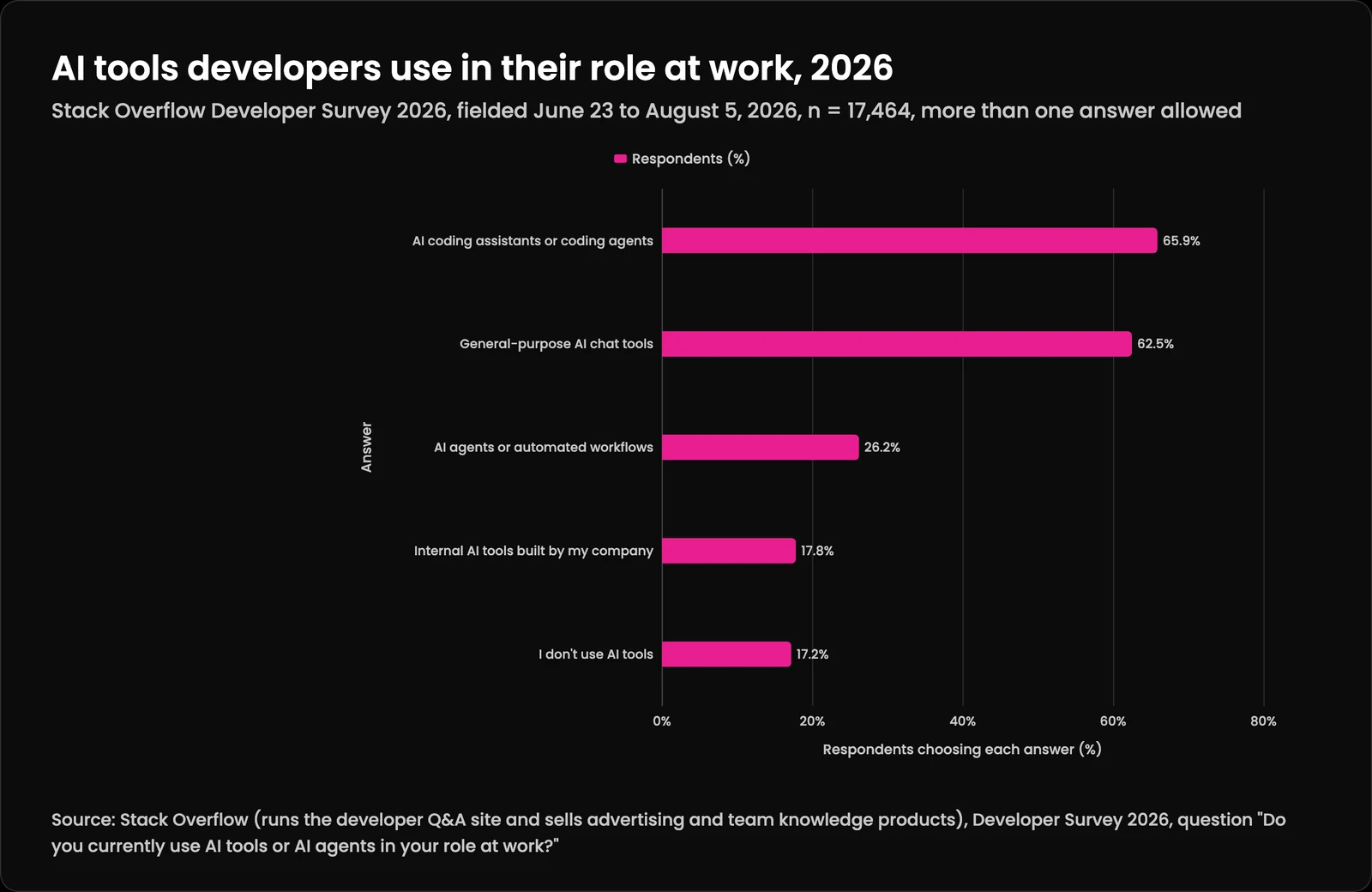
For the parts an AI system determined on its own, nobody does. US copyright requires a human author, and that limit runs through every contract built on top of it. That matters because AI tools are now common in development. In the Stack Overflow Developer Survey 2026, 65.9% of 17,464 responding developers said they use AI coding assistants or coding agents in their role at work.
About two in three developers in Stack Overflow's 2026 survey use AI coding assistants or coding agents at work, so delivered code may include AI output.
AI tools developers use in their role at work, 2026 (Stack Overflow (runs the developer Q&A site and sells advertising and team knowledge products), Developer Survey 2026, question "Do you currently use AI tools or AI agents in your role at work?")
Answer
Respondents (%)
AI coding assistants or coding agents
65.9%
General-purpose AI chat tools
62.5%
AI agents or automated workflows
26.2%
Internal AI tools built by my company
17.8%
I don't use AI tools
17.2%
The Copyright Office's registration guidance of March 16, 2023 says: "When an AI technology determines the expressive elements of its output, the generated material is not the product of human authorship." Its Part 2 report on copyrightability, published January 29, 2025, concludes that "prompts do not alone provide sufficient control," and that copyright "does not extend to purely AI-generated material."
The same report draws the line most development work actually sits on: "The use of AI tools to assist rather than stand in for human creativity does not affect the availability of copyright protection for the output." Commenters pointed to uses such as "detecting errors in software code," and the Office agreed that "assistive uses that enhance human expression do not limit copyright protection." Human authors keep rights in their own expression, in creative selection and arrangement, and in creative modifications of AI output, case by case.
The courts agree on the core point. In Thaler v. Perlmutter, decided March 18, 2025, the D.C. Circuit held that "the Copyright Act requires all work to be authored in the first instance by a human being," while noting the rule "does not prohibit copyrighting work that was made by or with the assistance of artificial intelligence." The Supreme Court denied review on March 2, 2026.
The Copyright Office's January 2025 report concludes that prompts alone do not give enough control to make the user the author of AI output.
What that means for your contract
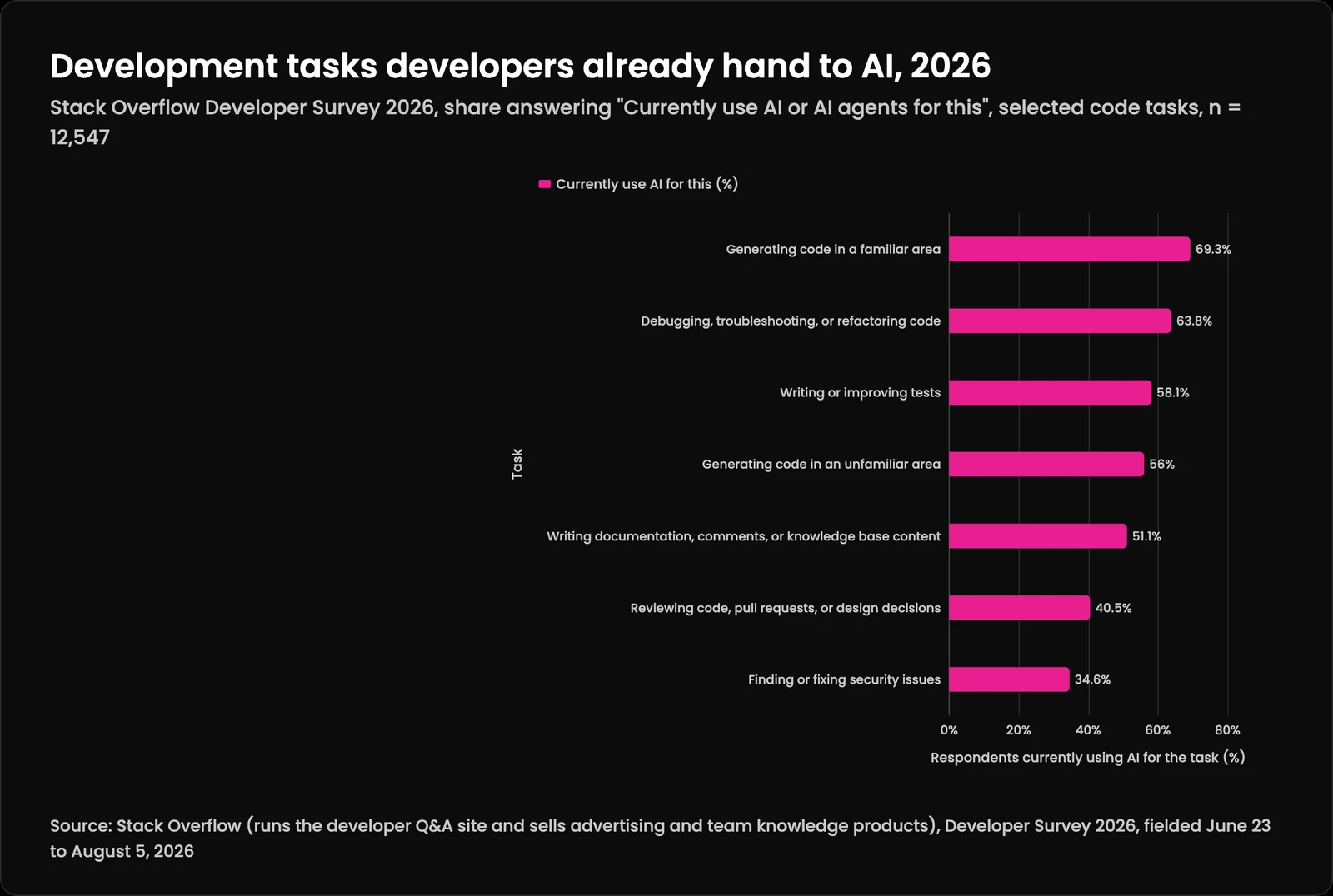
When AI tools were involved, who owns the source code depends on which parts have a human author. An assignment transfers whatever copyright exists. Where a stretch of code was generated with no human authorship, there is nothing in that stretch to assign, for the agency or for you. In practice, most production code is a mix that people have reviewed, selected, rearranged and changed, and the human-authored parts are protected the usual way. In the same survey, 69.3% of developers said they currently use AI or AI agents to generate code in a familiar area, and 40.5% to review code, pull requests or design decisions.
Developers hand writing code to AI more often than reviewing it, which is why a contract that requires human review of everything that ships matters.
Development tasks developers already hand to AI, 2026 (Stack Overflow (runs the developer Q&A site and sells advertising and team knowledge products), Developer Survey 2026, fielded June 23 to August 5, 2026)
Task
Currently use AI for this (%)
Generating code in a familiar area
69.3%
Debugging, troubleshooting, or refactoring code
63.8%
Writing or improving tests
58.1%
Generating code in an unfamiliar area
56%
Writing documentation, comments, or knowledge base content
51.1%
Reviewing code, pull requests, or design decisions
40.5%
Finding or fixing security issues
34.6%
Three contract terms keep that honest. A disclosure that AI coding tools are used, and which ones. A warranty that delivered code does not knowingly include third-party code under terms that conflict with your use. And a commitment that a person reviews and tests everything that ships. Those same rules belong in your own team AI policy, and the seats and API keys behind those tools are part of how to audit AI spending across a company.
There is a bigger lesson for owners here. When some of the code may carry no copyright at all, the protections that do not depend on copyright carry more weight: the confidentiality terms, the repository in your name, and the operating knowledge written down. That is the same reasoning behind owning the workflow while renting the model.
A source code ownership checklist before you sign
Find the assignment. Confirm it is signed, in present tense, by the company that owns the work.
Ask who wrote the code, including subcontractors, and whether each one assigned their rights to the agency.
Read the definition of deliverables against the list above, from source to design files.
Check the carve-out for pre-existing materials and confirm the licence back is perpetual, irrevocable and transferable.
Ask for a component and licence list at each release.
Replace "assignment on full payment" with assignment per milestone, plus an interim licence.
Create the repository, cloud and domain accounts in your company's name before the first commit.
Ask how AI coding tools are used, and put disclosure, warranty and review terms in writing.
If the developer is an individual and the contract says "work made for hire," ask counsel whether an assignment alone fits better where you are.
Where Kief Studio fits
We write custom software and web applications for businesses that need to own what they run, and the contract questions above are the ones we expect clients to ask. If you would like a second read of the build side of a proposal, reach out.
This is general information about how software ownership works, not legal advice. Kief Studio is not a law firm, and reading this does not create an attorney-client relationship. Have a licensed attorney read the contract before you sign it.
Who owns the source code if I hire a freelance developer?
The freelancer does, by default. A freelancer is usually an independent contractor under the agency test from CCNV v. Reid, so the code belongs to them until they sign a written assignment transferring it to you.
Does a work made for hire clause make me the owner of custom software?
Not by itself. For a commissioned work, the label only works if the work falls into one of nine statutory categories, and software is not named. A signed, present-tense assignment is what reliably transfers ownership.
If I paid for the software, can I keep using it without an assignment?
Usually, yes. Courts have found an implied nonexclusive licence when someone creates work at your request and hands it over. That licence lets you use it. The developer still owns the code and can license it to others.
Can a developer reuse code they wrote for my project?
Without an assignment, yes, because they still own it. With an assignment, they can reuse only their pre-existing materials and general know-how. The contract should carve those out explicitly and give you a licence to them.
Who owns the source code that AI coding tools write?
Code an AI system generated without human authorship has no copyright owner in the US. Code a person wrote, selected, arranged or meaningfully modified is protected, and the Copyright Office says assistive use of AI does not affect protection.
Does a copyright assignment have to be notarized or registered?
No. Section 204(b) says a notarial certificate is not required for a valid transfer, though it is evidence of signing. Recording with the Copyright Office is optional under section 205 and decides priority if conflicting transfers ever surface.
Who owns the source code my own employees write?
Your company does, when an employee writes it within the scope of the job. That is a work made for hire, and the employer is treated as the author. Code written on personal time for a side project is a separate question.
Who owns the source code if the agency goes out of business?
Whoever ends up with the agency's assets, unless it already assigned the code to you. Under 17 U.S.C. 201(d), copyright passes like other property, by conveyance or operation of law. An assignment signed during the build avoids that search.
Custom software cost starts with labor: the Bureau of Labor Statistics puts the 2025 Massachusetts median software developer wage at $165,210. How to turn that into a project estimate, what a build costs to run after launch, and when it beats SaaS or low-code.
NetDiligence found business interruption incidents cost small and mid-sized organizations over five times more than incidents without it. Duration is the expensive variable, and an MSP SLA usually does not commit to it.
An MSP scope of work earns its keep on the exclusions page: counted assets, named security duties and documentation rights. Gartner forecast $92.8 billion in security services spending for 2026, and security is where scope language is loosest.