Two-Way Doors: Make Reversible Decisions Fast and Irreversible Ones Slow
Only 20 percent of executives say their organizations excel at decision making, and most report that much of the time they spend on it is used ineffectively. A large share of that waste comes from treating reversible decisions as if they were permanent. Amazon has a name for the...
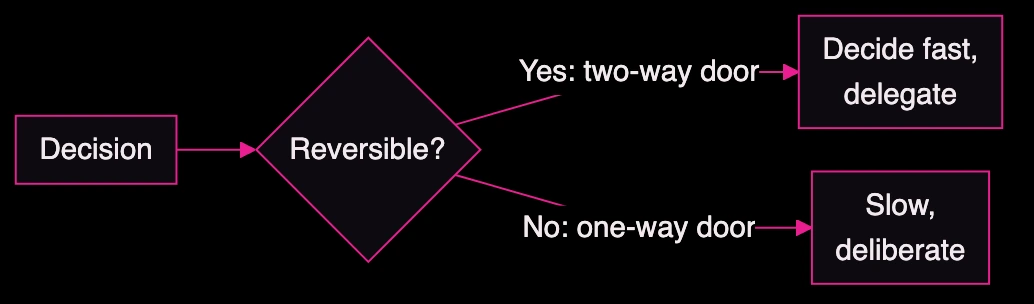
Only 20 percent of executives say their organizations excel at decision making, and most report that much of the time they spend on it is used ineffectively. A large share of that waste comes from treating reversible decisions as if they were permanent. Amazon has a name for the reversible kind: a two-way door. You walk through, you look around, and if you dislike what you see, you walk back.
Most business choices are two-way doors: reversible decisions you can walk back through if the other side disappoints.
I study behavioral psychology, and one pattern shows up in almost every stuck team I meet. They apply the same slow, careful, consensus-heavy process to nearly everything, from choosing a project management tool to signing a five year lease. The lease deserves that weight. The tool does not. When one process fits every decision, the cheap and recoverable choices inherit the cost of the expensive and permanent ones.
What a two-way door actually is
The clearest description comes from Jeff Bezos. In Amazon's 2015 letter to shareholders, he split decisions into two types. Some are consequential and irreversible or nearly irreversible, which he called one-way doors. Once you walk through, you cannot get back to where you were before.
Most decisions are not like that. In his words, "most decisions aren't like that. They are changeable, reversible. They're two-way doors. If you've made a suboptimal Type 2 decision, you don't have to live with the consequences for that long. You can reopen the door and go back through."
The insight is not that reversible decisions matter less. It is that they carry a built in safety net. A choice you can undo cheaply is a choice you can test in reality instead of debating in a conference room. The cost of being wrong is one reversal, not one catastrophe. That changes how much deliberation the decision can justify.
This is why the framing outlives the buzzword. A two-way door is any decision where the exit is roughly as cheap as the entrance. Trialing a new email platform, changing a meeting cadence, restructuring a landing page, adopting a naming convention. If undoing it costs a week and an apology rather than a quarter and a lawyer, you are standing at a two-way door.
Why organizations slow the wrong decisions down
Bezos named the failure mode directly. As organizations grow, he wrote, "there seems to be a tendency to use the heavy-weight Type 1 decision-making process on most decisions, including many Type 2 decisions. The end result of this is slowness, unthoughtful risk aversion, failure to experiment sufficiently, and consequently diminished invention."
The pull toward heavy process is not irrational. It comes from loss aversion, the well documented tendency for losses to feel larger than equivalent gains. A visible mistake gets remembered and discussed. A missed experiment leaves no evidence at all. So the safe career move is to slow everything down, add another reviewer, wait for more data. The organization optimizes against the error it can see and ignores the one it cannot.
The cost is not abstract. McKinsey estimated that inefficient decision making burns roughly 530,000 days of managers' time a year at a typical large company, about 250 million dollars in wages. Small teams do not have that slack. When a two-person studio or a ten-person shop runs every choice through a lease-sized process, the whole business moves at the speed of its most cautious meeting.
There is a quieter tax too. Every heavy decision consumes attention, and attention does not switch cleanly between tasks. I have written before about the real cost of context switching, and slow deliberation on trivial choices is one of its most common sources. The meeting to pick a font color is rarely about the font.
How do you tell a one-way door from a two-way door?
The test is a single question asked honestly: if this turns out badly, what does it cost to undo, and can we undo it at all? Reversibility is not a feeling, it is a measurable property. Estimate the exit cost the same way you estimate the entry cost.
Route every decision by reversibility first: two-way doors go fast and get delegated, one-way doors go slow.
Three factors move a decision toward the one-way side. The first is data lock-in. Migrating into a platform is usually easy, and migrating out is where you discover whether your records travel with you. The second is public commitment. A pricing page you can quietly revise is reversible; a promise printed on ten thousand mailers is not. The third is compounding. A schema, a naming convention, or an architecture decision looks reversible on day one and calcifies as every later choice builds on it.
That last factor is why some technical choices deserve more weight than they appear to. A database structure is a near one-way door dressed up as a two-way door. This is part of why I keep recommending founders start with a monolith: it keeps the genuinely reversible parts reversible instead of hard-coding early guesses into infrastructure you cannot easily unwind.
Be honest about the reverse case as well. Many decisions feel permanent because of the effort already invested, not because they are actually hard to exit. That confusion is the sunk cost fallacy running your technology stack. A tool you spent six months configuring is still a two-way door if you can export your data and leave. The configuration is spent whether you stay or go.
Push reversible decisions to the people closest to the work
Once a decision is confirmed reversible, the next move is not to make it faster in the same meeting. It is to hand it to whoever is nearest the problem. Bezos was explicit that Type 2 decisions "can and should be made quickly by high judgment individuals or small groups." A two-way door does not need a committee standing in front of it.
This matters most for the people doing the actual work. The person answering support tickets knows which macro to change. The person writing the copy knows which headline to test. When those reversible calls climb to a founder's desk, two things break: the decision gets slower, and the people closest to the evidence learn that their judgment does not count. Both are expensive.
The McKinsey survey found that speed and quality are not actually in tension. Faster decisions tended to be higher quality, not lower, which suggests that dragging out a reversible choice rarely buys the better outcome people imagine it buys. The extra week usually adds anxiety, not information.
Delegation like this is a system, not a personality trait. It works when the reversible category is written down, when people know they are trusted to act inside it, and when a wrong call is treated as data rather than a failure. That is the same discipline behind building systems before you need them: the structure that lets someone act fast without asking permission has to exist before the moment they need it.
Make the few irreversible decisions slowly, on purpose
The framework is not an argument for speed everywhere. It is an argument for spending your slowness where it counts. One-way doors deserve the methodical, careful, deliberate process, because on the other side you cannot get back.
For a small business the genuine one-way doors are a short list. Where your customer data lives and who can reach it. The legal structure of the company. A rebrand your market has already memorized. A key hire, since people are not a configuration you roll back. An architecture choice that every future feature will depend on. These earn the long meeting, the outside opinion, the night to sleep on it.
Slowing these down is also where good engineering pays off. When a system is built to keep its options open, more doors stay two-way for longer. Data you can export, infrastructure you control, and clean contracts turn choices that would otherwise be permanent into ones you can still walk back through. Reversibility is partly a property you design in, not just a property you discover.
The pressure to rush a one-way door usually comes from outside, often dressed as a deadline. I have written about artificial urgency in technology sales for a reason: "this price expires Friday" is a technique for pushing an irreversible commitment through before you have finished thinking. A real one-way door can almost always wait until Monday.
Running a reversibility audit on your own operations
The practical version of this is a sorting exercise, not a philosophy seminar. List the decisions your business is currently sitting on, and put each one on the correct side of the door. Most teams find the pile is badly balanced: reversible choices stuck in review, and a couple of genuinely permanent ones getting waved through on instinct.
For each reversible item, name the owner and the exit. Who decides, and what does undoing it cost if they are wrong? If the exit is cheap, the decision should already be moving. Waiting on it is not caution, it is a hidden cost with no offsetting benefit. This is the same logic behind treating automation maintenance as the job: small reversible adjustments made continuously beat one large irreversible overhaul made under pressure.
For each one-way item, name what makes it permanent and what evidence would actually change your mind. If you cannot answer the second question, you are not deliberating, you are stalling. The point of slowness on a one-way door is to gather the specific information that reduces the risk, not to feel busy while the decision ages.
This kind of clear-eyed sorting is hard precisely because the mind resists it. Reversibility is easy to misjudge under stress, which is one more instance of the bias you do not see making your technology decisions. Writing the audit down, on paper, is what pulls the judgment out of your gut and into the open where a teammate can check it.
Teams that run their operations well tend to do this instinctively, sorting choices by reversibility before they sort by importance. It is one of the quieter habits behind managed digital operations that hold up under growth: fast where fast is safe, slow only where slow is warranted, and a clear line between the two that everyone can see.
A two-way door is a reversible decision. If you make it, dislike the result, and can undo it at a cost close to what it took to make it, you are at a two-way door. Jeff Bezos introduced the term in Amazon's 2015 shareholder letter to distinguish these changeable choices from irreversible one-way doors that must be made slowly and carefully.
How do I know if a decision is reversible or irreversible?
Ask what it costs to undo, and whether you can undo it at all. Watch for three things that make a decision permanent: data lock-in that traps your records inside a platform, public commitments you cannot quietly retract, and compounding choices like a schema or architecture that later work depends on. If none apply and the exit is cheap, the decision is reversible.
Why do small teams make reversible decisions too slowly?
Because losses feel larger than equivalent gains, so a visible mistake gets remembered while a missed experiment leaves no trace. Teams add reviewers and delay to avoid the error they can see, and end up paying for the error they cannot. McKinsey found that only 20 percent of organizations say they excel at decision making, and that faster decisions tend to be higher quality, not lower.
Should every reversible decision be delegated?
Nearly all of them should be pushed to the person closest to the work, since they hold the most relevant evidence and can act fastest. Delegation works when the reversible category is written down, people know they are trusted to act inside it, and a wrong call is treated as information rather than a failure. The rare exceptions are reversible decisions with an unusually high one-time cost to reverse.
Which business decisions are genuinely one-way doors?
For most small businesses the list is short: where customer data lives and who can reach it, the legal structure of the company, a rebrand the market has already learned, a key hire, and an architecture choice that every future decision will build on. These deserve deliberation and outside input. Almost everything else is a two-way door you can walk back through.
Imagining that a project has already failed raises a team's ability to correctly identify the reasons for a future outcome by about 30 percent, according to research by Deborah Mitchell, Jay Russo, and Nancy Pennington published in the Journal of Behavioral Decision Making. That single...
Software maintenance accounts for 50 to 80 percent of a system's total lifecycle cost, according to decades of engineering research summarized in the peer-reviewed literature on maintenance economics. A large share of that money is spent touching things nobody currently understands....
In a study of 133 popular open-source projects, 46 percent had a bus factor of one, meaning a single person held enough of the knowledge that the project would stall if they walked away, and 65 percent had a bus factor of two or fewer (Avelino, Passos, Hora and Valente, 2016). The bus...