The Cheapest Way to Protect Data Is to Not Keep It
The safest record is the one you never collected. Data minimization treats retention as liability, not free storage, and builds deletion in as a default.
IBM's 2024 breach research put the global average cost of a data breach at $4.88 million, and more than a third of those breaches involved data sitting in unmanaged stores nobody was watching. The quiet discipline that shrinks both numbers is data minimization: the safest record is the one you never collected, and the second safest is the one you deleted when its purpose ended.
Data minimization treats an empty shelf as a feature, not a gap to fill.
Most security spending goes toward guarding the data a business holds. Far less goes toward the prior question of whether it should be holding that data at all. That order is backwards, and it is expensive.
I study how systems fail, and the pattern is consistent. Breaches rarely start with the record you meant to protect. They start with the copy you forgot you had.
The safest record is the one you never collected
There is a plain logic underneath every privacy law and every breach report. You cannot lose what you do not hold. You cannot leak an address you never asked for, and no attacker can exfiltrate a column that was never in the table.
Cyberhaven frames it directly: less retained data means a smaller attack surface and less exposure if a breach occurs. The same explainer makes a point that regulators love and engineers underrate, that a subject access or erasure request is trivial to satisfy for data you never collected.
This is not an argument for running blind. It is an argument for intention. Every field on a form, every event in an analytics pipeline, every backup that copies a customer table is a decision to take on risk, and most of those decisions are made by default rather than on purpose.
The default is almost always to keep more. Storage is cheap, deletion feels irreversible, and "just in case" is a comfortable reason to do nothing. That comfort is the liability.
Its twin sits one clause later. Article 5(1)(e), storage limitation, requires that data be kept in identifiable form "for no longer than is necessary" for those same purposes. One principle governs how much you take. The other governs how long you keep it.
Exabeam lists both inside the six core principles of Article 5, alongside purpose limitation, accuracy, lawfulness, and integrity. Read together, minimization and storage limitation say the quiet part out loud. Data is not an asset you accumulate. It is a responsibility you hold only for as long as a real purpose justifies it.
Two clauses, one discipline: limit what you take, then limit how long you keep it.
You do not need to operate in Europe for this to apply to how you build. These two principles are simply good engineering written into law, and they translate cleanly into schemas, retention windows, and deletion jobs.
Retention is standing liability, not free storage
The accounting mistake most businesses make is treating retained data as a cost of pennies per gigabyte. The storage bill is real but small. The liability is the part that does not show up on the invoice.
Every record you keep is a record you must secure, encrypt, back up, access-control, patch around, and eventually explain if it leaks. IBM found that breaches involving data spread across multiple environments took an average of 283 days to identify and contain and cost more than $5 million. Scattered, retained, half-forgotten data is not neutral. It is the terrain a slow breach hides in.
A smaller footprint is not just cheaper to store. It is a smaller thing to lose.
Why "we might need it someday" is the expensive answer
Almost every over-retention decision traces back to one sentence: we might need it someday. It sounds prudent. In practice it is how a manageable footprint quietly becomes a breach headline.
The someday case is real often enough to feel responsible and rare enough that the daily cost of holding the data goes unnoticed. So the export from a project that ended two years ago stays in a bucket. The full customer table gets copied into a staging environment for a one-time analysis and never gets cleaned up. The old CRM keeps running read-only because nobody wants to be the person who deleted it.
Each of those is a rational-feeling choice that adds to the pile. None of them is governed by a purpose that still exists, which is exactly the test Article 5(1)(e) sets. If the purpose has ended, the clock on keeping the data has run out too.
The honest reframe is to price the someday. If a record has a one-in-fifty chance of being useful again and a standing cost in security, backup, and breach exposure every single day it exists, the math usually favors deletion and re-collection over indefinite retention. "We might need it" is a reason to write down when you will decide, not a reason to keep it forever by omission.
Shadow data is where breaches quietly live
The category that punishes over-retention hardest has a name: shadow data, meaning data in unmanaged or forgotten stores that no owner is actively watching. IBM reported that more than one-third of breaches involved shadow data, a direct signal that the proliferation of copies is making data harder to track and to protect.
Shadow data is not the record in your primary database with monitoring and access controls around it. It is the CSV in a shared drive, the debug log with real emails in it, the third-party tool holding a sync you set up once and forgot. Cyberhaven puts the response problem plainly: an organization cannot safely delete or restrict data it does not know exists, where it came from, or everywhere it has since spread.
That is the compounding cost. Retained data does not sit still. It gets copied into analytics, exported into spreadsheets, synced into SaaS tools, and captured in backups, and every copy is a new place a breach can start and a new place you have to look during response. This is closely related to the sub-processor problem, where every tool you feed data to becomes another party holding your data under its own policy.
Minimization attacks this at the root. Data you never collected generates no shadow copies. Data you deleted on schedule stops generating them the day the retention window closes. Knowing what you actually hold and expose is its own discipline, and platforms like Kief Studio's Aegis exposure monitoring exist because you cannot reason about an attack surface you have never mapped.
The engineering practice: collect less, delete on a schedule, map what you hold
Minimization is not a policy you write and file. It is a set of defaults you build into systems so the right thing happens without anyone remembering to do it. Three practices carry most of the weight.
Put limits at the point of collection. The cheapest field to secure is the one that is not on the form. Before adding an input or an analytics event, ask what decision it enables and delete it from the design if the answer is thin. This is one of the honest arguments in favor of a little friction in a signup flow, since a shorter form both converts more and collects less to protect.
Make deletion a scheduled default, not a someday chore. Exabeam's practical guidance is to define clear retention periods and then run automated deletion when those periods expire, plus audits of legacy systems for data that has outlived its purpose. Deletion that depends on a human remembering will not happen. Deletion that runs as a cron job against a retention field happens every night. The engineering habit of building systems that clean up after themselves is the same instinct that produces systems that do not leak by default.
Keep a data map so you know what you hold. You cannot minimize what you cannot see. A simple inventory of what data you collect, where it lives, why you keep it, and when it gets deleted turns shadow data back into managed data. This is the same foundation behind where data governance actually starts, and it is why governance is the real prerequisite for AI. A model trained on data you cannot account for inherits every retention problem you never fixed.
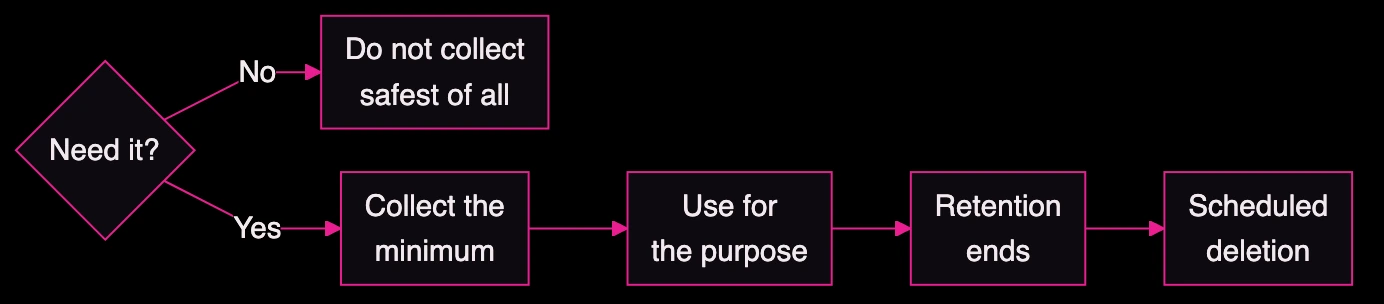
The data minimization lifecycle: the safest record is never collected, and everything kept has a scheduled end.
None of this requires a security team or a compliance budget. It requires deciding that the default answer to "should we keep this" is no unless there is a live purpose, and then wiring that decision into the schema and the scheduler.
This is engineering, not caution
It is tempting to file minimization under fear, one more thing to worry about after breaches and regulators and audits. That framing gets it exactly wrong. Holding less data is not a defensive crouch. It is the cheaper, simpler, faster way to build.
A smaller dataset is faster to query, cheaper to store, easier to move, and simpler to reason about. Usercentrics counts operational efficiency and better data quality among the benefits precisely because focused data outperforms bloated data at almost everything you would want data to do.
The compliance benefit is real, and for regulated work it matters. But it arrives as a side effect. Build systems that collect only what they need and delete what they no longer need, and you have satisfied the regulator, lowered the bill, and shrunk the breach surface in one move.
The most durable version of protecting data is not a bigger wall around a bigger pile. It is a smaller pile. Data you do not keep cannot leak, cannot be subpoenaed, cannot be sold in a breach, and cannot cost you 283 days of response. That is not caution. That is good engineering.
Data minimization is the practice of collecting only the data a specific purpose actually requires, and keeping it only as long as that purpose lasts. It comes from GDPR Article 5, which says data must be limited to what is necessary and kept no longer than necessary. In plain terms: take less, hold it for less time, and you have less to protect.
Does data minimization only matter if I have to follow GDPR?
No. The legal principle originates in GDPR, but the benefits are universal. Holding less data lowers storage and management cost, shrinks the volume of sensitive information an attacker could reach, and simplifies your governance regardless of which regulations apply to you. It is good engineering first and a compliance win second.
What is shadow data and why is it dangerous?
Shadow data is information sitting in unmanaged or forgotten stores that no one is actively monitoring, such as old exports, debug logs, or abandoned tool integrations. IBM found more than a third of breaches involved shadow data. It is dangerous because you cannot secure, or even delete, data you have lost track of, so it becomes the quiet place a breach begins and hides.
How do I actually delete data on a schedule?
Define a retention period for each category of data based on the purpose it serves, store that period as a field alongside the record, and run an automated job that deletes records once the window closes. The key is that deletion runs as a default process rather than depending on a person to remember. Automated deletion at end of retention is a standard, recommended practice.
Will collecting less data hurt my analytics or future AI plans?
Rarely, and less than most teams assume. Focused, well-governed data usually outperforms bloated data for analysis and modeling, because quality and clarity beat raw volume. Data you cannot account for is a liability to any AI project, not an advantage, which is why governance and minimization are prerequisites for using AI well, not obstacles to it.
Worcester life sciences startups added jobs in 2025 while Massachusetts biopharma employment fell 3.1%. The systems a twenty-person lab sets up now are exactly what its first audit will inspect.
Poor data quality costs organizations an average of $12.9 million a year, according to Gartner, and most of that damage starts with a number nobody can trace. Data lineage is the practice of following a figure from its point of origin through every ingest, transform, and model until it...
Ninety days is a realistic plan to offboard a managed service provider. Compress it and the revocation step is what gets cut, leaving agents installed and credentials live for months.