An AI readiness assessment starts with where your data lives and how repeatable work gets done, before any tool is chosen. Census found 24.6% of US businesses used AI in the survey it collected October 5 to 18, 2026. Scan the company, then build one workflow at a time.
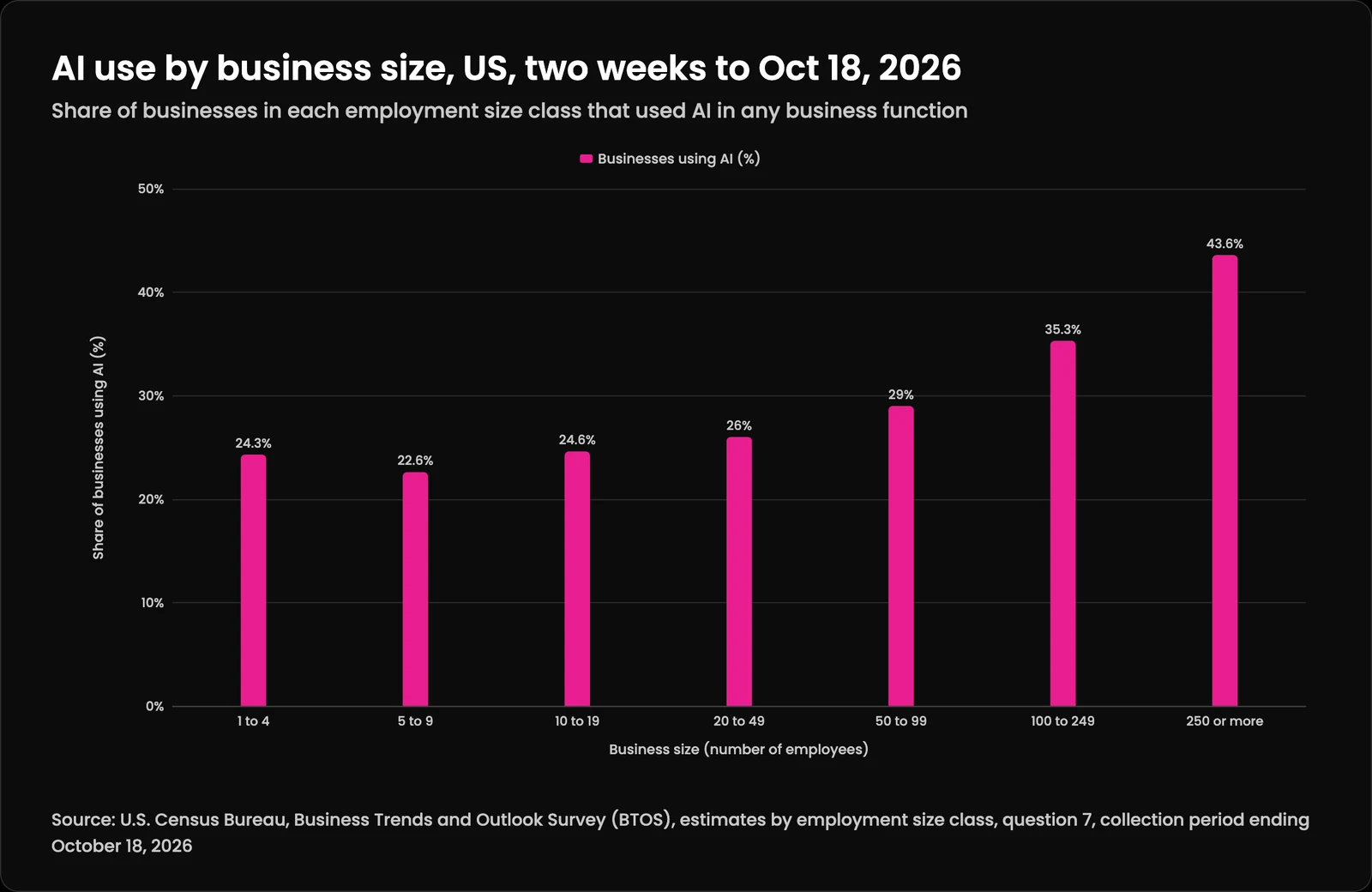
An AI readiness assessment answers one question: can a specific part of your business take AI today, and if not, what has to be fixed first? Adoption is climbing. The U.S. Census Bureau's Business Trends and Outlook Survey found 24.6% of US businesses used AI in the survey Census collected October 5 to 18, 2026, and 43.6% of those with 250 or more employees.
The method below is the one we use with companies of 20 to 500 people. Look at where the data lives and how repeatable work gets done, scan the whole company, then build one workflow at a time. If your business is in Central Massachusetts, Brian Gagne wrote the local version: an AI readiness assessment for Worcester County businesses.
Census researchers found 64% of AI-using firms reported no institutional adjustments, which is why an AI readiness assessment starts with the plumbing.
What does an AI readiness assessment look at first?
First, I look at where a company's data actually lives and how repeatable work gets done today, before we ever talk about models or software.
The reason is simple. AI doesn't fix a disorganized operation; it just speeds up the mess. If critical information is scattered across five disconnected platforms, buried in spreadsheets or trapped in one person's head, plugging AI into it won't give reliable answers, and it often opens security and privacy gaps.
You have to see the real plumbing of the business first. Then you know whether AI has clean data to work with, or whether you would just be automating chaos. Two questions get most of the way there:
Where does the data for this job live? Name every system, spreadsheet and inbox it passes through, and who is responsible for each copy.
How does the work get done today? Ask the people who do it to walk through the task step by step, in their own words, without the software open.
The national data points the same way. In an April 2026 Census working paper, "The Microstructure of AI Diffusion", researchers found 64% of AI-using businesses reported no institutional adjustments. Training staff and developing new workflows each applied to about 15% of AI-using firms, and changes to data management and storage practices to 7% to 8%. The authors read the 64% as "a reliance on 'off-the-shelf' AI/GenAI tools or a significant lag in organizational restructuring." It is a working paper, so it has not been through the review the Bureau gives its formal publications.
How many companies already use AI, and does size matter?
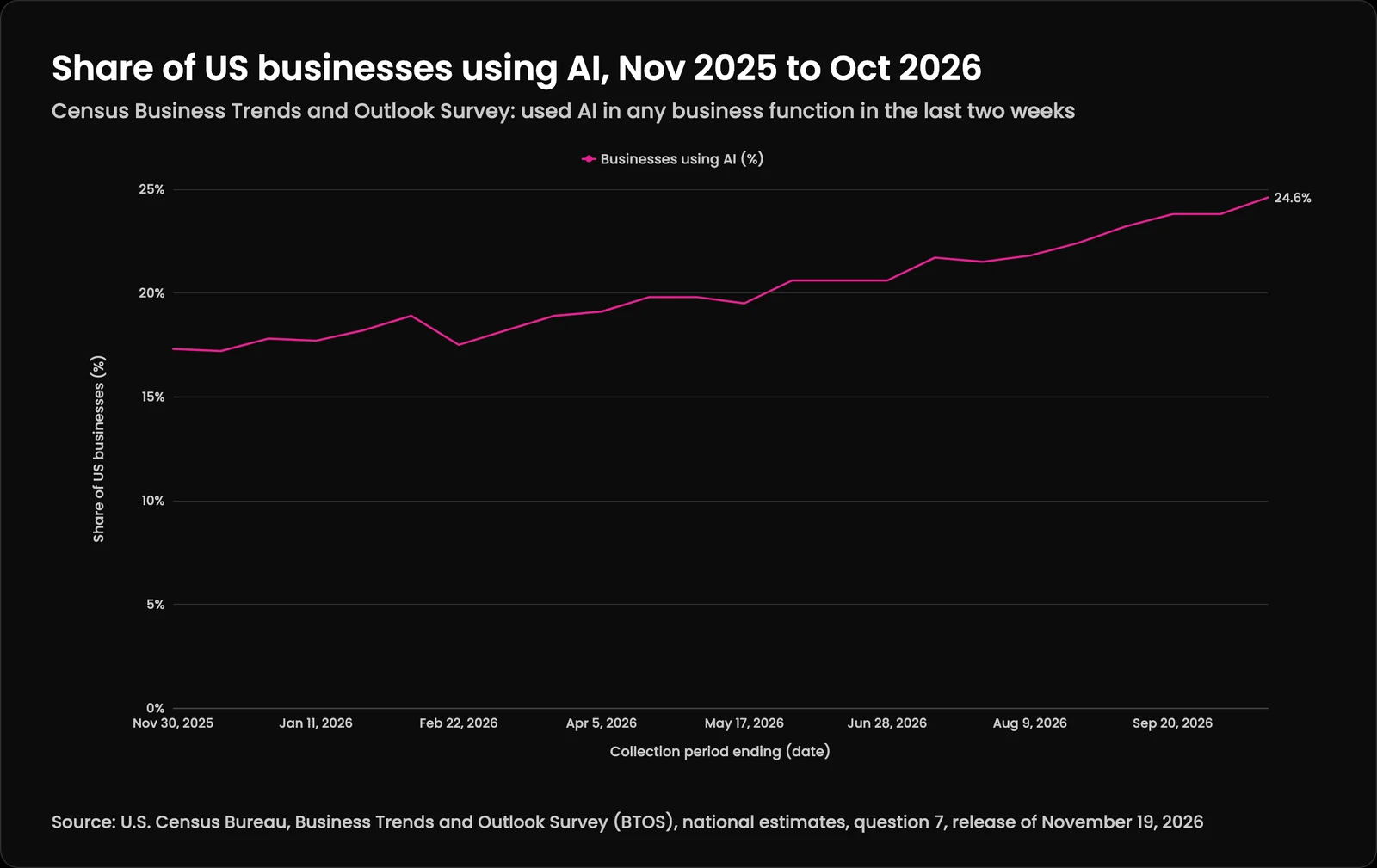
Before an AI readiness assessment, it helps to know where you stand, and the most neutral number comes from Census. Its survey samples about 1.2 million businesses split into six panels and releases data every two weeks. In the national estimates released November 19, 2026, 24.6% of US businesses said they used AI in a business function in the period ending October 18, 2026, up from 17.3% in the period ending November 30, 2025.
Census's biweekly survey put business AI use at 24.6% in mid-October 2026, up from 17.3% at the end of November 2025.
Share of US businesses using AI, Nov 2025 to Oct 2026 (U.S. Census Bureau, Business Trends and Outlook Survey (BTOS), national estimates, question 7, release of November 19, 2026)
Two-week collection period ending
Businesses using AI (%)
Nov 30, 2025
17.3%
Dec 14, 2025
17.2%
Dec 28, 2025
17.8%
Jan 11, 2026
17.7%
Jan 25, 2026
18.2%
Feb 8, 2026
18.9%
Feb 22, 2026
17.5%
Mar 8, 2026
18.2%
Mar 22, 2026
18.9%
Apr 5, 2026
19.1%
Apr 19, 2026
19.8%
May 3, 2026
19.8%
May 17, 2026
19.5%
May 31, 2026
20.6%
Jun 14, 2026
20.6%
Jun 28, 2026
20.6%
Jul 12, 2026
21.7%
Jul 26, 2026
21.5%
Aug 9, 2026
21.8%
Aug 23, 2026
22.4%
Sep 6, 2026
23.2%
Sep 20, 2026
23.8%
Oct 4, 2026
23.8%
Oct 18, 2026
24.6%
The line starts in late November 2025 for a reason. Census says that on November 17, 2025, it "revised the core AI use questions," so this chart does not mix in figures from before the change. Each two-week estimate also carries a margin of a few tenths of a point, so the trend matters more than any single step.
It stops at October 18 on purpose too. The BTOS questionnaire Census posted in October 2026 asks whether a business used "Super Intelligence or SI (formerly referred to as Artificial Intelligence or AI)" in any of its business functions. In the period ending November 1, the share answering "do not know" rose to 13.9% from 9.6%. The newest release puts use at 25.0% in the survey collected November 2 to 15, 2026; read it with that wording change in mind.
Use rises with size. In the Census estimates by employment size for the period ending October 18, 2026, AI use was 26.0% for businesses with 20 to 49 employees, 29.0% at 50 to 99, 35.3% at 100 to 249 and 43.6% at 250 or more. Census's own May 26, 2026 story found the same pattern earlier in the year, with 37% of firms with at least 250 employees using AI.
AI use climbs from 26.0% of US businesses with 20 to 49 employees to 43.6% of those with 250 or more, in the two weeks to October 18, 2026.
AI use by business size, US, two weeks to Oct 18, 2026 (U.S. Census Bureau, Business Trends and Outlook Survey (BTOS), estimates by employment size class, question 7, collection period ending October 18, 2026)
Employees
Businesses using AI (%)
1 to 4
24.3%
5 to 9
22.6%
10 to 19
24.6%
20 to 49
26%
50 to 99
29%
100 to 249
35.3%
250 or more
43.6%
Peer numbers are context, and they are a poor reason to buy anything. A rising line tells you other companies are trying AI. It can't tell you whether your intake process, your scheduling or your month-end close is ready for it, and that is the work of an AI readiness assessment.
What are the signs a company is not ready for AI?
The biggest red flag I see is a broken process disguised as a tech problem, usually paired with messy, fragmented data. When a team can't clearly walk you through how a task gets done step by step today, buying an AI tool won't magically organize it for them.
The signs tend to show up together:
Nobody can describe the task from start to finish, or three people describe it three different ways.
The same records live in several tools, and nobody is sure which copy is right.
Key knowledge sits with one person, and the work stops when they are out.
Several overlapping third-party platforms each do a slice of the same job.
No one has decided where a person signs off before something goes out the door.
Before anyone spends a dime on new software, I tell them to fix two things. Map the actual manual workflow from start to finish, and clean up the tool sprawl: cut the overlapping third-party platforms, centralize where the core data lives, and decide where a human needs to stay in the loop. Once the process makes sense on paper, building or buying the right AI layer becomes much clearer, and usually cheaper. It is the same pattern behind why your technology problem probably isn't a technology problem.
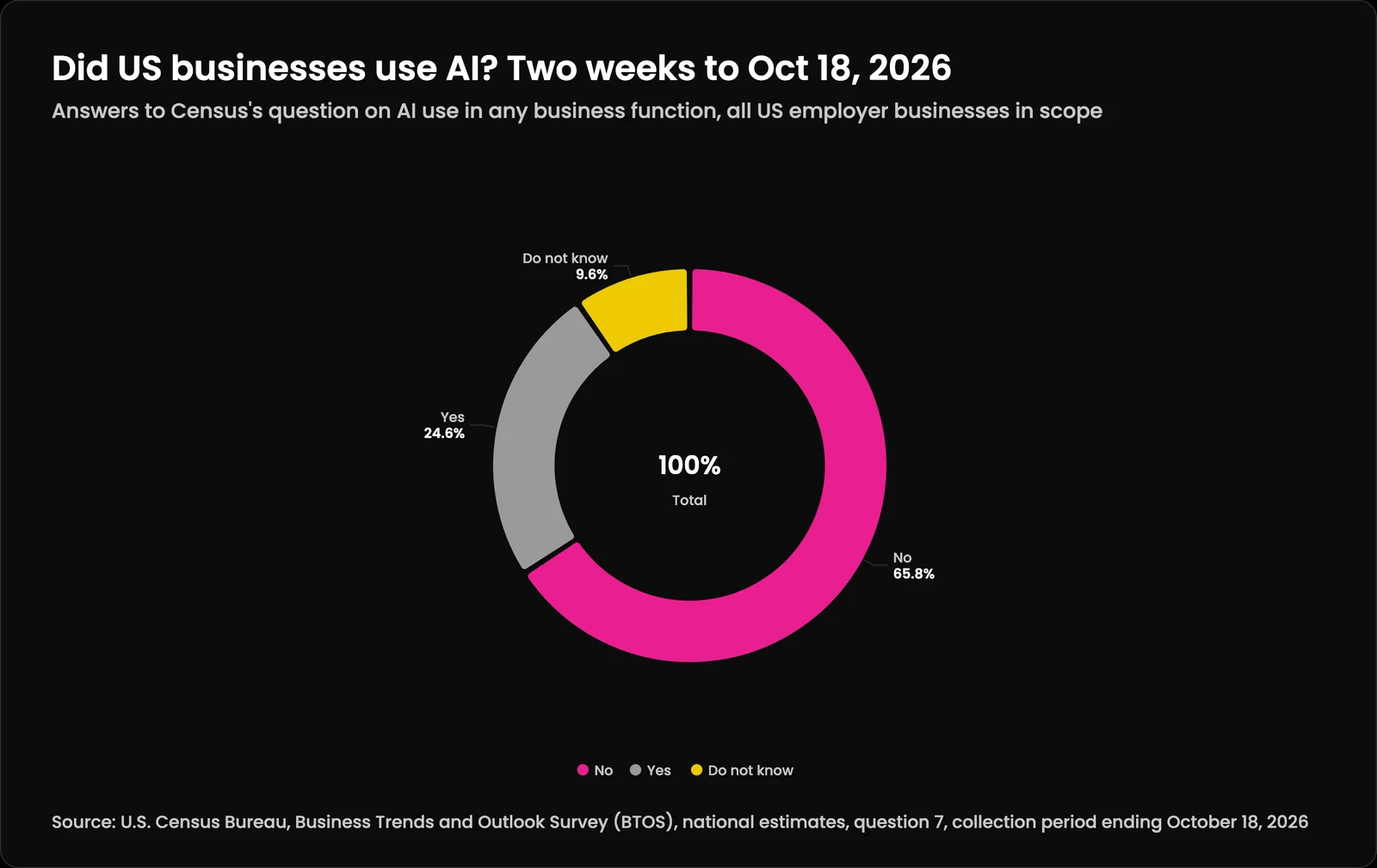
Some of the gap shows up in the national numbers. In the Census national estimates for the period ending October 18, 2026, 9.6% of US businesses said they did not know whether they used AI at all, beside 24.6% who said yes and 65.8% who said no.
Nearly one business in ten could not say whether it used AI at all, which is itself a readiness finding.
Did US businesses use AI? Two weeks to Oct 18, 2026 (U.S. Census Bureau, Business Trends and Outlook Survey (BTOS), national estimates, question 7, collection period ending October 18, 2026)
Answer
Share of businesses (%)
Yes
24.6%
No
65.8%
Do not know
9.6%
If leadership can't say whether AI is in use, staff may be using tools nobody has reviewed. A short AI policy for your team is the first fix there, and writing one takes a meeting.
Census researchers found 66% of AI-using firms rely on AI solely to augment tasks, so the first win is usually one task done better.
Should you assess the whole company or one workflow at a time?
Both, in that order. We do a quick big-picture scan of the whole company first to see how data moves and where time or money is leaking, and then we build one workflow at a time.
Trying to "AI-ify" an entire company all at once is the fastest way to end up with expensive shelfware that nobody uses. Focusing on one high-friction bottleneck first lets you show a return sooner, makes usage costs easier to predict, and gets the team comfortable with how the tool fits into their day before moving on to the next piece. Projects that skip that focus tend to stall before production for ordinary reasons: no owner, no definition of done, no data path.
That matches how most firms use AI now. The same Census working paper found "Most users (66%) rely on AI solely to augment tasks," while AI-related employment decreases are rare, "occurring in only 2% of firms." For a company of 20 to 500 people, the realistic first win is a person doing one task faster and better. A dental group's insurance verification, a logistics company's delivery exceptions or a manufacturer's quote turnaround are all single workflows you can map in an afternoon.
How to score each workflow in an AI readiness assessment
For the workflows on your shortlist, the structure can come from a public framework a board will recognize: NIST's AI Risk Management Framework 1.0, released January 26, 2023, which NIST says is being revised. Its MAP function asks organizations to document an AI system's intended purposes and setting (MAP 1.1), their risk tolerances (MAP 1.5), and the potential costs of AI errors, "including non-monetary costs" (MAP 3.2).
Turned into a page per workflow, that becomes six short answers:
Purpose. What the job is, who does it today and what "done" looks like (MAP 1.1).
Data. Where the inputs live, how clean they are and who is allowed to see them.
Process. Written steps that match what people actually do, including the workarounds.
People. Who will use it, who signs off on its output and what they need to learn.
Risk tolerance. How much error the business can accept in this job (MAP 1.5).
Cost of errors. What a wrong answer costs in money, time and trust (MAP 3.2).
In an AI readiness assessment, each workflow then gets one of three calls: build now, fix first, or not yet. For the risk rows, a premortem, where the team assumes the workflow already failed and works backward, brings failure modes to the surface early. Where a workflow touches regulated data, such as patient records or client files at a law office, counsel or the regulator's reading decides what is allowed, and the assessment records that decision.
When is the honest answer "not yet"?
A team came to us looking for AI solutions, and the honest answer had to be "not yet." When we looked closer, the real problem wasn't technical: they hadn't actually formed a company yet. It was a few people with a bunch of ideas and a product they thought they might be able to sell.
AI can't replace the fundamentals of building a business. Before we talked about AI tools, we helped them set up a real foundation: their mission and branding, a clear hierarchy and SOPs, and the basics of cybersecurity. You can't automate an operation until you actually build one.
"Not yet" is a common answer nationally, too. Among firms not planning to use AI in the near term, the Census researchers found the most common barrier was that AI is not applicable to the business (65% of firms), with lack of knowledge of AI's capabilities "a distant second (22%)" and privacy or security concerns at 20%. Some of those firms are right. Others haven't looked closely yet, and an AI readiness assessment is how you tell which one you are.
Europe shows the data side of the same problem. In Eurostat's 2025 enterprise survey, among EU enterprises with 10 or more employees that had considered AI but did not use it, 70.31% cited a lack of relevant expertise and 43.51% cited difficulties with data availability or quality.
A good "not yet" comes with a list. It says what to fix, in what order, and when to look again, so the next AI readiness assessment starts from a stronger place.
Among US firms not planning near-term AI use, 65% said AI was not applicable to them, according to a Census working paper from April 2026.
What should you have in hand at the end of an AI readiness assessment?
You should walk away with an actionable blueprint you can actually execute, and a vague theory document doesn't count. Specifically, you need four things in hand:
A reality check on your foundation. A clear breakdown of what needs to be fixed before you touch AI, whether that is missing SOPs, scattered data, cybersecurity gaps, or overlapping third-party tools that are leaking information and budget.
A prioritized workflow roadmap. The top one or two manual bottlenecks most likely to deliver real return first, mapped out step by step, in place of a wish list of 30 AI ideas.
Clear build-versus-cut decisions. Honest guidance on where AI makes sense, where basic automation or process cleanup is the better fix, and which bloated SaaS add-ons you can cancel right away.
Real numbers and guardrails. Scoped costs, model and infrastructure recommendations, and clear human-in-the-loop rules, so you know what it should cost to build and run before you sign anything.
One quick test works on any AI readiness assessment you receive: could your team start the first workflow next week using only what is in it? If the answer is no, something is missing.
An AI readiness assessment comes before an AI audit for your business, which reviews AI you already run: its inventory, data exposure, access and oversight. If you are weighing outside help for either, the cost to hire an AI consultant lays out the pricing models and the questions to ask.
NIST's AI RMF 1.0 asks organizations to document purpose, risk tolerance and the cost of AI errors, which maps cleanly onto a per-workflow AI readiness assessment.
What is fluff in an AI readiness assessment?
In my experience, most of what gets sold in traditional assessments is expensive fluff, starting with the 60-page "AI maturity" slide deck packed with buzzwords and generic industry trends that nobody ever opens again.
The other big piece of fluff is a shopping list of pricey third-party AI tools and enterprise licenses, handed over before anyone has looked at your actual SOPs or data security. Shiny off-the-shelf platforms and fully autonomous "AI agents" with zero human oversight sound impressive on a call. In practice they create tool sprawl, compliance risk and monthly bills for features your team never asked for.
Here is the line I use to judge any AI readiness assessment: if it doesn't tell you what to stop paying for and what manual work to fix first, it's fluff.
A company-wide maturity score can start a useful conversation. It can't tell a law office whether its intake process is ready, or an online retailer whether its returns queue is, and those are the decisions in front of you.
Where we fit
This is how we usually start AI implementation work with a company: a scan of the whole operation, then one workflow built and proven before the next, with a person approving any spend. If you would like a hand with yours, reach out to us.
An AI readiness assessment checks whether a specific part of your business can take AI today. It looks at where the data lives, how repeatable the work is, who signs off, and what errors would cost, then says build now, fix first, or not yet.
What does an AI readiness assessment include?
A useful one includes a scan of the whole company, then a page per candidate workflow covering purpose, data, process, people, risk tolerance and cost of errors. It ends with a foundation check, a ranked roadmap, build-versus-cut decisions, and costs with guardrails.
Should an AI readiness assessment cover the whole company?
Start with a quick company-wide scan to see how data moves and where time or money leaks, then assess and build one workflow at a time. Trying to change everything at once tends to produce shelfware nobody uses.
How many US businesses use AI?
Census's Business Trends and Outlook Survey found 24.6% of US businesses used AI in a business function in the survey Census collected October 5 to 18, 2026. Use was 43.6% among businesses with 250 or more employees and 26.0% among those with 20 to 49.
What is the most common sign a company is not ready for AI?
A broken process disguised as a tech problem, usually with fragmented data. If the team can't walk through how a task gets done today, step by step, an AI tool won't organize it. Map the workflow and cut overlapping tools first.
Is an AI readiness assessment the same as an AI audit?
No. A readiness assessment comes first and asks whether a workflow is ready for AI. An AI audit reviews AI already in use, covering its inventory, data exposure, access, decision authority and oversight.
Can the result of an AI readiness assessment be "not yet"?
Yes, and it is a legitimate result. Census researchers found 65% of US firms not planning near-term AI use said it was not applicable to them. A good "not yet" lists what to fix, in what order, and when to reassess.
The Massachusetts data privacy act passed the Senate 40-0 and the House 146-0 in different versions. As written, the House text can cover a business of any size that targets Massachusetts residents and keeps customer passwords. Seven systems to build, with checks.
Massachusetts call recording laws make secret recording a crime, and section 99 of chapter 272 lets each person secretly recorded sue for actual damages, with a floor of $1,000 or $100 a day, whichever is higher. What that means for AI notetakers, AI receptionists and the transcripts they keep.
The cost to hire an AI consultant starts above a wage: the Bureau of Labor Statistics put the median management analyst at $48.97 an hour in May 2025. How hourly, project, retainer and fractional models compare, what moves the price, and seven questions to ask first.