Antifragile Operations: Building a Business That Gains From Disruption
A single disruption to lean, just-in-time production cost the global auto industry an estimated $210 billion in lost revenue in 2021, per consulting firm AlixPartners. An antifragile business reads a shock like that differently: not as a catastrophe to survive, but as information to...
A single disruption to lean, just-in-time production cost the global auto industry an estimated $210 billion in lost revenue in 2021, per consulting firm AlixPartners. An antifragile business reads a shock like that differently: not as a catastrophe to survive, but as information to grow from. Antifragile, a term coined by Nassim Nicholas Taleb, names systems that gain from disorder rather than merely enduring it.
Taleb's image for antifragility: a package you could write "please mishandle" on, because its contents get better from the rough handling.
I study behavioral psychology, and the reason antifragility keeps my attention is that it inverts a habit most operators share. We are trained to remove slack, chase efficiency, and treat every buffer as fat to trim. That instinct builds businesses that run beautifully right up until the day they do not.
The distinction that matters most is the one between robust and antifragile. As Taleb puts it, the resilient resists shocks and stays the same, while the antifragile gets better. Resilience is a good floor. It is not the ceiling.
Nature is the reference example. Bones and muscle do not merely tolerate load; they remodel and grow stronger in response to it, which is why disuse is its own kind of damage. A business can be built to work the same way, where measured stress becomes an input rather than a threat.
Taleb frames the whole idea as an asymmetry. Fragility means more to lose than to gain from a random event, and antifragility means more to gain than to lose. The practical question for any operator is not "is this risky" but "which way does the asymmetry point," because a system with capped downside and open upside can afford to be wrong often and still come out ahead.
The $210 billion lesson: where over-optimization hides fragility
The clearest way to see fragility is to watch a hyper-optimized system meet an unplanned event. Over a decade, manufacturers stripped inventory buffers, alternate suppliers, and spare capacity out of their supply chains in the name of lean efficiency. The result traded resiliency for cost, and when the 2021 semiconductor shortage hit, there was, in one executive's words, nothing left to scrape.
AlixPartners forecast that the shortage would erase 7.7 million units of production in a single year. The efficiency that looked like discipline in calm weather was the exact property that turned a parts delay into a $210 billion event.
This is the trap that hides in a smaller company just as easily. A single sales channel that produces every lead. One key employee who holds every password and process. A tech stack tuned so tightly to today's volume that a modest surge takes it down. Optimization feels like maturity. Often it is concentration risk wearing a nicer suit, which is why fixing your loudest constraint tends to just relocate the problem, a pattern I unpack in the bottleneck always moves.
The correction, once the shock exposed the fragility, was expensive and industry-wide. Firms began rebuilding the buffer stock and second-supplier relationships they had spent years eliminating, swinging from just-in-time back toward just-in-case. The slack they had treated as waste turned out to be the price of staying in business, and they paid for it twice: once to remove it and again to put it back.
Optionality: many small, reversible bets beat one big prediction
The first antifragile move is to stop betting on your ability to predict. Taleb's alternative is optionality: hold many small, cheap options where the downside is capped and the upside is open. Venture capital works this way on purpose, funding a spread of small bets knowing most will fail, because one outsized win can dwarf every loss combined.
A small business has more of these options than it uses. A new service line tested with three existing clients before it becomes a whole department. A content format tried for a month before it becomes a strategy. A tool piloted on one team before it is rolled out everywhere.
The design rule is that each bet must be small enough that losing it teaches you something without hurting you. That is also why starting simple beats starting clever; a plain approach you can change later keeps your options open, which is the argument in start with a monolith. Reversibility is what makes disorder informative instead of expensive.
There is an honest cost here worth naming. Optionality is deliberately wasteful, because most of the small bets will fail and that time and money is gone. Efficiency thinking hates this, which is exactly why so few businesses do it. The payoff is that you stop needing to predict the future, since with a spread of live options you get to decide after events unfold rather than before, when you know least.
Redundancy is not waste, it is antifragile armor
Efficiency culture treats redundancy as failure. Taleb treats it as the central risk-management property of natural systems, noting that nature over-insures itself, which is why you have two kidneys rather than one perfectly utilized one. The spare looks wasteful right up until the moment it is the only thing keeping you alive.
Redundancy is also opportunistic. Extra strength held for a rare hazard can be spent on ordinary upside in the meantime, so a buffer is closer to an investment than to dead insurance. A cash reserve funds an opportunistic hire. Cross-trained staff cover a sick day and also catch each other's mistakes.
For a small team the practical version is deliberate slack. Documented processes so knowledge does not live in one head. A second supplier you actually use, not just one on file. Systems built a little ahead of current need, an idea I keep returning to in building systems before you need them and in the case for a deliberately small, high-redundancy team.
The failure mode to watch for is a single point that everything depends on. One admin account, one senior person, one server, one payment processor. Each is efficient in isolation and fragile in aggregate, because the whole system now inherits the failure probability of its weakest single link. Redundancy is simply the practice of never letting one link carry the entire load.
The barbell: extreme caution plus small experiments
In practice that means protecting the core of the business with real rigor while running speculative bets that are small enough to lose. The danger zone is the moderate-risk middle: the medium bet big enough to hurt if it fails but too cautious to change your trajectory if it works.
The barbell reframes how you decide. Guard revenue, data, and reputation with a wide margin of safety, then spend a defined, capped slice of time and money on experiments with open-ended upside. Which commitments deserve protection and which have become dead weight is exactly where the sunk cost fallacy and the endowment effect quietly distort the math.
Antifragility for a business you actually run
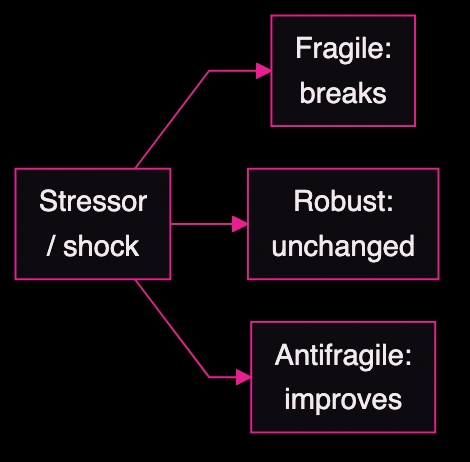
The theory becomes operational when you route every stressor toward one of three fates: absorb it, ignore it, or learn from it. A small business gains from disorder when it treats a lost client, a failed launch, or an outage as a signal to adjust the system rather than an event to paper over.
The same stressor produces three outcomes: the fragile breaks, the robust holds, and the antifragile turns the shock into an improvement.
The mechanism is a short loop rather than a grand strategy. A shock arrives, you ask what it revealed, you make one small change to the system, and you keep the change. Run that loop often enough on small stressors and the business quietly accumulates the kind of hard-won structure no planning session would have produced.
That learning only compounds if the maintenance happens. Buffers erode, documentation goes stale, and second suppliers lapse unless someone tends them, which is why the upkeep is the actual work, not the launch. I make that case directly in automation maintenance is the job. This is also where managed digital operations earn their keep, keeping the redundancy real between shocks instead of only after one.
One caution keeps antifragility honest. More disorder is not automatically better, and stripping every rule in the name of volatility is its own error. Taleb calls the opposite mistake naive interventionism, the meddling that suppresses small stressors and stores up large ones. Not every process should be automated away either, a line I draw in the tasks you should never automate. The goal is a business that is exposed to small, survivable shocks often enough to keep getting stronger, and protected from the rare one that could end it. That balance is the same secure-by-construction thinking we apply across the broader work at Kief Studio.
Antifragile describes a system that gains from disorder. Where a fragile system breaks under stress and a robust system withstands it unchanged, an antifragile system improves in response to shocks, volatility, and failure. The term was coined by Nassim Nicholas Taleb in his book Antifragile: Things That Gain from Disorder.
What is the difference between antifragile and resilient?
Resilience is the ability to absorb a shock and return to the same state. Antifragility goes one step further: the system does not just recover, it ends up stronger than before. Resilience keeps you where you were; antifragility uses the stressor as fuel to improve.
How can a small business become more antifragile?
Favor many small, reversible bets over one large irreversible prediction, hold deliberate redundancy such as documented processes and a second supplier, and use a barbell approach that protects the core of the business while running capped experiments. Then maintain those buffers, because they erode if no one tends them.
Isn't redundancy just inefficiency?
In calm conditions redundancy looks like waste, which is why efficiency-driven optimization tends to remove it. Under a shock, that same slack is the margin that keeps the business running. Redundancy is also opportunistic: a cash reserve or cross-trained staff can be put to productive use even when no emergency arrives.
Does antifragility mean seeking out chaos?
No. The aim is exposure to small, survivable stressors that carry information, combined with strong protection against the rare catastrophic event. Suppressing every small stressor, what Taleb calls naive interventionism, tends to store up larger and more damaging shocks later.
Roughly 15,600 developers from more than 1,400 companies have built the Linux kernel, described by the Linux Foundation as the largest collaborative project in the history of computing, and no manager ever assigned most of that work (Linux Foundation, 2017). The mechanism underneath...
Every system has one bottleneck governing its output. The theory of constraints explains why improving anything else is wasted motion, and why the constraint always moves the moment you break it.
In a study of 133 popular open-source projects, 46 percent had a bus factor of one, meaning a single person held enough of the knowledge that the project would stall if they walked away, and 65 percent had a bus factor of two or fewer (Avelino, Passos, Hora and Valente, 2016). The bus...